

Thai Roots: A CMBN Research Series, No. 1
Published 26 June 2026, Thailand’s national Sunthon Phu Day
Each 26 June, schools across Thailand hold ceremonies for a man who spent two stretches in prison, was homeless for years, and began his masterwork while jailed after a bar fight.
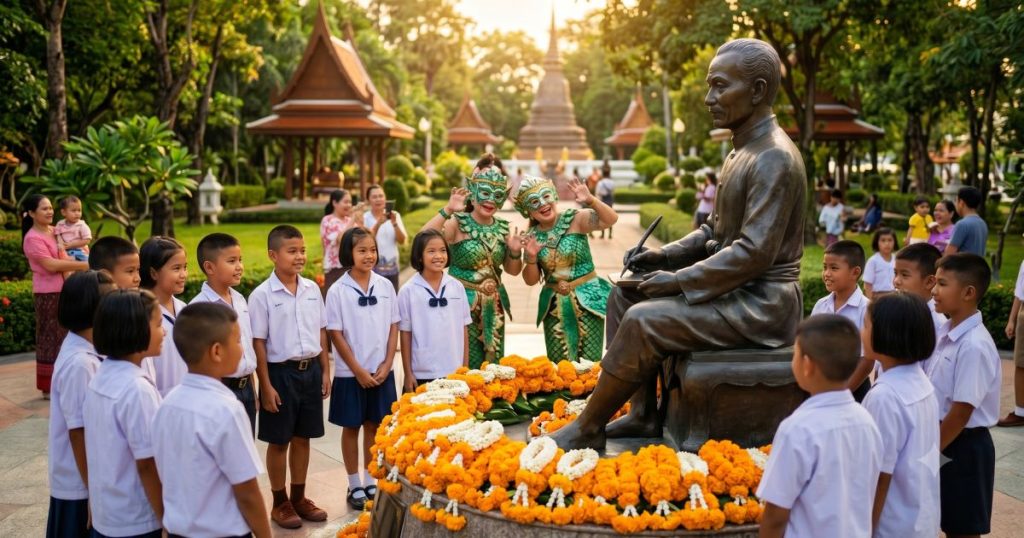
Students recite his verses in grade-level assemblies. Flowers are placed at his portraits and statues. In Rayong Province, three hours south of Bangkok, a three-day festival fills the memorial park built in his honour. The programme runs to poetry competitions, verse duels, and a costume pageant where people dress as the villain of his most famous epic. They queue to wear the costume of a sea-ogress.
The man being honoured was born in 1786 in Thonburi, with no court connections, into a literary culture that belonged almost entirely to the palace. He died in 1855 as Phra Sunthorn Voharn, a UNESCO-designated World Poet, with a 30,000-line epic as his monument. The decades in between were not smooth.
The world he was born into
Thai poetry in the late 18th century was court work. It was composed in formal language for royal ceremonies and aristocratic patrons, on subjects the palace approved. The language was elevated, the characters were noble, and the emotions were the ones a king would sanction.
Sunthon Phu wrote in the language of ordinary people. His characters fell and recovered and fell again, and he gave them inner lives that formal verse had ignored. The court of King Rama II saw something in this and appointed him court poet. That appointment was the platform he built his career on, and the first thing he lost.
The first fall
His first imprisonment came from a love affair with a woman of the royal palace named Chan. The court would never have approved it, and it produced the first great poem of his career. The nirat is a Thai poetic form shaped by departure and absence. Sunthon Phu wrote his first major nirat, Nirat Muang Klaeng, from inside a cell, and the feeling he put into the form has outlasted everything written in it since.
He was released, recovered his position, and found a second patron in King Rama II himself. When the king died in 1824, Sunthon Phu lost his income and his standing along with him.
After the patron
The years that followed were the most difficult and the most productive of his career. He had no court appointment, no reliable income, and a drinking problem that had grown severe. Around 1821, before the king’s death, he had been jailed again after a fight. Somewhere in the middle of all this, with no patron and no clear path forward, he began Phra Aphai Mani.
He published it in instalments over the following 20 years, producing 30,000 lines with no fixed address and no one paying him to write.
What the poem chose to be about
Phra Aphai Mani is an epic, but it does not behave like the Thai epics of its era. Its hero is not a warrior but a musician. When the two brothers are sent to choose a field of study, his brother selects the martial arts suited to a future ruler. Phra Aphai Mani chooses the flute. The court read this as a failure of judgement, and the poem spends 30,000 lines proving otherwise.
His flute can stop armies. Across fantasy kingdoms, sea voyages, and encounters with monsters, he wins with the skill everyone around him had dismissed. The flute does the work a sword does in other epics. Phra Aphai Mani’s name translates as the Jewel of Forgiveness.
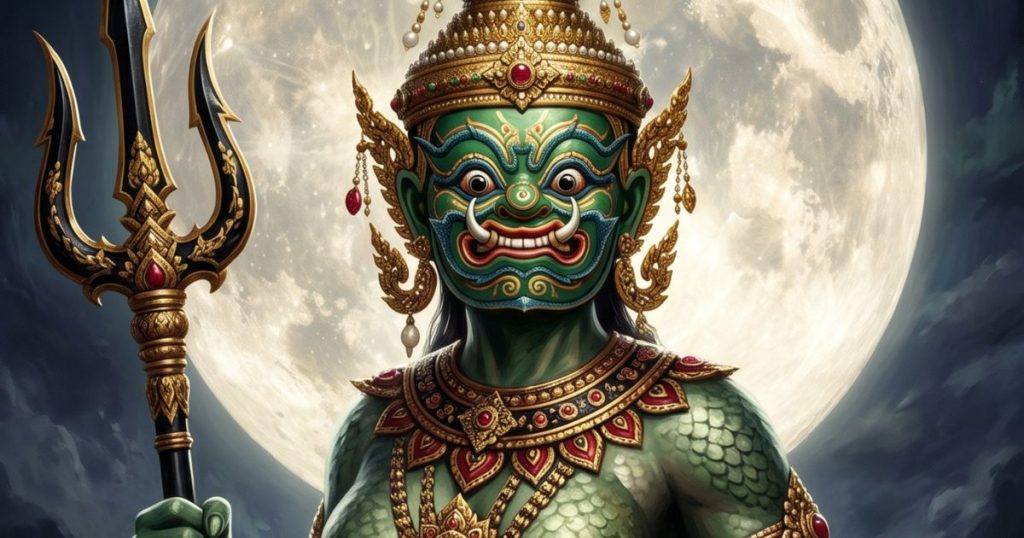
The villain is a sea-ogress named Phi Sua Samut. She is a giant who falls obsessively in love with the hero, and she becomes the obstacle he has to outthink rather than outfight. She is fierce and devoted, and her devotion is what destroys her. In Rayong each June, she is also the subject of a costume pageant. Adults and children spend weeks competing to embody a character from a poem written by a homeless man in a cell in the 1820s.
Some Thai scholars read Phra Aphai Mani as a disguised anti-colonial text, written as European powers pressed into Southeast Asia. Its hero wins without force and moves between kingdoms without being swallowed by any of them. That runs against the military logic of the colonial period. Whatever the intention, the poem holds to the unconventional path from start to finish.
How Thailand celebrates him
Thailand declared a national Sunthon Phu Day in 1987, the year after UNESCO designated him a World Poet of the 20th century. Every 26 June the country marks the occasion in two places: in schools and at dedicated memorial sites.
In classrooms, the day brings poetry recitals, Thai language activities, and grade-level assemblies around his work. His poems are already in the school curriculum, but Sunthon Phu Day is when students perform them rather than study them. The tradition is built on oral recitation, and performance is the point.
The national focal point is the Sunthon Phu Memorial Park in Klaeng District, Rayong Province. The three-day celebration runs there from 26 to 28 June each year. The park covers 33 acres and is free to enter. At its centre, sculpted characters from Phra Aphai Mani stand in the grounds: the prince with his flute, the ocean butterfly, and the mermaid who becomes his companion. Poetry reading contests draw competitors from across the country. Verse duels, a form of live competitive poetry from classical Thai tradition, run throughout the festival. The Phi Sua Samut costume pageant brings the poem’s most dramatic character to life in fabric and paint.
In Bangkok, the Sunthon Phu Museum at Wat Thepthidaram in the Rattanakosin district is open daily from 10:00 to 17:00 (admission 100 baht). The museum sits inside the temple complex where the poet lived as a Buddhist monk during one of the long stretches between court appointments. It holds manuscripts, portraits, and artefacts from across his life, and most visitors on 26 June are Thai school students.
A country that holds a three-day festival, sends its children to recite his verse, and runs adult costume contests for a poet who spent years in poverty and two spells in prison has settled the question of what it values in a creative life. The festival keeps the poverty and the prison in the story rather than editing them out.
The practice that outlasts everything else
The order of events in Sunthon Phu’s career is what gives it shape. Patron lost, income lost, housing lost, work produced. Patron found, position elevated, work produced. Patron lost again, conditions worse, work produced. The work did not pause for better conditions or wait for a new patron to appear.
Resilience advice built in well-resourced places tells people to treat failure as data and keep their momentum through the rough patch. That advice is not wrong, but it was developed in places where failure has a soft landing and the next source of help is close by. Sunthon Phu worked from different ground, where there was no next round and the court was not coming back, and the practice continued anyway.
His career poses one question to anyone working without a safety net: whether the core practice continues when the conditions do not. For him it did, and the conditions became the material the work was made from.
The institutions that supported Sunthon Phu have not survived him. Phra Aphai Mani has. He made it from the conditions that should have stopped him.
INSIGHT
What Sunthon Phu offers entrepreneurs and business operators today.
The practice is the constant. Sunthon Phu lost patrons, income, shelter, and freedom more than once, and the work continued through all of it. For an operator, the equivalent is the core activity that earns trust and revenue. That might be the service you deliver, the product you make, or a relationship you keep warm. Markets turn, landlords change terms, a major client walks. The question is whether that core activity holds when the conditions around it do not.
The dismissed skill often decides the outcome. Phra Aphai Mani chose the flute when everyone expected a sword, and the flute is what won in the end. Inside a business, the ability that does not fit an obvious category is the easiest to underrate: the quiet operations manager, the dull after-sales habit, the product line that looks like a sideline. It is worth auditing what you have already written off.
Constraint is working material. The prison produced the first great poem and the homeless years produced the masterwork. A tight budget, a small team, or a single market forces choices a comfortable position never would. During a hard stretch, the question worth asking is what this specific constraint makes possible that comfort would not.
He worked alone, and it cost him. He had no next round, no peers to compare notes with, and no one to catch him between patrons. The resilience was real, and so was the price of carrying it by himself. A network of operators removes the avoidable part of that story. The discipline stays personal. The isolation does not have to.
Thai Roots: A CMBN Research Series is published by Chiang Mai Busienss Network that reads Thai history, literature, and philosophy as working material for entrepreneurs and business operators in Thailand today.
Next: King Taksin and the 500-Soldier Startup. How a half-Chinese general rebuilt an entire kingdom from scratch, in three years, after total defeat.
