

The most awkward thing about Thailand’s tourism data is not what it reveals about failure. It is what it reveals about success. The system works. It brings in visitors, fills rooms, and sustains employment across every region of the country. Measured against the metrics Thailand’s tourism architecture has historically rewarded, the performance is largely as intended. That is precisely what makes it so hard to change.
When a system produces outcomes different from its goals, the path forward is operational. Find the blockage, remove it, adjust the execution. When a system produces outcomes that perfectly match what it was built to measure, the problem is structural. The system is not broken. It is just optimised for the wrong thing.
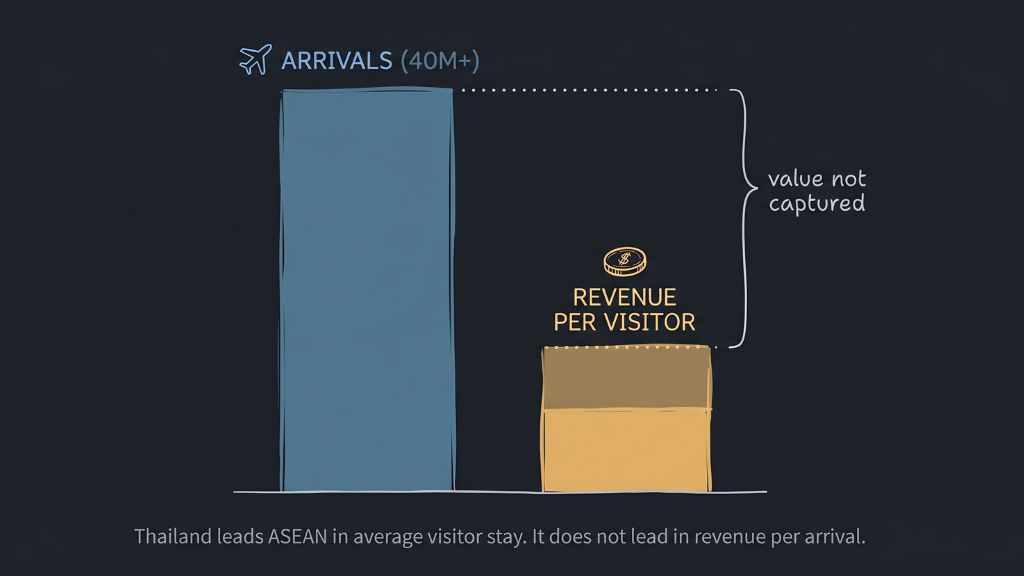
Thailand’s most visible tourism KPI for decades has been arrival volume. Headline success gets announced through arrival numbers. Recovery benchmarks are pegged to arrival numbers. Marketing campaigns are judged by reach and visitor counts. Infrastructure investment, visa liberalisation decisions, airline route subsidies, destination marketing budgets — all of it flows toward the thing being measured, year after year, until the architecture of the entire system bends in that direction. The result is a country that has become exceptionally efficient at one thing: getting people in. Converting those arrivals into revenue that reflects the quality of what Thailand actually has to offer is a different matter.
This shows up in the long-stay data in a way that should concern anyone involved in Thai tourism planning. The average international tourist stays more than nine days in Thailand, which is among the longest average stays in the region. More time in-country should mean more value extracted per visitor. In practice it does not, because those additional days are priced as affordable time rather than premium time. The system is not capturing the value the visitor’s presence represents. It is absorbing the volume.
The visitors who generate high revenue per day are not missing. European long-haul travellers stay an average of nearly 17 days and consistently outspend Asian regional markets on a per-day basis, and wellness, premium leisure, and long-stay segments generate a disproportionate share of total tourism revenue relative to their numbers. These visitors are already here, already spending, already returning. The system is just not primarily organised around them, because they do not drive the headline arrival metrics that the system treats as its primary signal of success.
For businesses in Chiang Mai, the misalignment has a direct commercial expression. The city’s strongest revenue position, the one that generates genuine yield rather than just occupancy, sits in the long-stay, experience-driven, premium wellness segment. That visitor costs more to reach, takes longer to convert, and requires deeper product quality than the mass-market visitor. Most of Chiang Mai’s current commercial infrastructure is not priced or designed to extract the value that visitor is willing to pay. The gap between what a serious wellness or cultural visitor would pay for a genuinely premium experience here and what is currently being charged for comparable experiences is not a market gap. It is a system gap, and it is one Chiang Mai businesses can start closing without waiting for national policy to catch up.
Thailand has articulated the goal clearly for years. Quality over quantity. Higher yield. Sustainable tourism. The language has been consistent. The incentives within the system have not caught up, which means operators across every category continue to respond to the incentives they actually face rather than the strategic narrative being written above them. Notably, in 2025 Thailand saw fewer arrivals but higher per-visitor revenue, which suggests the relationship between volume and value is already shifting, whether by design or default.
The shift does not begin with a new marketing campaign or a government designation. It begins with changing what the system measures, and therefore what it rewards. Until that changes, Thailand will continue to attract the world and undercharge it. That is not a tourism problem. It is a choice.
