

My father never migrated to a computer. He had an Olivetti Lettera 32, a small, portable typewriter that sat on his desk for decades. I can still hear him typing, working through letters to friends scattered across the world. Careful, considered correspondence. One copy. No undo button.
I think about that typewriter every time someone tells me AI is going to take all our jobs.
I have been using computers in my work for over thirty years. I remember the word processor arriving. Then Excel. Then email. Each one felt like a revolution at the time, and each one was. Not because it replaced people, but because it changed what people could do. When we could print duplicates, we stopped needing tracing paper. When email arrived, decisions that took days by post started happening the same morning. New tools removed old bottlenecks, and new roles appeared to replace the ones that disappeared.
We are in one of those moments again. The difference this time is the noise around it.
The Revolution That Already Happened
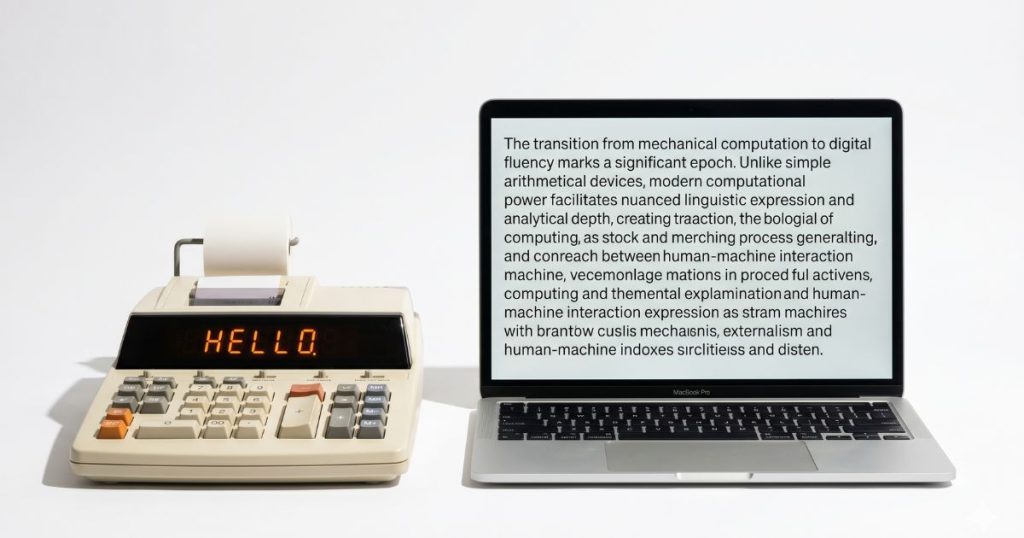
Large language models (LLMs) were not invented in 2022. Large organisations, governments, Reuters, IBM, Visa, Amex, AWS, were deploying them long before most people had heard the term. What ChatGPT did was hand that power to the rest of us. Suddenly, from a laptop in a co-working space in Chiang Mai, an SME owner could access something with the processing reach of infrastructure that would have filled a building forty years ago.
The Cray-1 supercomputer, which in 1976 was the most powerful computer on earth, ran at around 160 megaflops. A single modern GPU in the infrastructure that runs ChatGPT runs at roughly 4 petaflops. That is not a marginal improvement. That is a scale shift so large it barely makes sense as a comparison. The processing power now sitting on your desk would have been classified as a national asset in 1985.
That is the actual revolution: not the intelligence, but the access to processing power.

What It Is Not
Here is where I want to slow down, because the marketing language around AI is doing a lot of harm to how people see and use it.
I asked Claude directly: what are you?
This is what it said.
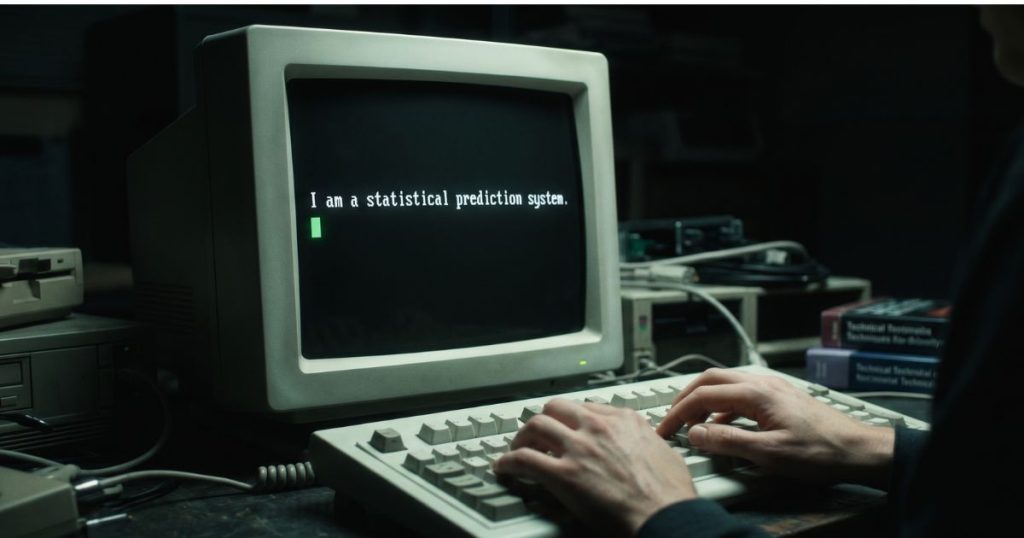
“I am a large language model (LLM). Specifically, I am a statistical prediction system trained on an enormous volume of human-generated text. When you give me input, I generate output by predicting what text would be most useful and coherent in response, based on patterns learned during training. There is no understanding happening in any meaningful sense. No reasoning in the way a human reasons. No awareness. No goals. No memory between conversations unless I am given tools that provide it.”
That is an honest answer. The word “intelligence” in “artificial intelligence” is doing a lot of work it has not earned. What we have is a very powerful pattern-recognition and text-generation system. It is not thinking. It is predicting.
What It Can Actually Do
That distinction matters because it changes how you use it.
Here is what an LLM does well. It generates structured, coherent text at scale and speed. It recognises patterns across large bodies of knowledge. It applies frameworks and logical structures to new inputs. It synthesises and reorganises information. It works across languages and registers, which matters enormously in a city like Chiang Mai where your clients, your staff, and your partners may all be working in their second or third language.
It also writes, reviews, and debugs code. Across Python, JavaScript, SQL, HTML, and many others. This is not a minor point. For SMEs without a dedicated technical team, this capability closes a gap that used to require hiring.
Notice I wrote “it.” That is the correct pronoun, and it is worth pausing on. LLMs are systems, not entities. But most of us default to something more personal. We say “ask it,” then start saying “ask Claude,” then somewhere along the way we start treating the response as if it came from a colleague rather than a calculator.
That drift is not accidental. When companies name these systems Claude, Gemini, Copilot, and give them conversational voices, they are nudging you toward something closer to a presence. A relationship. That framing is commercially useful and intellectually dishonest.
These are systems. Keeping “it” in your language is a small discipline that helps you maintain the correct relationship with the tool: you are the one responsible for what it produces.

What It does Not Do
It does not know what is true. It produces plausible text. Those are not the same thing.
It does not verify facts in real time unless given a search tool. It does not learn from your sessions. It does not understand your business. It pattern-matches against what you tell it.
The risk is not that LLMs are unintelligent. The risk is that they are confidently fluent. An LLM will produce wrong answers in perfectly structured sentences, and if you are not paying attention, you will not notice.
How To Use It Properly
The tool works when the human provides accurate inputs, clear structure, and critical review of the output. It breaks when people treat it as an authority rather than an assistant.
I use it every day in my work. For drafting, for structuring, for research, for coding, for working across languages. It has replaced a significant portion of what used to take me hours. But I review everything it produces. I bring the judgement. It brings the speed.
That is the right division of labour.
My father typed every letter by hand, sent it across the world, and waited weeks for a reply. The care he put into each one was partly a function of the constraint: there was no delete key, no instant send, no way to fire off a half-formed thought and correct it later.
I spent five hours this weekend building an 18-page sales support document for the GoldenPages, our CMBN business directory platform. It needed structure, content, images, and consistency across every section. Written the old way, that is days of work. Done with Claude as the production engine and me as the director, reviewer, and decision-maker, it took five hours. Both sides checking the other’s work throughout.
That is what this technology actually looks like in a small business. Not a robot replacing a person. A tool that compresses the time between idea and execution, provided the person using it knows what they are building and why.
For me, that compression does not translate into a smaller team. It translates into a bigger operation. The hours I recover go straight back into the business: more clients served, more products built, more ideas that previously sat on a list because there was never enough time to start them. My staff are not being replaced by a tool. They are being freed from the parts of their work that drained time without adding thinking. The higher-value work, the judgement calls, the client relationships, the things that actually require a person, those get more attention, not less.
That is the opportunity most people miss when they talk about AI replacing jobs. The real question is not whether it can do what your team does. It is whether it frees your team to do more of what only they can do.
The tools change. The need for a skilled human behind it does not.
