
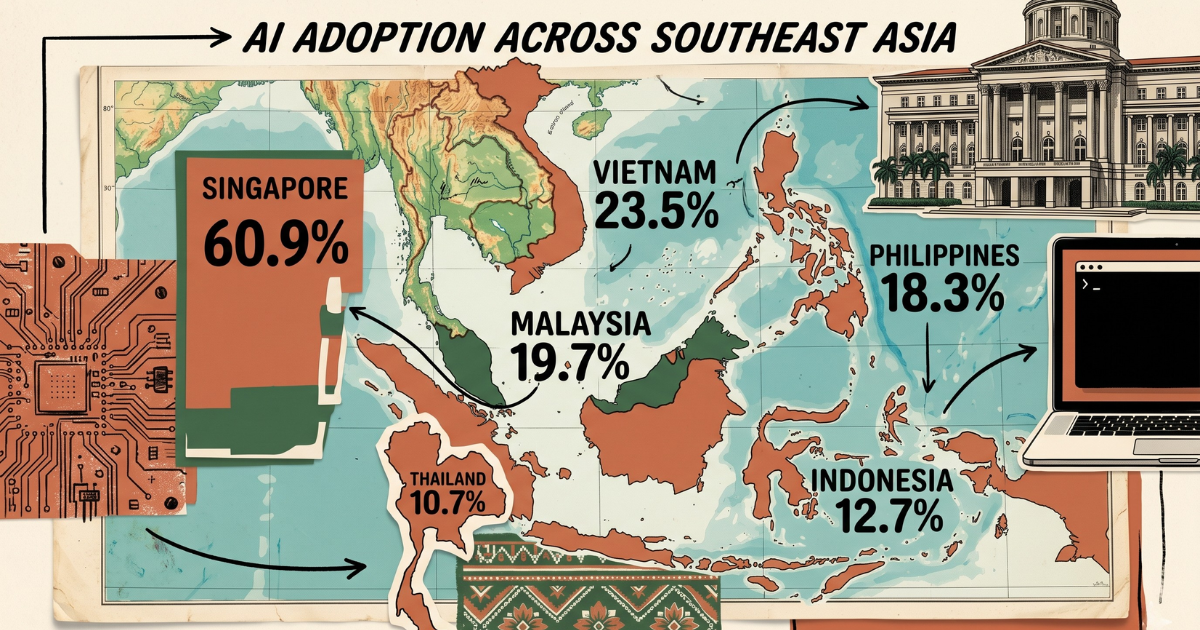
Vietnam sits at 38th in the world for AI adoption. Malaysia is 29th. Singapore is second. Thailand is 89th, placed in the same cohort as Nicaragua and Iran by the report Global AI Adoption in 2025: A Widening Digital Divide, which measured actual population-level usage across more than 100 countries in the second half of 2025.
The figure that matters most is not the rank but the rate. Thailand’s AI adoption rate stands at 10.7% of the population, against a global average of 16.3%. Vietnam recorded 23.5%. Malaysia reached 19.7%. The Philippines came in at 18.3% and Indonesia at 12.7%, both ahead of Thailand despite smaller digital infrastructure bases.
These are not projections. They are measurements of how many people in each country are using AI tools in practice, not the volume of data centre announcements, not the number of ministerial AI task forces, and not the reach of corporate pilot programmes. Thailand has all of those. What it does not yet have is adoption at the population level.

What the gap reflects
Thailand’s digital economy expanded 23.35% in 2024 to reach 2.496 trillion baht, according to DEPA and the IMC Institute, and the three-year outlook through 2027 projects digital services growing at 10 to 14% annually. The AI market alone is forecast to reach 114 billion baht by 2030. Investment is real and accelerating. Google Cloud opened its Bangkok region in January 2026, adding local data residency and direct access to AI infrastructure for the first time. Global technology companies have identified Thailand as a viable regional investment base.
The adoption numbers indicate that this investment has not yet reached ordinary users. Nearly 90% of Thailand’s population does not use AI or lacks access to it. Infrastructure creates capacity. It does not by itself create the skills, habits, or institutional frameworks that move people from awareness to active use.
The countries ranked above Thailand in the region have invested in both sides of that equation. Malaysia’s AIForMYFuture programme, developed with Microsoft and the National AI Office, set out to train 800,000 Malaysians in AI skills by end of 2025, reaching students, civil servants, and business leaders simultaneously. The government backed it with RM64.2 billion in education funding and a national AI roadmap running through 2025, with a second plan already in development targeting 2030. Vietnam enacted its Law on Digital Technology Industry in late 2024, providing fiscal incentives for AI research, foreign investment, and workforce development in the same legislative instrument. Vietnam’s ranking of 38th reflects those parallel commitments, not a natural advantage.
Thailand’s policy response exists but has moved more slowly on the skills side. The Ministry of Digital Economy and Society launched THAI Academy in April 2025 in partnership with Microsoft, targeting one million Thais through a free, open-access AI and digital skills platform. DEPA’s One Tambon One Digital initiative targets 15,600 SMEs, micro-retailers, and farmers by 2026. The Department of Skill Development offers more than 280 courses covering digital literacy through to advanced AI management, and DEPA provides grants and tax incentives of up to 250% for corporate training expenditures. The tools are available. The adoption rate indicates they are not yet reaching people at scale.

The Chiang Mai position
Around 77% of Thais say they believe AI will do more good than harm, among the highest rates of positive sentiment in the region. Adoption among SMEs sits at roughly 39%, which places Thailand behind Indonesia and Vietnam even in the business context where the tools are most accessible and the use cases most direct.
Chiang Mai sits within this national picture but operates with particular characteristics. The city’s tech and startup community includes remote workers, international founders, and local operators who have been building AI into their workflows through self-directed learning rather than through structured national programmes. The Digital Talent Visa, projected to bring 8,000 to 10,000 active holders to Chiang Mai by late 2026, adds a further layer of AI-literate professionals to the city’s working population. That knowledge does not automatically transfer to local businesses, but the proximity creates conditions that do not exist in most of Thailand.
The practical consequence of the national adoption gap shows up here in three ways. First, the available talent pool for AI-capable roles is thinner and more expensive than the headline cost of living in Chiang Mai suggests, because qualified people have options that extend well beyond the local market. Second, international clients and partners increasingly expect AI-integrated workflows as a baseline, and businesses that have not yet built those capabilities face a perception gap that is not easily explained away. Third, the government programmes that exist, including DEPA grants and the 200% tax deduction on qualifying digital training expenditure, are underused by Chiang Mai’s SME community relative to what is available.
The businesses in this network that are furthest ahead on AI adoption have reached that position through peer knowledge-sharing, not through formal programmes. That path works and works faster than waiting for national initiatives to reach the north. It also places real value on networks where that knowledge circulates, which is precisely the function the Chiang Mai Business Network exists to serve.

What the numbers do not measure
The 89th-place ranking captures population-level tool adoption. It does not capture the quality of use, the business impact of the tools being used, or the distribution of capability within the population it measures. Thailand’s student AI adoption rate is above 90% among university students and 81% among teachers, which places it at the top of ASEAN in that segment. The gap between that figure and the 10.7% general population rate reflects how concentrated current adoption is, in cities, in education, and among younger users, rather than distributed across the economy.
For businesses operating here, the concentration matters. The talent pool that knows how to use these tools is real but uneven. The businesses that have moved earliest are accumulating a working advantage that compounds, because AI-integrated operations produce data and output that inform the next cycle of improvement. That dynamic applies as directly to hospitality and tourism operators as it does to tech companies, and as directly to professional services firms as it does to e-commerce sellers attending the Cross Border Summit.
Thailand’s 89th-place ranking will change. The investment going into infrastructure, the programmes now running on skills, and the pace of tool accessibility all point toward a higher adoption rate within two to three years. The question for businesses in Chiang Mai is not whether to wait for that national shift. It is how much ground to cover before it arrives.
Source: The Nation Thailand, May 2026, citing “Global AI Adoption in 2025: A Widening Digital Divide.”
