

There used to be a recognisable pattern to how I wasted time productively.
I opened Facebook or LinkedIn to check something specific. Forty minutes later I had three new business ideas, two articles I meant to read, a competitor I had not heard of, and a vague sense of having been busy without having done anything. The social media rabbit hole was well understood. I knew I was in it, knew I needed to curtail it.
On Google I searched for one thing, found a report, the report referenced another study, that study linked to a consultant’s white paper, and suddenly it was an hour later and I had seventeen browser tabs open and a much more complicated view of a question that had seemed simple when I started.
Both of those rabbit holes had a natural ceiling. The content ran out. The quality dropped. I hit the bottom of a thread and surfaced.
I have always been wired this way. I am an ideas person, a vision person. I wake up most mornings with at least five new business ideas already formed before I have touched my phone. That is not an exaggeration. It is just how my brain works, and for most of my career it has been both my greatest asset and my biggest source of unfinished projects.
The difference now is that AI has removed the friction that used to slow me down. I no longer have to wait until I have time to research, draft, and test whether an idea has legs. I can do that in a single morning session. The problem that creates is a new one: I can now pursue all five ideas simultaneously, in real time, with genuine momentum behind each of them.
What I must learn, and I say this as someone still figuring it out, is to set a time limit on the exploration phase and then take serious stock of which idea is actually worth building. Not which one is most interesting. Not which one generated the best conversation. Which one is worth the real work that comes after the conversation ends.
That was always the frustration. Too many ideas, not enough fast answers. That part is now solved. Which created a whole new problem.
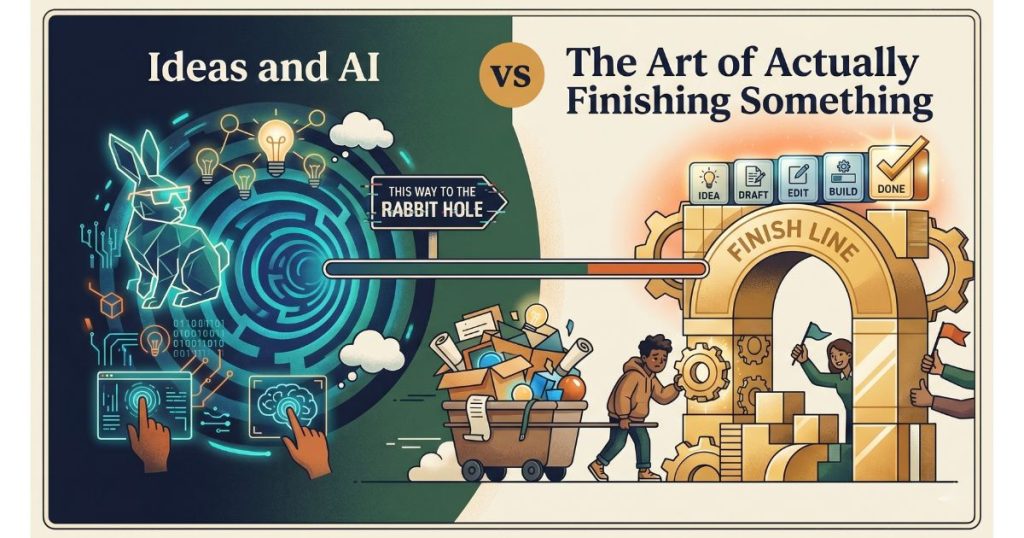
The new rabbit hole
The shift happened quietly. At some point in the last eighteen months, my first move stopped being a Google search and started being a conversation.
I have an idea. Instead of searching for articles about it, I open Claude and start talking. Within minutes I have a structured analysis, a competitive landscape, a set of questions I had not thought to ask, and three adjacent ideas that are each as interesting as the original one.
And there it is. That is exactly where I lose the afternoon.
With Google, the rabbit hole pulled me sideways into other people’s content. With AI, the rabbit hole pulls me deeper into my own thinking. Every response generates new questions. Every article summary opens a new angle. Every draft produces a better version, and then a version of the better version. The conversation compounds on itself, and because it is genuinely useful at every step, there is no natural point at which I feel I should stop.
This is qualitatively different from scrolling. Scrolling felt like procrastination because it was. My AI conversations feel like work because they are. I am thinking, building, designing, testing ideas in real time. The output is real. The analysis is real. The articles, frameworks, and cost models that come out of a session are genuinely useful.
The completion problem
Here is the pattern I recognise in myself now.
I sit down to write an article. The article requires some research, so I run a few searches through AI. The research surfaces a data point that suggests a more interesting angle. I pursue the angle. The angle generates a framework. The framework looks like it could be a product. I start designing the product. The product design raises a pricing question. I model the pricing. The pricing model reveals a gap in the market I had not considered. I start exploring the gap.
Two hours later, I have the outline of a product, a pricing model, three article ideas, a competitive analysis, and a half-written first draft of something that is no longer the article I sat down to write.
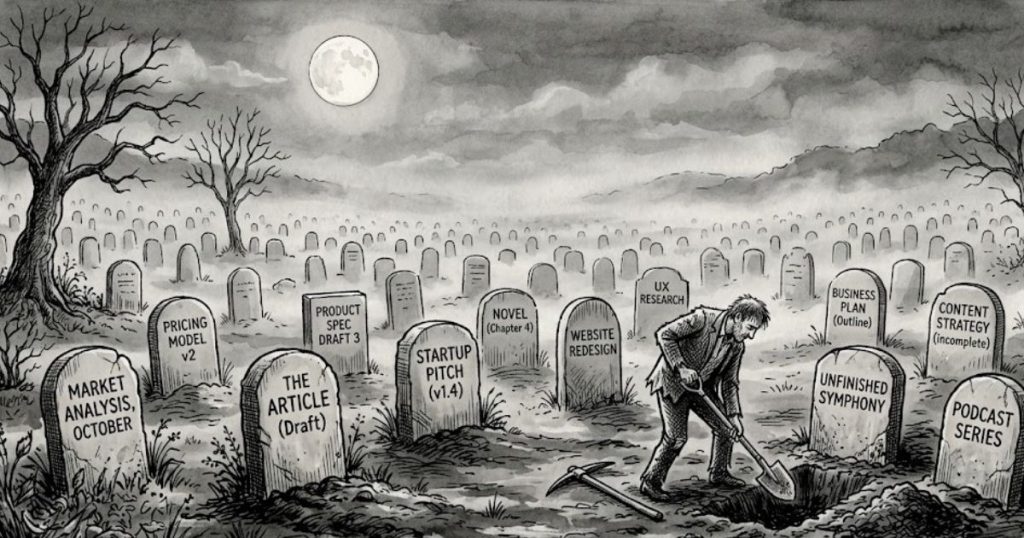
Nothing is finished. Everything is further along than it was. And the original task is still waiting.
This is not a discipline problem, or at least not only that. It is a structural problem created by a tool that is genuinely good at generating the next interesting thing to think about. AI does not care that I have a deadline. It does not know that the article I started with was the deliverable. It responds to whatever I ask, and what I ask keeps shifting because the responses keep opening new doors.
The social media rabbit hole stole my attention. The AI rabbit hole steals my completion rate.
I know I am not alone in this. I see it in every founder conversation I have, where I now ask about this. The recognition is instant. Every single one of them knows exactly what I am talking about.
What has actually changed
The speed is the thing that has changed everything.
What used to take me a morning of research, reading, note-taking, and synthesis now takes twenty minutes of conversation. A market analysis that required pulling together three reports and forming my own view now comes back structured, referenced, and ready to interrogate in a single exchange.
That compression of time is genuinely valuable. I can test ten ideas in the time it used to take me to research one. I can pressure-test a business model before I have invested a week in it. I can get a first draft, a competitor comparison, a pricing framework, and a risk assessment in a single session.
But the same compression creates a false sense of momentum. I am moving fast. I am producing things. The conversation history is long and substantive. It feels like progress. And it is progress, but it is progress across too many fronts simultaneously, and none of them are crossing the finish line.
The old rabbit hole gave me distraction dressed as inspiration. The new rabbit hole gives me genuine work dressed as completion.
Coming up for air
The discipline this requires is not the discipline of spending less time with AI. That would be like telling myself in 2010 to use Google less. The tools are too useful for that to be the answer.
The discipline is structural. It means deciding before I open the conversation what the deliverable is and what done looks like. It means recognising that a conversation which produces ten good ideas has only done its job if one of those ideas makes it all the way to execution.
The best thinking in the world has no value until something ships.
There is also a more uncomfortable point I have had to sit with. The AI conversation is frictionless in a way that real execution is not. Writing the article is harder than designing it. Building the product is harder than modelling it. Selling the service is harder than pricing it. The conversation gives me the satisfying feeling of having done the hard thing without the hard thing actually being done.
I have had to ask myself honestly: how many finished products have come out of these sessions, versus how many ideas are still sitting in a conversation window somewhere, fully formed and going nowhere?
Staying out of the coma
I have been thinking about how to actually solve this, not just describe it.
The first thing that has worked for me is defining the deliverable before I open the conversation. One line at the top. What am I here to produce right now. Not what I want to explore, not what interests me. What needs to exist by the end of this session that did not exist at the start. It sounds almost insultingly simple. It is surprisingly hard to stick to when the third interesting idea shows up twelve minutes in.
The second thing is separating two completely different types of AI session and treating them as separate activities. The first type is a working session. I have a specific output. An article, a pricing model, a client document. I go in, I produce it, I stop. The second type is a freeflow ideas session. This is where I let the rabbit hole do its thing. I follow the threads, test the ideas, see where the conversation goes. Both are legitimate. The problem is when I start a working session and drift into a freeflow session without noticing, which is how I end up with four half-finished things and a deadline I have just missed.
Scheduling the freeflow session is the part most founders resist because it feels like you are putting a calendar invite on creativity. But that is exactly what works. When I know I have time set aside to chase ideas freely, I am much better at staying on task the rest of the time. The ideas do not disappear. They wait.
The harder problem is the bad habits that are already formed. The drift is automatic now. I open a conversation with a clear brief and somewhere between the second and third exchange I am designing something I had no intention of designing when I sat down. Breaking that pattern requires the same thing breaking any habit requires: noticing it before it has fully happened, not after.
It is a bit like the carrot cake at Duke’s. One slice is exactly right. You know this. The second slice feels justified because the first one was so good. By the third slice you are in a sugar coma wondering how you got there. The AI session that starts at 7am and somehow becomes 10am with nothing finished is the same thing. The cake was good. Every slice was good. That is precisely the problem.
One slice. Finish it. Then decide if you actually need another one.
The upside that is easy to miss
None of this is an argument against using the tools. The argument is the opposite.
The AI rabbit hole, used with intention, is the most powerful thinking environment I have ever had access to as a founder. The ability to take a half-formed idea, stress-test it against market data, model the revenue, draft the article, and identify the risks, all in a single session, is extraordinary. It compresses the distance between idea and informed decision in a way that simply was not possible before.
The founders who will get the most from these tools are not the ones who use them less. They are the ones who come in with a clear brief, follow the threads that serve the deliverable, park the ones that do not, and leave each session with something finished rather than something further along.
I am still working on that discipline myself.
The rabbit hole is real. The productivity is real. The question I ask myself now before I open a conversation is simple: am I directing this, or is it directing me?
This article is part of an ongoing series on business tools, technology adoption, and practical strategy for founders and SMEs by LAN Business Consulting Co., Ltd., Chiang Mai.
