
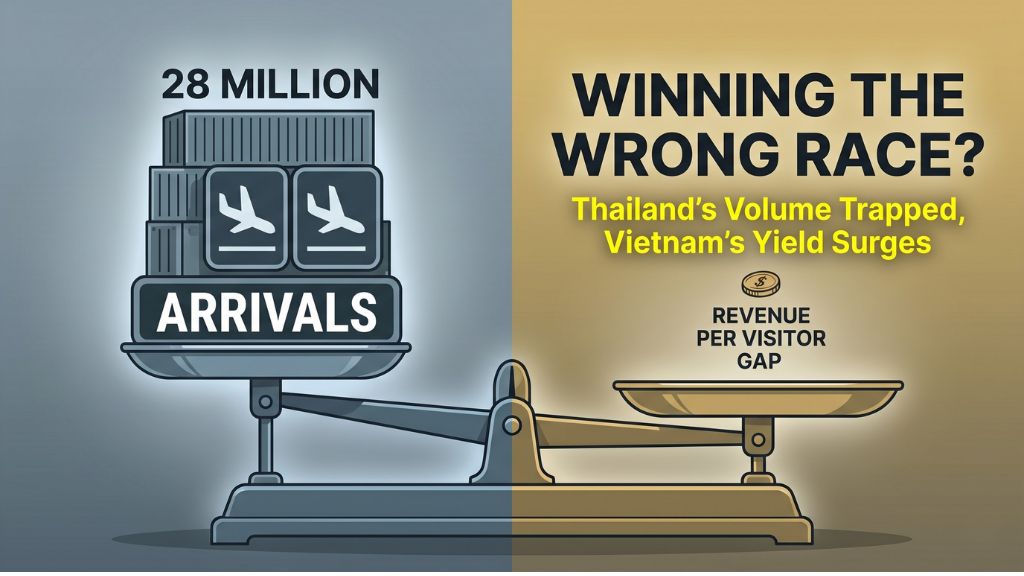
Vietnam received 12.6 million international arrivals in 2023, less than half of Thailand’s 28 million. By the headline numbers that dominate regional tourism coverage, Thailand is still well ahead. The problem with treating that gap as reassurance is that Vietnam is not trying to beat Thailand at the game Thailand is currently playing. It is building a different game, and the pace of construction is worth paying attention to.
Every few months, the comparison resurfaces in regional tourism analysis framed as a race. Growth rates, arrival rankings, market share. Thai tourism ministry briefings engage with it. Trade media in Bangkok return to it. The framing is understandable, because a race is a clean narrative and clean narratives are easy to publish. It is probably the wrong frame.
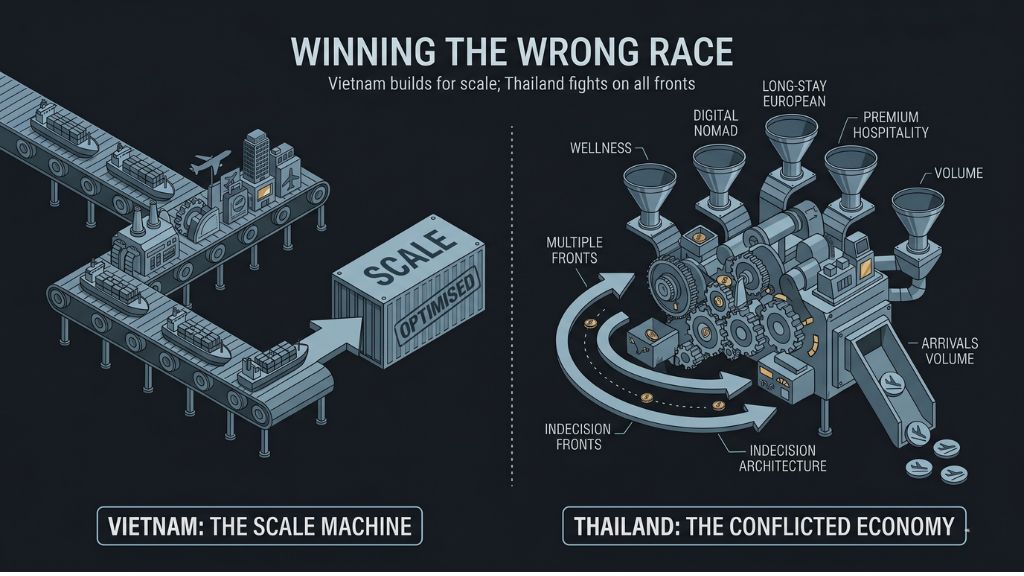
Thailand and Vietnam are not running the same race. Vietnam has brought visa liberalisation, aviation capacity, infrastructure investment, and regional demand capture from Chinese and Korean travellers into alignment around a single objective: scale. In the first quarter of 2026 alone, international arrivals to Vietnam climbed 12.4% year on year to 6.76 million, and the trajectory has been deliberate rather than incidental. Thailand, by comparison, is navigating a recovery that feels like it should be further along. Arrivals have returned but revenue per visitor has not moved in a direction that justifies the volume ambition.
What the comparison actually reveals is structural. Thailand is competing on multiple fronts simultaneously, trying to win the Asian volume battle while also pursuing wellness tourism, long-stay Europeans, premium hospitality, and the digital nomad segment. Each of those is a legitimate play. None benefits from being chased at the same time, through the same system, without a clear hierarchy of which one leads.
The cost of that indecision shows up in a decade of data. Between 2010 and 2019, Thailand’s international arrivals grew at close to three times the global average while revenue per visitor barely moved across the same period. More tourists came, and each one was worth less. That is not the result of bad luck or poor marketing. It is what a system produces when it is designed to bring people in rather than extract value once they arrive.

Vietnam is not Thailand’s most pressing problem. The harder question is what kind of tourism economy Thailand is actually building, because the current answer, read through the data rather than the press releases, is a system that rewards volume and speaks the language of value. That gap between stated ambition and operational logic does not close without something changing in the underlying architecture.
For businesses in Chiang Mai, that structural tension has a direct commercial translation. Chiang Mai saw 12.5 million tourists in 2023, yet the visitors who spend the most per day are not the visitors around whom most of the city’s accommodation, dining, and experience infrastructure is priced. The segments generating the highest revenue per head are not the segments that drive the occupancy numbers operators celebrate at the end of each quarter. The tourists who return, refer others, and increase their spending on repeat visits are already here. The commercial ecosystem is just not primarily organised around them. That is a design problem, and design problems do not fix themselves.
