
Domestic tourism is not a backup market. Six years of data show it is one of Thailand’s most reliable demand engines, and one of its most under-monetised.
Thailand’s tourism story is usually told through the eyes of international visitors. The industry asks whether China has returned, how much Europeans are spending, how fast India is growing, and whether foreign arrivals will meet this year’s target. Meanwhile another market has been here all along, travelling, spending, and keeping the system moving whenever external demand weakens. That market is domestic tourism.
In practice, domestic tourism is often treated as a fallback: something to rely on when foreign tourists disappear, a crisis stimulus tool, a discount campaign, or a temporary support mechanism for hotels, restaurants, and tourist towns when the main engine stops working. That framing understates what the data shows. Domestic tourism should not be treated as a crisis substitute but as a strategic market in its own right, because six years of evidence point to the same conclusion. It is one of the most important demand engines in the country’s tourism system.
The question is no longer whether Thai travellers matter, since the data has already answered that. The larger question is why a system with this much domestic demand has struggled to convert that demand into value.
1. The market that was never secondary
Before COVID-19, 2019 stood as one of the largest years in the history of Thailand’s tourism industry. That year the country received around 39.79 million international visitors, generating roughly 1.93 trillion baht in revenue. These are the numbers the industry celebrates and the numbers that make headlines.
In the same year, Thai residents made around 166 million domestic trips and generated roughly 1.08 trillion baht in domestic tourism revenue. That second number rarely makes the front page, and this is the contradiction at the heart of Thailand’s tourism economy. A market that generates more than one trillion baht a year, more than half the revenue produced by 39.79 million foreign visitors, cannot reasonably be described as a backup market. It was already large before the crisis and it remained part of the system after the crisis.
Domestic and international tourists do not create value in the same way. International visitors spend more per trip, stay longer, and generate higher revenue per head. Domestic travellers give the system something foreign demand cannot always provide in an uncertain world, which is frequency and continuity. Thai travellers travel repeatedly and nearby, during holidays and festivals, to rest, to visit family, to run errands, and to return home. For Thai travellers the line between tourism and everyday mobility is much thinner than it is for foreign visitors, who arrive primarily to travel.
Domestic tourism is therefore not only a leisure economy. It is a mobility economy, the movement of Thai people across the country, and that movement supports hotels, restaurants, cafés, petrol stations, markets, souvenir shops, car rentals, temples, and tourism communities.
This is also where the market’s strength and its limitation sit side by side. Frequency and proximity make domestic demand resilient and geographically widespread, but the same short, nearby trips are harder for the system to monetise. The article returns to this problem below. For now one point is clear: domestic tourism is not as eye-catching as international arrivals, but it is far too large to be treated as a supporting character.
2. Where Thais actually travel
Beyond the simple claim that Thais travel a lot, a more interesting picture emerges. Thai travellers are not concentrated in the country’s main tourism hotspots.
In 2019, domestic trips were relatively well distributed across the country. The Northeast accounted for the largest share of domestic trips at 18.3 per cent, followed by Bangkok at 17.9 per cent, the Central and Western regions at 13.7 per cent each, the North at 13.3 per cent, the East at 11.6 per cent, and the South at 11.5 per cent. Almost no region fell below 11 per cent. This is a picture of distributed demand, very different from international tourism, which clusters in a smaller number of provinces.
Shift from trips to revenue and the picture changes sharply. Bangkok generated 34.4 per cent of domestic tourism revenue. The South generated 18.7 per cent and the North 12.8 per cent. The Northeast, the region with the highest number of domestic trips, generated only 8.8 per cent of domestic tourism revenue, and the Central region generated just 4.8 per cent.
The gap becomes clearer when measured as revenue per trip. The South, despite having the lowest share of domestic trips, generated roughly 10,600 baht per trip. The Northeast, despite having the highest share of trips, generated only around 3,100 baht per trip, more than three times lower. This is the same market, the same year, and the same domestic travellers, yet the value captured by each region is dramatically different. The pattern existed before COVID-19 and appears again across the years examined in this series: mobility is distributed, value is not.
The explanation is not that travellers in one region are richer than travellers in another. It lies in the structure of the trip itself. Some regions receive a large number of short trips, including same-day visits, family visits, errands, and short-distance travel. Other regions function as overnight leisure destinations where travellers stay in hotels, eat multiple meals, and buy additional activities. The Northeast attracts the highest number of domestic trips, but many of those trips involve returning home, visiting family, or handling personal business, and these trips naturally generate lower spending per trip even though they matter socially and economically. The South, by contrast, is a longer-distance leisure destination that requires more time, more nights, and more services, which is why it captures more value per trip.
This is where the policy question around domestic tourism needs to change. The usual question asks how Thailand can get more Thai people to travel. The data points to a better question: how can the places Thai people already visit capture more value from those trips? In many provinces the problem is not that people do not go. The problem is that they go and return home the same day.
3. The market that did not disappear
The year 2020 was the real stress test for Thailand’s tourism system. When COVID-19 arrived, the government barred international tourists from entering the country from late March, and the effect was immediate. In April, May, and June, foreign tourist arrivals fell by 100 per cent for three consecutive months. International tourism went to zero for all practical purposes, foreign tourism revenue stopped almost overnight, and hotels, restaurants, and tourism service providers absorbed the full shock.
The domestic market behaved differently. Domestic tourism contracted sharply but never disappeared. Even in April 2020, when lockdown measures were at their strictest, Thai residents still made around 0.12 million domestic trips in a month when foreign arrivals were zero. Across the first ten months of 2020, Thai residents made roughly 65.19 million domestic trips and generated around 0.37 trillion baht in tourism revenue.
This does not mean domestic travellers replaced the foreign revenue that disappeared. They did not, and no one should have expected them to. What the numbers show is something different: domestic tourism acted as the demand floor of the system. It collapsed without vanishing, and in a crisis that distinction matters. When external demand fell to zero, the only market still moving inside the system was the domestic one, and the hotels, restaurants, and tourism towns that survived that year did so in part because Thai travellers continued to move.
The lesson of 2020 is therefore sharper than the observation that domestic tourism matters. Domestic tourism is the market that keeps the system from reaching zero.
4. Demand was constrained, not exhausted
The same stress test revealed something else. In early 2020, before the full lockdown took effect, the spending pattern of Thai travellers who were still able to travel barely changed. Thailand’s emergency decree began in late March, so the first quarter still mostly captured pre-crisis behaviour.
Compared with the first quarter of 2019, the number of Thai travellers in the first quarter of 2020 fell by around 28.8 per cent, and total domestic tourism revenue fell by a similar margin. Average daily spending by Thai tourists actually rose slightly, by around 0.25 per cent, from roughly 2,496 baht to 2,502 baht per day, while average length of stay slipped only from around 2.45 days to 2.40 days.
Among those still able to travel, Thai travellers did not suddenly become tourists who refused to spend. What disappeared was the ability to travel, not the willingness to spend. Many people stopped travelling because they were not permitted to, not because they had no intention of spending, and that distinction challenges one of the easiest assumptions made about the domestic market: that Thai travellers do not spend much, require discounts, and form a naturally low-value segment.
The data tells a more complicated story. The problem is not that Thai travellers are inherently unwilling to spend. The problem is that many domestic trips are structurally too short for the system to capture much value from them, and those are not the same thing.
One caveat applies. These figures reflect the behaviour of people who were still able to travel, not the entire population, and it is possible that those who continued travelling in early 2020 had higher purchasing power than the average domestic traveller. The safer conclusion is therefore narrower: among those who continued to travel, spending intensity did not fall in line with the number of travellers.
5. When movement returned, value did not
If 2020 proved that domestic demand survives a crisis, the following years tested whether value returns once restrictions ease. The answer was clear: not at the same speed.
In 2021 the system began to recover unevenly. Most remaining tourism revenue still came from Thai travellers while international demand had not yet returned, but as domestic trips recovered, spending intensity did not recover at the same pace. By 2023 the picture had become clearer, and it was confirmed by evidence beyond tourism ministry data. The Bank of Thailand reported that while tourism volume had returned close to pre-COVID levels, revenue had recovered to only around 65 per cent of its pre-COVID level. The people came back faster than the money did.
By 2025 the conclusion was difficult to avoid. National data showed Thai residents making around 202.37 million domestic trips and generating roughly 1.167 trillion baht in domestic tourism revenue. At first glance this looked like good news, since both total trips and total revenue exceeded 2019 levels. Revenue per trip told a different story. In 2019, domestic tourism generated around 1.08 trillion baht from 166 million trips, roughly 6,500 baht per trip. In 2025 it generated around 1.167 trillion baht from 202.37 million trips, roughly 5,765 baht per trip.
Total revenue had recovered while value per trip had not. Domestic revenue per trip remained about 11 per cent below its pre-COVID level, and because both figures are nominal, the real gap is wider after adjusting for cumulative inflation over six years. The blunt conclusion is that Thailand recovered its domestic tourism revenue by generating more trips, not more value per trip.
This brings the argument back to the central tension in Thailand’s domestic tourism economy. The domestic market is reliable in volume and continuity. It prevented the system from reaching zero in its worst year and produced record trip numbers in a stronger year, but that reliability has not translated into stronger value capture. Thailand can rely on Thai travellers. It has not yet learned to capture enough value from that reliance. The country does not have a domestic demand problem. It has a domestic monetisation problem.
6. Thais do not spend less. They stay less.
A long-standing assumption in Thailand’s tourism industry holds that Thai travellers are low spenders who need discounts and form a lower-value market. The data suggests that assumption is wrong, and wrong in an interesting way. The following figures refer only to Thai travellers and do not include a single baht of foreign tourism revenue.
In 2025, revenue per domestic trip varied dramatically by province. Krabi generated more than 12,000 baht per Thai trip and Phuket more than 11,000. Bangkok was around 8,600 baht, Chiang Mai around 8,000, and Surat Thani around 7,600. By contrast, Kanchanaburi generated around 2,500 baht per Thai trip, Nakhon Ratchasima also around 2,500, and Ayutthaya around 2,200. The first group captured four to five times more value per trip than the second, and all of it was Thai spending.
Because the data is Thai-only, the usual explanation, that some provinces simply have more foreign tourists, does not apply. The same Thai traveller generates very different value depending on the structure of the destination. When Thai travellers go to places that require overnight stays, hotel spending, several days in the area, and paid activities, they generate high value. When they travel to nearby destinations for a same-day visit, to make merit, eat lunch, visit a café, and drive home, the value per trip is structurally lower regardless of their purchasing power.
This is not a post-COVID phenomenon. The same pattern was visible in 2019, before the pandemic existed, when the South had the lowest share of domestic trips yet generated more than three times the revenue per trip of the Northeast, which had the highest share. The gap existed before the crisis, survived the crisis, and remained visible after the system had largely recovered. That persistence makes it structural rather than temporary.
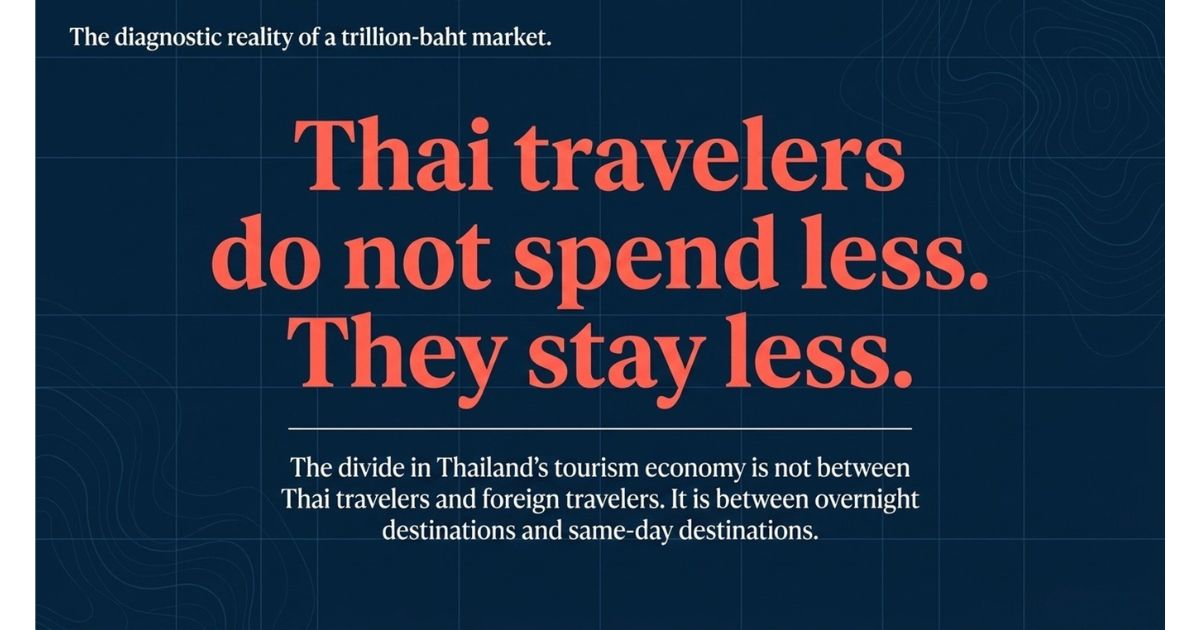
All of this points to the sentence that best summarises the core finding of this article: Thai travellers do not spend less, they stay less. In the language of the data, the gap is not between Thai travellers and foreign travellers but between overnight destinations and same-day destinations. The real divide is not nationality. It is duration.
Domestic tourism therefore needs to be understood differently. It is not a market that needs more discounts. It is a market that needs more reasons to stay overnight.
7. Value is time
Across six years of tourism data, the mechanism behind tourism value is not complicated. Value does not come from having more tourists alone. It comes when travellers stay longer, spend more per day, buy more services, connect multiple activities into a single trip, and return again.
This is why terms such as wellness tourism, long stay, community-based tourism, green tourism, and premium experiences have become more prominent in tourism policy language. Strip away the labels and these models share the same logic: they sell time, not just place. A wellness package does not sell only a spa treatment but several days of recovery. Community-based tourism does not sell only a village but a multi-day experience, a sequence of activities, and a relationship with place and people. Long stay tourism does not sell only a room but the ability to live with a city for a period of time. Value is created when a trip becomes longer, deeper, and more connected to services.
Two cautions apply. First, many of these models are proof of mechanism rather than proof of scale. They show that longer stays create more value. They do not yet show how that model extends across a domestic market of more than 200 million trips. Second, and more important, many of these value models are designed for higher-spending segments, which is not the same group as the mass domestic market. The millions of same-day trips to places such as Kanchanaburi, Ayutthaya, or Nakhon Ratchasima often involve family visits, errands, religious trips, or short-distance leisure, and these trips are short because there is often no reason to stay overnight in the first place. A high-end wellness package costing thousands of baht per night is not designed for this group.
The hard question is therefore not whether wellness creates value, because that has already been demonstrated. The harder question is who will design affordable reasons to stay overnight for the millions of Thai travellers who currently return home the same day. That is not a marketing campaign. It is a supply-design problem, and it requires mid-priced accommodation, evening activities, connected experiences, and second-night reasons in the very provinces that receive large numbers of Thai travellers but capture relatively little value from them.
8. The policy language has changed. The outcome has not yet followed.
Over the past few years, Thailand’s tourism policy language has changed noticeably. The conversation has shifted from arrivals to value, from headcounts to wellness, long stay, high-spending visitors, and higher-quality experiences. Thailand has begun to speak the language of value over volume.
Two things need to be separated. First, speaking the language of value does not mean value has appeared in the data. As of 2025, domestic revenue per trip remained below its pre-COVID level. Policy language often moves faster than outcomes, and structural change takes time, so what can be observed at this stage is not policy failure but a gap that remains open between what is being said and what has been achieved.
Second, and more important, the logic of value has been applied far more clearly to international tourism than to the domestic market. On the international side, value-oriented tools have become concrete: wellness tourism, long stay, digital nomad visas, medical tourism, and premium tourism. These are not promotional slogans but structural attempts to extend length of stay and increase spending by foreign visitors. On the domestic side, the main tools still focus on generating more trips and higher travel frequency through promotions, discounted accommodation, and campaigns encouraging Thais to travel. Even in the following year’s targets, domestic revenue is expected to grow more slowly than domestic trips, implying that, by plan, value per domestic trip continues to decline.
Put plainly, Thailand has learned the language of value but speaks it most clearly to foreign visitors.
This is not to say the state has ignored the domestic market. The evidence says otherwise. Domestic tourism has had plans, budgets, and campaigns for years, and during the crisis domestic stimulus measures became one of the main tools supporting the tourism system. The point is more precise than neglect. The domestic market has not been forgotten. It has been managed as a volume market while international tourism is increasingly managed as a value market. Thai travellers are encouraged to travel more. They have not yet been systematically given more reasons to stay longer.
9. What it means to treat domestic tourism as strategic
If domestic tourism is to be treated as a strategic market, the word strategic has to mean more than launching another campaign. It does not mean more discounts, more long weekends, or more trips alone. Treating domestic tourism strategically means designing a system that allows this market to generate more value.
In practice that means converting some same-day trips into overnight trips, designing activities that give travellers a reason to stay for a second night, creating multi-day packages for nearby destinations, turning secondary cities from stopover points into places worth staying in, and connecting restaurants, accommodation, communities, and activities into routes that justify an overnight stay.
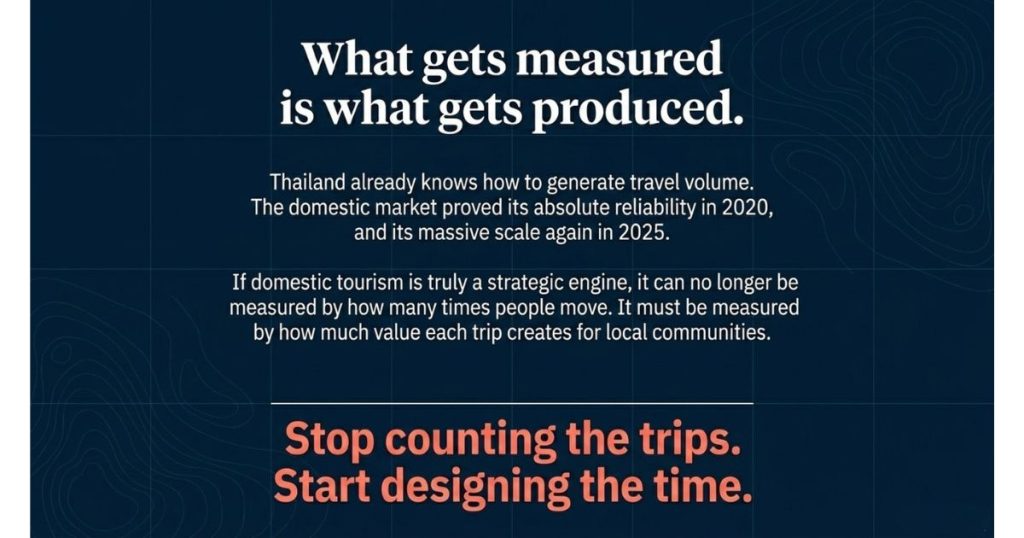
Above all, it means changing what Thailand measures. As long as domestic tourism success is measured primarily by the number of trips, the entire system of budgets, campaigns, incentives, and institutional behaviour will keep optimising for more trips. What gets measured is what gets produced. Six years of data show that Thailand already knows how to generate domestic travel volume. If the country wants value, it has to start measuring value.
The problem is not that Thai travellers do not travel, because they already do in record numbers. The problem is that too many domestic trips are too short for the system to capture enough value from them.
Conclusion: the market that keeps Thailand moving
Domestic tourism is not what Thailand falls back on when foreigners disappear. It is the market that keeps the system moving when external demand becomes uncertain.
Six years of data tell a consistent story. In 2019, domestic tourism was already large, at 166 million trips and more than one trillion baht in revenue, before anyone had heard of COVID-19. In 2020, when foreign arrivals fell to zero for three consecutive months, domestic tourism never did. In 2021, when foreign visitors were still largely absent, nearly nine out of every 10 baht in tourism revenue came from Thai travellers. In 2023, as the system reopened, volume recovered faster than value. And in 2025, even as domestic trips reached a new high, value per trip remained below its pre-COVID level.
The question is no longer whether Thai travellers matter. The data has answered that repeatedly, in both the best and worst years of Thailand’s tourism industry. Thailand has begun to speak the language of value, and the test now is whether it is ready to speak that language seriously to its own domestic market.
Six years of data show that Thailand does not lack domestic demand. It lacks a system designed to turn that demand into value. If domestic tourism is no longer to be treated as a backup market, it cannot be measured only by how many times people travel. It has to be measured by how much value each trip creates for cities, communities, and local businesses.
This market has already proved itself in the industry’s worst year. What remains unproven is how the system will repay that reliability, beyond discounts.
Notes and sources
General note on data sources: This article uses two tourism datasets that apply different counting methods. The first is the national-level dataset, which counts visitors on a non-duplicated basis and is used in Sections 1 to 5. The second is the provincial-level dataset, which counts visits by province; if one traveller visits multiple provinces in the same trip, that traveller is counted in each province visited. This provincial dataset is used in Section 6. As a result, average revenue per trip differs between the two datasets and should not be compared across them directly. Provincial figures are used only to compare provinces within the same counting method.
Section 1. International visitors in 2019: 39.79 million arrivals and 1.93 trillion baht in revenue. Thai domestic visitors in 2019: 166 million domestic trips and 1.08 trillion baht in revenue. Ministry of Tourism and Sports, 2019 Annual Report.
Section 2. Regional shares of domestic trips in 2019: Northeast 18.3 per cent, Bangkok 17.9 per cent, Central 13.7 per cent, West 13.7 per cent, North 13.3 per cent, East 11.6 per cent, and South 11.5 per cent. Regional shares of domestic tourism revenue: Bangkok 34.4 per cent, South 18.7 per cent, North 12.8 per cent, East 11.7 per cent, West 8.8 per cent, Northeast 8.8 per cent, and Central 4.8 per cent. Ministry of Tourism and Sports, 2019 Annual Report, domestic visitor section. Estimated regional revenue per trip, approximately 10,600 baht in the South and 3,100 baht in the Northeast, calculated by the author using regional revenue share divided by regional trip share, multiplied by the national domestic average of roughly 6,500 baht per trip. These are author estimates, not figures directly published in the report.
Section 3. Foreign arrivals fell by 100 per cent in April, May, and June 2020 after Thailand restricted international arrivals under the Emergency Decree, effective from 26 March 2020. Domestic trips in April 2020 stood at around 0.12 million. Ministry of Tourism and Sports. January to October 2020 domestic tourism figures: 65.19 million Thai domestic trips and 0.37 trillion baht in revenue. Tourism Economic Review, October 2020, Tourism Economic Division, Ministry of Tourism and Sports. Figures are preliminary.
Section 4. First quarter 2020 versus first quarter 2019: Thai domestic visitors declined by 28.8 per cent; average daily spending by Thai tourists rose to 2,501.91 baht per day from 2,495.74 baht, an increase of 0.25 per cent; average length of stay declined to 2.40 days from 2.45 days. Domestic tourism situation reports, Ministry of Tourism and Sports.
Sections 5 and 6. Bank of Thailand recovery assessment, 2023. National 2025 figures: 202.37 million domestic trips and 1.167 trillion baht in revenue. Provincial 2025 revenue-per-trip figures from the provincial-level dataset described in the general note above.
