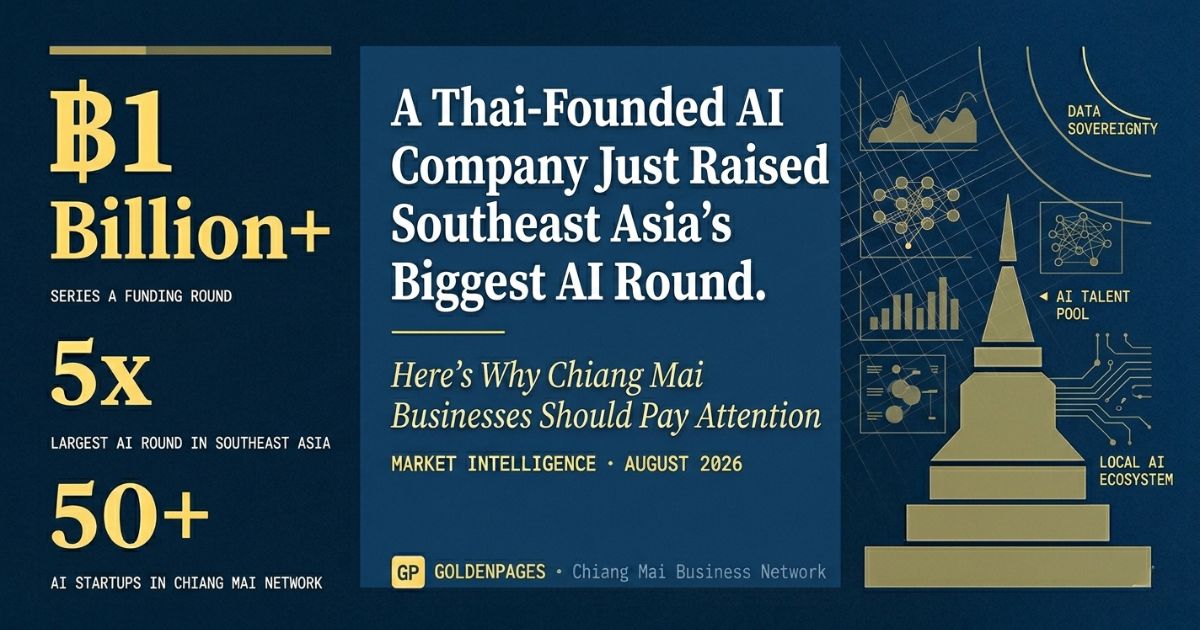
A Thai-Founded AI Company Just Raised Southeast Asia’s Biggest AI Round. Here’s Why Chiang Mai Businesses Should Pay Attention
When a Bangkok-founded technology company raises the largest generative AI funding round in Southeast Asian history, it’s tempting for businesses outside the capital to file it under “interesting but irrelevant” and move on. That would be a mistake.
Amity, the AI and software company founded by Korawad Chearavanont in 2012, has just closed a $100 million Series D round — the largest generative AI capital raise in the region to date — bringing its total funding to $160 million. The round was led by EDBI, the investment arm of Singapore’s SG Growth Capital, alongside Asia Partners and SMDV. An IPO is targeted for mid-2027, with the Stock Exchange of Thailand, Singapore, and Hong Kong all under consideration.
The numbers are impressive. But the real story for Chiang Mai businesses is buried in the details of what Amity actually does, who its clients are, and where AI investment is flowing next.
Who is Amity and why does it matter here?
Amity isn’t building the kind of AI that makes headlines at Silicon Valley conferences. It builds what its founder calls vertical AI — artificial intelligence tailored to the specific operational needs of individual industries, primarily retail and telecoms. Its core products include enterprise chatbots, voice AI platforms, and agentic AI systems capable of running end-to-end business processes autonomously.
Its client list in Thailand reads like a map of the country’s dominant commercial infrastructure: CP All (7-Eleven), True Corp, Kasikorn Bank, AirAsia, and major government agencies. Between 35% and 40% of Amity’s revenue comes from Thailand. The rest comes primarily from Europe, where over 75% of its EBITDA is now generated — a remarkable feat for a company headquartered in Bangkok.
Korawad himself is the grandson of CP Group patriarch Dhanin Chearavanont, whose family Forbes ranks as Thailand’s second-wealthiest with a net worth of $29 billion. But he has been deliberate about building Amity independently, keeping family investment below 10% and seeking institutional scrutiny from external investors. “If the family just leads or funds,” he has said, “it will not have the kind of scrutiny that external institutional investors give.”
The CP Group connection and what it means for Chiang Mai
Here is where this story connects directly to the daily business environment in Chiang Mai.
CP Group’s commercial footprint in this city is enormous. Lotus’s supermarkets, Makro cash-and-carry, 7-Eleven convenience stores, True telecommunications — these are not background players. They are the primary suppliers, landlords, logistics partners, and service providers for thousands of Chiang Mai SMEs. A significant portion of the city’s retail supply chain runs through CP infrastructure in some form.
As Amity’s AI tools — customer service automation, voice bots, agentic business processes — are adopted deeper into CP Group’s operating companies, the knock-on effects will reach the businesses that supply, franchise, and partner with those companies. AI-powered procurement systems, automated supplier communication, AI-driven inventory management: these are not abstract future scenarios. They are already being piloted in Thailand’s largest retail networks, and the standards and processes they create will eventually become the baseline that suppliers are expected to meet.
For Chiang Mai businesses in the food production, logistics, retail, and hospitality sectors, understanding where Thailand’s dominant corporate infrastructure is heading technologically is not optional background reading. It is competitive intelligence.
The vertical AI signal — and what it means for your sector
Amity’s $100 million bet on vertical AI — AI built for specific industries rather than general-purpose tools — deserves attention from any Chiang Mai business owner thinking about their own digital transformation.
The era of “use ChatGPT for everything” is giving way to something more sophisticated and more useful: AI systems that understand the specific language, workflows, regulations, and customer behaviour of a particular industry. A chatbot built for a Thai telecoms company understands bill disputes, plan upgrades, and network outage protocols. One built for a hotel chain understands late check-outs, room type requests, and loyalty programme rules. These are not the same tool.
For Chiang Mai’s dominant industries — hospitality, food and beverage, wellness, artisan manufacturing, agricultural processing — the implication is clear. The most valuable AI investments in the next few years will not be generic. They will be tools that understand your industry’s context. The smart move now is to start defining what that context looks like for your business — what are your most repetitive customer interactions, your most time-consuming internal processes, your most common supplier communications — before the tools designed to automate them arrive.
A Thai success story as proof of concept
There is one more reason this story matters for Chiang Mai businesses, and it is perhaps the most important one.
Amity is a Thai company, built by a Thai entrepreneur, competing and winning in European markets with technology developed in Bangkok. Its revenue grew more than tenfold between 2022 and 2025, surpassing $100 million annually. It is now targeting a public listing on one of Asia’s major stock exchanges.
This matters because one of the persistent mental barriers to AI adoption among Thai SMEs — and Chiang Mai businesses are no exception — is the sense that this technology belongs to other people, other countries, other industries. That AI is something that happens to Thai businesses rather than something Thai businesses build and use on their own terms.
Amity is a direct rebuttal to that narrative. So, for that matter, is the depa OTOD AI Transformation programme currently offering up to 200,000 baht in grants to Chiang Mai SMEs willing to adopt digital tools before the 30 April 2026 deadline.
The technology is Thai. The funding is here. The tools are available. The question, as always, is whether local businesses will move before the window closes.