
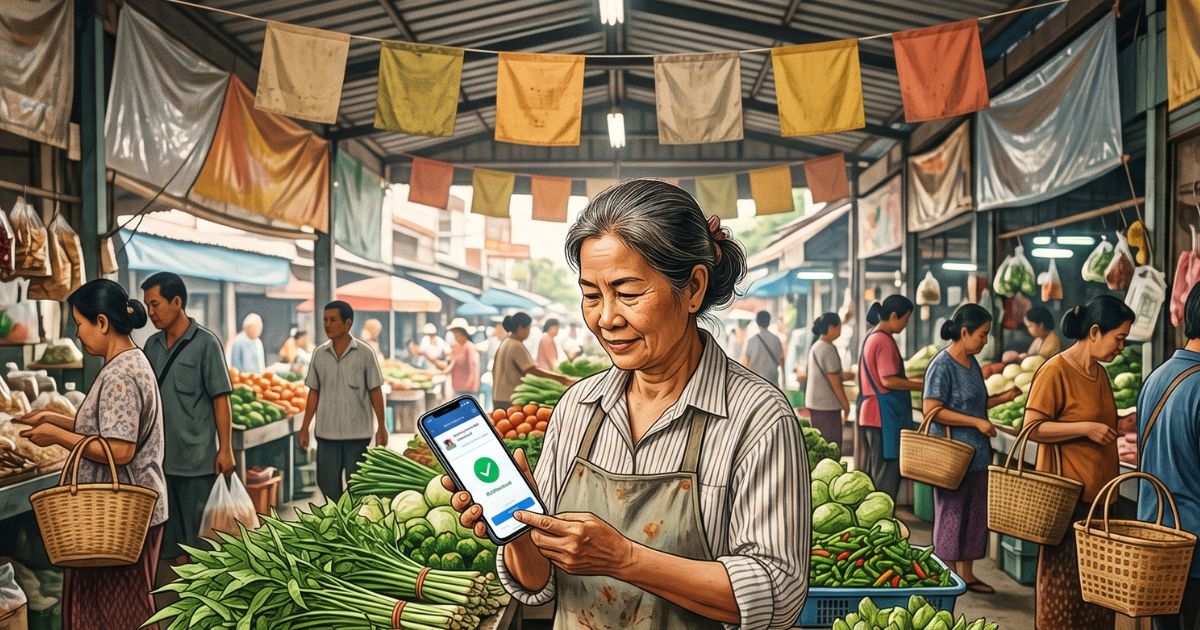
Merchants at Sirivattana Market gathered on Sunday morning with smartphones already open, working through the registration flow for the government’s latest co-payment stimulus: Thai Chuay Thai Plus. The scene carried the easy familiarity of a process vendors have done before, which is partly the point.
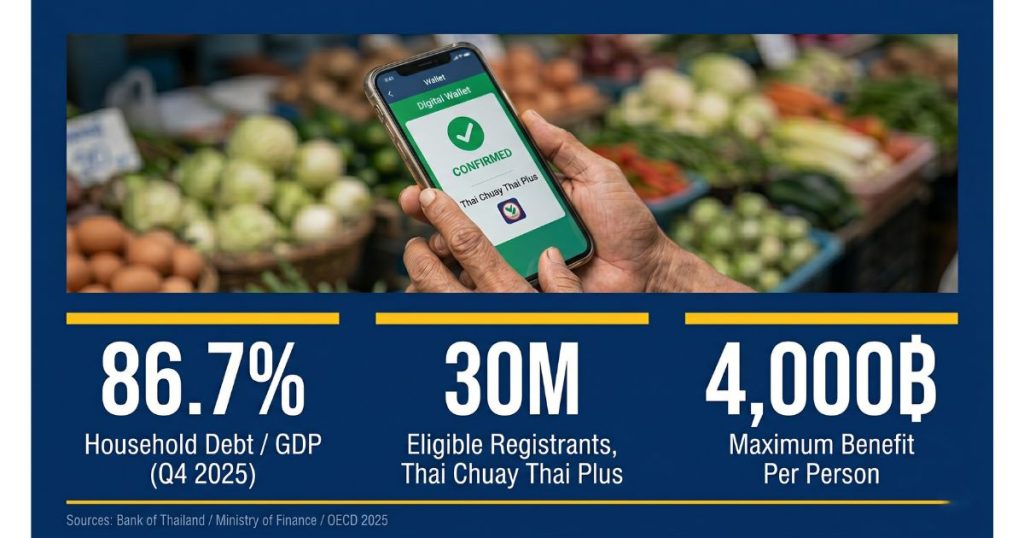
The programme, approved by Cabinet and set to run from 1 June 2026, offers registered participants up to 4,000 baht in subsidised spending across two four-month phases. Under the 60/40 co-payment model, the government covers 60 percent of each qualifying purchase, with the participant paying the remaining 40 percent. Registration runs via the Paotang application from 25 to 29 May 2026, open to Thai citizens aged 18 and above who do not already hold a state welfare card. Around 30 million people are expected to qualify under the co-payment category. State welfare card holders, approximately 13.2 million people, receive an additional 700 baht per month on top of their existing 300-baht monthly benefit.
Why vendor registration moved fast
Most merchants registering now participated in the previous Khon La Khrueng Plus (Half-Half Plus) scheme, which ran from October to December 2025 and recorded 84 billion baht in total spending before closing. Because those vendors are already set up on the Thung Ngoen merchant application within the broader Paotang infrastructure, onboarding is a matter of reactivation rather than learning a new system. Experienced traders at Sirivattana stepped in to help newer or older peers complete registration on their devices, a pattern seen at previous scheme launches and one that illustrates how deeply embedded government digital wallet tools have become in grassroots retail across Thailand.
For Suree Jinamun, a Sirivattana trader quoted by Chiang Mai Citylife, spending has felt heavy and quiet in recent months. The co-payment is expected to give residents the financial confidence to spend more freely on daily necessities. That reading is consistent with national data. Thailand’s household debt stood at 86.7 percent of GDP at the end of 2025, with outstanding borrowing reaching 16.44 trillion baht, and the SCB Economic Intelligence Center found that much of the recent increase was driven by personal consumption loans rather than housing or investment, a sign that many households are borrowing to cover day-to-day costs rather than building assets.
What the programme does for small vendors in practical terms
When consumer confidence contracts, the businesses hit first are independent food stalls, fresh market traders, and neighbourhood shops. These operators carry limited stock buffers, have no marketing budgets, and depend on daily foot traffic to cover supplier payments and operational costs. Larger convenience store chains and corporate supermarkets absorb lean periods more easily because they operate on tighter supply chains, maintain loyalty card infrastructure, and run promotional cycles that independent vendors cannot match.
Thai Chuay Thai Plus changes that equation temporarily. By channelling subsidy spending specifically through registered small businesses, the programme directs consumer cash away from the large chains and back into local markets. For vendors, the practical effects are two: immediate liquidity that allows them to pay suppliers and maintain stock, and a price advantage that gives shoppers a direct financial reason to visit traditional markets rather than branded retail.
Finance Minister Ekniti Nitithanprapas also noted that the programme will be enhanced with AI tools to help merchants analyse balance sheets, track income and expenses, and identify best-selling products, a feature that, if it reaches vendors at the grassroots level, would represent a meaningful step beyond simple cash transfer.
The structural argument the programme does not settle
The previous Khon La Khrueng schemes, which ran across five phases from 2020 to 2022 at a total budget of 234.5 billion baht, generated strong spending spikes during active periods. When the schemes ended, spending patterns returned to baseline. That cycle has repeated consistently, and Thai Chuay Thai Plus is launched into a macro environment that makes any spending recovery harder to sustain. The OECD projects Thailand’s GDP growth at 1.5 percent in 2026, down from an already subdued 2.0 percent in 2025, citing the effects of global trade disruption and weak domestic demand. The IMF has separately flagged Thailand’s fiscal deficit trajectory as high relative to peers at a similar credit rating, raising questions about how many more rounds of demand stimulus the government’s balance sheet can absorb without structural adjustment elsewhere.
Bangkok Post editorial commentary has framed the tension directly: at a time of elevated household debt, a Middle East-driven energy cost squeeze, and shrinking productivity growth, consumption stimulus addresses symptoms rather than causes. The same fiscal resources allocated to energy infrastructure, for example, would work on the cost problem that is compressing household budgets in the first place.
That debate sits above the level of the Sirivattana market vendor. For a trader managing daily inventory on thin margins, the mechanics of fiscal policy are secondary to whether customers come through the gate. Thai Chuay Thai Plus will bring customers through the gate, for two months.
Chiang Mai’s specific position
Chiang Mai’s retail and fresh market economy is more dependent on resident and domestic visitor spending than Bangkok’s, making locally targeted stimulus proportionally more useful here than in the capital. The city does not absorb consumer slack through the volume of tourist spending that coastal resort destinations rely on, and the northern Thailand labour market has seen consistent informal sector pressure in recent years. When household budgets tighten, local markets in Chiang Mai feel it quickly.
The approximately 1.5 million shops that previously participated in government subsidy programmes nationally are eligible to rejoin Thai Chuay Thai Plus, and the vendor familiarity with the Thung Ngoen and Paotang infrastructure means uptake in established markets like Sirivattana, Warorot, and Ton Payom should be swift. The real commercial question for Chiang Mai’s independent retail operators is the same one the data has posed after every previous scheme: what happens to foot traffic when the subsidy period ends in October, and whether any of the customer habits formed during the programme carry forward without the price incentive.
There is no evidence from prior iterations that they do, at scale. Building that kind of retention requires investment in market experience, product quality, and community programming that government stimulus neither funds nor replaces. Thai Chuay Thai Plus is a useful tool. It is not a strategy.
For a comprehensive directory of Chiang Mai’s registered markets, food vendors, and independent retailers, visit Golden Pages.
