
Let’s be honest. Most working Thais know they have to pay taxes. We all learned that much in our high school civics class. But every year, as tax season rolls around, so does a familiar mix of dread, avoidance, and creative “planning.”
For some, taxes aren’t just an obligation – they’re a game. The rule of the game? Find the loophole.
And when it comes to Thailand’s land and building tax, some landowners have found a loophole so clever – and in some cases, so edible – it’s hard not to laugh (and maybe even admire a little).
The Law (and the Loophole)
Under the Land and Building Tax Act of 2019 – which came into effect in early 2020 – landowners are taxed based on how they use their property:
- Agricultural land: Up to 0.15%
- Residential land: Up to 0.3%
- Commercial or industrial land: Up to 1.2%
- Vacant or unused land: Starts at 1.2%, increasing every 3 years by 0.3%, up to a cap of 3%
That means the longer your land sits empty, the more you pay, significantly more.
On paper, 3% might not sound like much. But if your land is worth 10 million baht, that’s 300,000 baht per year in taxes. And in Bangkok, where some land is valued at over 1 million baht per square wah (about 4 square meters), tax bills can climb into the millions.
Now compare that to land used for farming. That same 10-million-baht plot might only be taxed at 15,000 baht per year. The difference is striking.
The Lamyai Solution
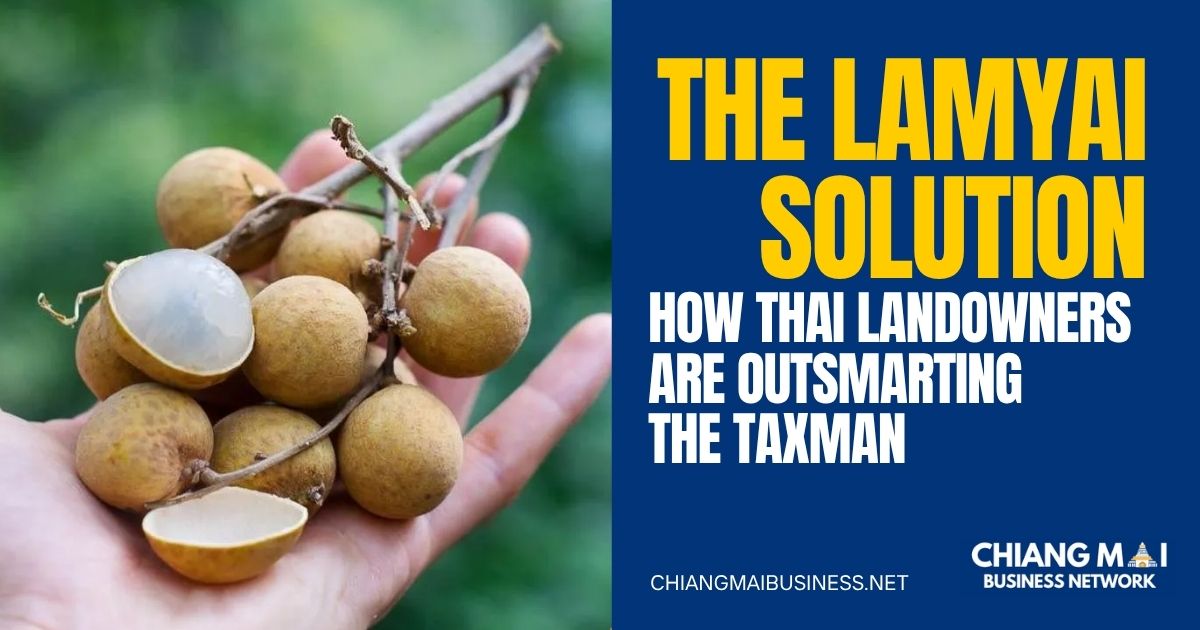
That’s where The Lamyai( Longan) trees come in. According to regulations from the Ministry of Agriculture, a plot can qualify as agricultural land if it contains at least:
- 200 banana trees per rai (about 1,600 square meters), or
- 20 trees per rai for fruit like durian, lychee, mango, longan or coconuts
So what did people do?
Simple: they planted. On expensive plots awaiting sale, especially in Bangkok and other high-value areas, landowners began growing just enough crops to technically qualify for the agricultural tax rate.
Let’s do the math. If you own one rai of land in Bangkok – generously valued at 200,000 baht per square wah – that’s an 80-million-baht property. At the full 3% vacant land tax, you’d owe 2.4 million baht per year. But if you grow a few longan trees, pay a caretaker, and water them occasionally, say for 1 million baht a year in costs, your new tax bill drops to around 120,000 baht.
That’s a savings of 1.28 million baht per year. Not bad for a fruit farm that might never produce a single smoothie.

Is It Legal? Technically, Yes.
What makes this all so brilliant – or infuriating, depending on your view – is that it’s not illegal. It’s just clever use of the system.
And it’s clever enough that the government is now taking notice.
While there haven’t been official amendments to the law yet, the Finance Ministry has signalled that it’s tightening its criteria. Local authorities have been given more discretion to determine whether agricultural activity is genuine or just for show.
A Matter of Ethics — and Perspective
Paying taxes is a duty, yes. But knowing your rights, and how to use the system legally, is also part of being an informed citizen. Just because something feels sneaky doesn’t make it unlawful.
That said, this workaround does raise valid concerns: is it fair for wealthy landowners to pay less tax than others, just because they can afford to game the system?
Maybe not. But from another point of view, it’s also a reminder that if the government doesn’t build smart laws, smart people will build workarounds.
A Bit of Genius — and a Bit of Mischief
Personally, I find the whole situation strangely impressive – even funny. There’s something surreal about watching a government trip over its own rules, while longan trees sprout on multimillion-baht plots of urban land.
So next time you’re on the BTS or driving over a flyover and spot an oddly placed “garden” in the middle of a city block, don’t be too quick to judge. That might just be the work of someone bold, resourceful, and quietly rebellious.
Tip your hat silently: “Respect, my friend. You’re not just growing fruit. You’re bending the system — one longan tree at a time.”

Worawee Saikhum is a Chiang Mai–based writer and content creator currently studying Integrated Journalism at Chiang Mai University. With a strong foundation in research and storytelling, he explores a wide range of topics through a clear, structured lens. Outside of writing, Worawee is passionate about music — particularly classical and vocal performance — which continues to shape his creative rhythm and sense of narrative.


