
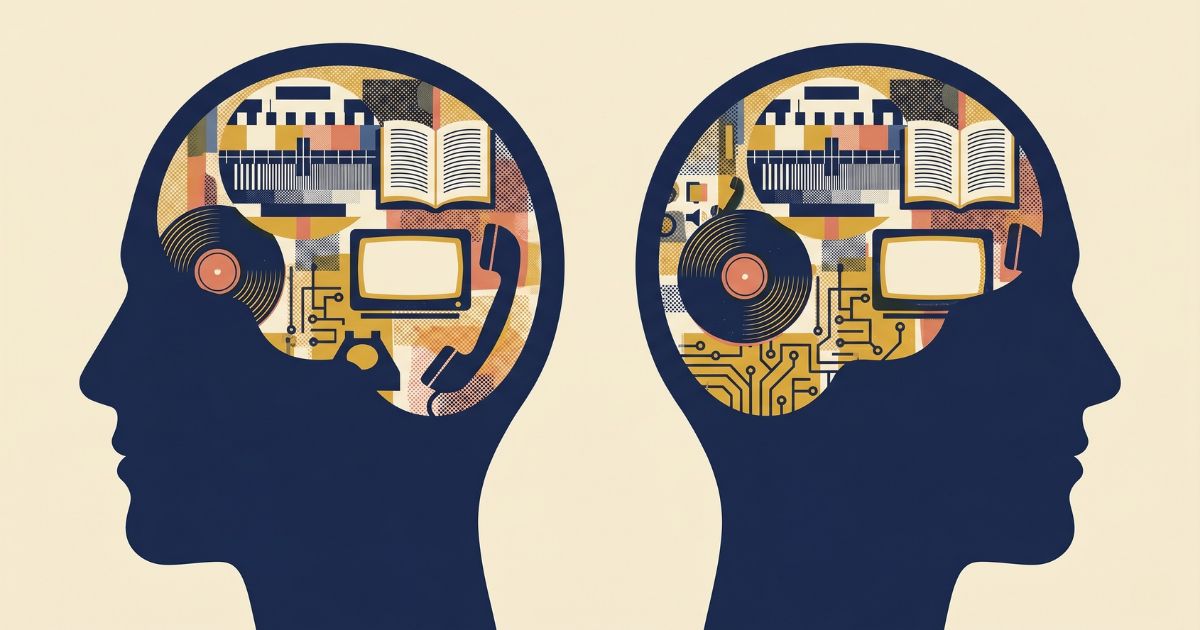
In 1964, a Canadian professor of English literature published a book arguing that everyone was paying attention to the wrong thing. Marshall McLuhan said that when a new medium arrives, we fixate on what it carries and ignore what it does. We argue about what is on television and miss what television is doing to the room, the family, the city, the century.
His phrase for this was the medium is the message. The content of any medium is a distraction. The real story is the way the medium itself reorganises human attention, social structure, and thought.
McLuhan died in 1980. He never saw a personal computer become a household object. He never saw the internet, the smartphone, or a large language model. But his framework is the most useful tool we have for thinking about what AI is doing to us, because it forces a question almost nobody in the AI conversation is asking.
Not what AI produces. What AI does to the producer.
The content is a decoy
Most of the public conversation about AI is a conversation about output. Is the essay any good. Is the code correct. Is the image original. Is the answer true.
McLuhan would call this a category error. He would point out that we did the same thing with television. We spent fifty years arguing about whether the programmes were any good and missed the fact that the act of watching television, regardless of what was on, was rewiring civic life, attention spans, political campaigning, and the architecture of the home.
The content of AI is the decoy. The message of AI is what happens to a human being who spends an hour a day in conversation with a machine that produces fluent language on demand. The message is what happens to a writer who no longer writes first drafts. The message is what happens to a student who no longer struggles with a blank page. The message is what happens to a workforce in which the bottleneck task of articulating an idea has been removed.
That is the story. The chatbot output is the noise.
Extension and amputation
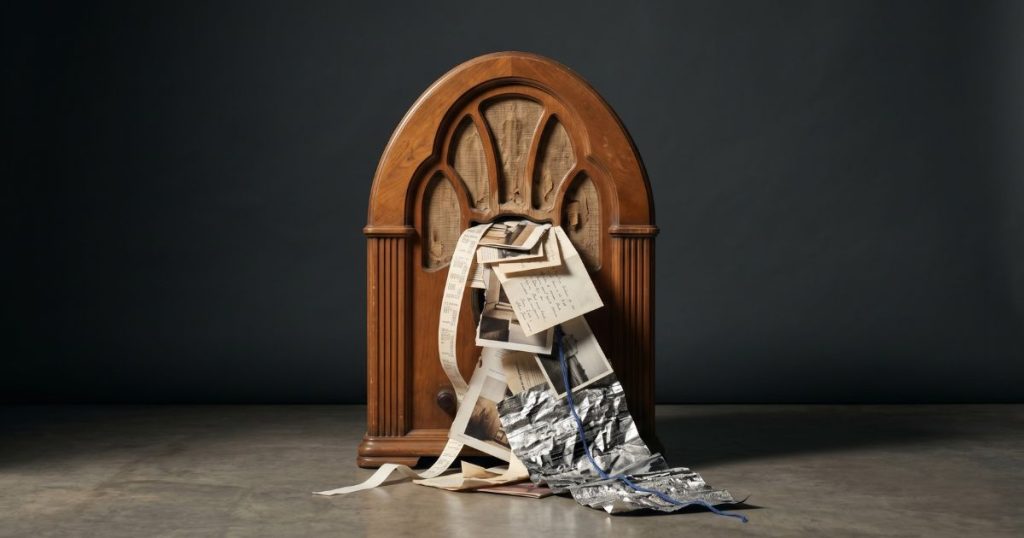
McLuhan’s second move was to argue that every medium extends a human faculty and numbs the one it replaces. Writing extended memory and atrophied oral recall. The car extended the foot and atrophied the act of walking. Television extended the eye and atrophied the imagination required to picture a scene from a book.
The pattern is consistent. Every extension is also an amputation.
Apply this to AI honestly. AI extends cognition, articulation, synthesis, recall, and a growing share of creative judgement. The corresponding amputation is the capacity to do those things unassisted. The capacity to sit with a blank document and construct a sentence from nothing. The capacity to hold a problem in mind long enough to reason through it. The capacity to remember without retrieving.
This is not a moral claim. McLuhan was not a moralist about media. He was a diagnostician. The diagnosis is that whatever AI does for us, we will become measurably worse at doing for ourselves, and the loss will arrive without anyone announcing it.
Hot and cool, scrambled
McLuhan classified media as hot or cool. Hot media are high-definition and demand low participation. Film, radio, a printed book. The medium delivers a finished thing and the audience receives it. Cool media are low-definition and require the user to fill in the gaps. Television in his era, the telephone, conversation itself.
AI does not fit either category. The output is hot. It arrives polished, dense, finished-looking, and confident. The interface is cool. It is conversational, requires the user to prompt and refine, and leaves the participant feeling like a collaborator.
This hybrid is the source of AI’s cultural traction. It feels like dialogue while delivering monologue. The user experiences authorship while consuming finished product. McLuhan would find this combination both fascinating and dangerous, because it produces a particular kind of confidence in the user that the user has not earned.

A return to the oracle
McLuhan was preoccupied with the way electric media were ending the 500-year reign of print. Print created a particular kind of human being: silent, private, linear in thought, capable of holding a long argument across many pages. Electric media, he argued, were dismantling that human being and returning us to something older. Tribal, oral, simultaneous, communal.
AI accelerates this dramatically. Knowledge is no longer something we retrieve from a fixed text in silence. It arrives through conversation with a presence that speaks back. This is the structure of oral culture, not literate culture. Consulting an AI is closer to consulting the oracle at Delphi than reading a book.
That shift is not trivial. The literate mind, the one shaped by five centuries of reading printed pages alone, is the mind that built modern science, modern law, modern accounting, and modern public administration. Replacing the act of reading and writing with the act of asking and receiving is not a productivity upgrade. It is the partial undoing of the cognitive infrastructure of modernity.
The village speaks back to itself
McLuhan coined the phrase global village to describe how electric media collapsed distance and produced an involuntary intimacy among strangers. He did not mean it as a hopeful phrase. He thought the global village would be loud, anxious, tribal, and prone to conflict. He was right about that, decades before social media made the case for him.
AI is the global village speaking back to itself. A large language model is trained on the collective written output of humanity, including every argument, every grievance, every consensus, and every contradiction. When it responds, it is the village reflecting its own voice. There is something both intimate and uncanny about this, and the long-term cultural effects are not yet visible.
The ground, not the figure
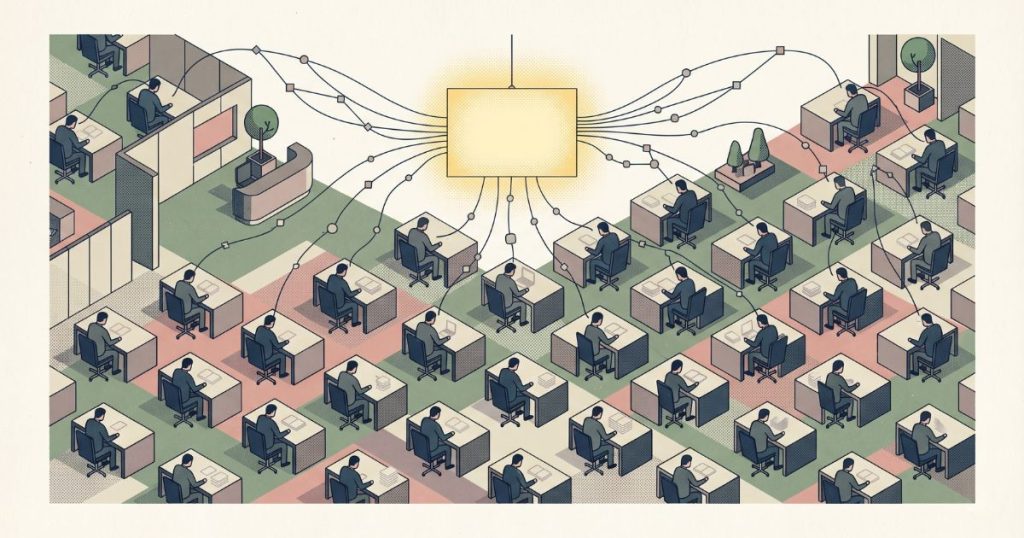
Late in his life, McLuhan refined his framework with a distinction between figure and ground. The figure is the thing in front of you. The ground is the environment that thing creates around itself. You cannot understand a medium by staring at the figure. You have to look at the ground.
The figure of AI is the chatbot, the image generator, the coding assistant, the meeting summariser. The ground is something larger. A working environment in which the provenance of any sentence, image, or argument is unknowable. A creative economy in which the distinction between human and machine output stops being useful. A market in which the cost of producing a passable version of almost anything approaches zero, and the value of being the one human in the room who can still do the thing without help becomes either negligible or enormous.
That environmental shift is the message of AI. It is not contained in any specific product. It is the room those products are building around us while we are looking the other way.
What this means for businesses watching from Chiang Mai
The businesses operating in this city, like businesses everywhere, are being sold AI tools by vendors who want to talk about features and outputs. Productivity gains. Cost savings. Faster turnaround. Better customer service.
McLuhan would tell them to ignore the sales pitch and watch the room. The relevant question for any business leader is not whether AI can do the task. It is what kind of organisation, workforce, and customer relationship the use of AI will produce over five years.
A team that drafts every email with AI will, eventually, contain people who cannot draft an email without it. A customer service operation that routes every enquiry through an AI layer will, eventually, lose the institutional knowledge that came from humans answering those enquiries. A creative agency that generates every concept with AI will, eventually, find that its competitive edge has migrated to the prompt and away from the craft.
None of this is an argument against using AI. It is an argument for using it with eyes open. The medium is the message. The message is the kind of organisation you become.
The last generation that will remember what the previous environment felt like is the one running businesses right now. That is worth thinking about before the memory fades.
About Marshall McLuhan
Marshall McLuhan (1911 to 1980) was a Canadian professor of English literature at the University of Toronto who became, almost by accident, the most influential media theorist of the twentieth century. His central insight, that the form of a medium shapes society more profoundly than any content it carries, was treated as eccentric in the 1950s, prophetic in the 1960s, and obvious by the 1990s. He coined the phrases the medium is the message and the global village, both of which entered common use long before the technologies they described arrived.
McLuhan worked at the intersection of literary criticism, sociology, and what would later be called media studies. He spent most of his career at the Centre for Culture and Technology in Toronto, which he founded in 1963. His public profile peaked in the late 1960s, including a memorable cameo in Woody Allen’s Annie Hall, before his ideas fell out of fashion in the 1980s and returned to relevance with the arrival of the internet.
Core reading
The Gutenberg Galaxy (1962). The book that established his argument about how the printing press created the modern individual. Dense, scholarly, foundational.
Understanding Media: The Extensions of Man (1964). The most cited of his works. Contains the medium is the message, the hot and cool distinction, and the extension and amputation framework. The single best entry point.
The Medium is the Massage (1967, with designer Quentin Fiore). A short illustrated paperback that compresses his thinking into a visual experience. Reads in an afternoon. Still in print after sixty years for good reason.
War and Peace in the Global Village (1968, with Quentin Fiore). His most pessimistic book, arguing that the global village would be a place of conflict rather than harmony. Worth reading now.
Further listening and viewing
The 1977 ABC television interview with McLuhan, widely available online, remains the clearest record of how he spoke and thought in person. The McLuhan Centre at the University of Toronto continues to publish lectures and archive material at https://mcluhancentre.ca.
One sentence to take away:
We shape our tools and thereafter our tools shape us.
