It is tax filing season, and for many people this is the time when questions start to come up. Why is this amount being deducted from my salary? Why does it change during the year? And how exactly does my employer calculate the tax they withhold every month?
In Thailand, income tax is not something you calculate only once a year. For employees, tax is deducted at source by the employer, month by month, under rules set by the Revenue Department. This means the figures on your payslip are not arbitrary. They are based on a defined formula that uses progressive tax brackets and assumes a full year of income.
Understanding how this system works makes it much easier to read your payslip, check your annual tax certificate, and avoid surprises when you file your personal tax return. It also helps explain why employers are strict about deductions, and why “tax-free” salary arrangements often do not work the way people expect.
Below is a practical explanation of how tax deducted at source is calculated in Thailand, what your employer is legally required to do, and why the system is designed the way it is.
Under the Thai Revenue Code, the obligation to withhold tax at source is a legal duty of the employer. This means that your employer will deduct tax from your salary based on a simple formula as depicted in the image below. It takes in progressive tax rate lofts as you hit them. The progressive rates are official; the effective % varies person to person. For the case below with an 85’000 THB monthly income the WHT deducted is about 9%.
Your Employer reports and pays the deducted WHT to the Revenue office monthly. At the end of the year, you get a tax statement showing the full amount of tax your Employer has paid on your behalf.
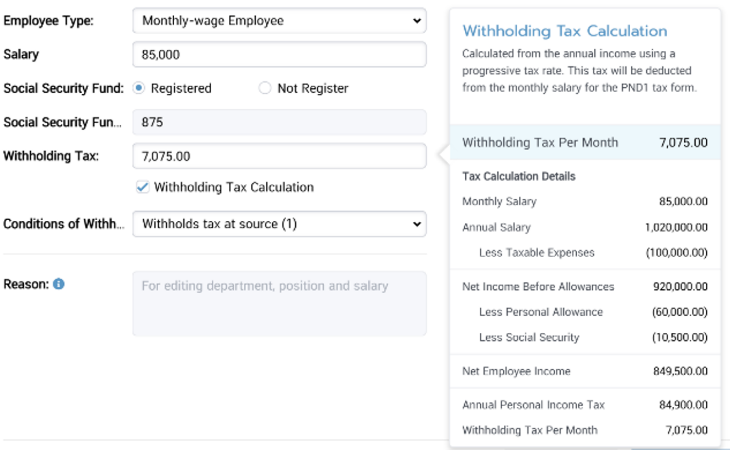
The example is based on a full year of income. If you started working here in the middle of the year the tax would be lower for the 6 months. Not always, as it also depends on things like bonuses or commission payments.
The Legal Obligation
According to Section 50 of the Revenue Code, any person or company paying assessable income (salary, wages, etc.) must deduct income tax at the time of each payment.
Employer Liability: If your employer agrees to pay you the full amount without deducting tax, they become personally liable for the unpaid tax, plus a surcharge of 1.5% per month on the outstanding amount.
No Employee Waiver: Even if you sign a waiver or an agreement saying you will handle your own taxes, the Revenue Department does not recognize it. They will still fine the employer for failing to withhold.
Are there any exceptions?
While you cannot opt out of the system, there are two scenarios where you might see “zero” deducted:
Below the Threshold: Thailand has a tax-exempt bracket for the first 15’,000 THB of net annual income. If your salary is low enough the calculated tax might be zero. In this case, the employer still “files” the form but with a 0 THB deduction.
Contractor vs. Employee: If you are hired as an independent contractor (Service Provider) rather than an employee, the rules change. Contractors are usually subject to a flat 3% withholding tax (under Section 40(2) or 40(8)). However, for individuals, even this 3% is technically mandatory for the payer to deduct if the payment exceeds 1’000 THB.
Why the system is so strict
The Thai Revenue Department applies Withholding Tax very strictly because it is one of its most effective enforcement tools. From the authorities’ perspective, it is far easier to ensure tax is collected by requiring one payer to withhold and remit tax than by relying on hundreds of individual taxpayers to declare their income accurately. At the same time, withholding creates a clear and traceable paper trail through documents such as the 50 Tawi certificate. This makes it difficult for income to be hidden or overlooked when individuals file their annual tax returns, and it gives the Revenue Department a reliable way to reconcile what was earned with what was declared.
What about “Tax-Free” Salaries?
You may also hear people talk about “tax-free” or “net” salary packages, where the company agrees to pay the tax on the employee’s behalf. In practice, there is no such thing as a tax-free salary once your taxable annual income exceeds 150’000 THB.
What actually happens is this: the Revenue Department treats any tax paid by the employer as additional income to the employee. Your salary is effectively “grossed up” to include the tax amount. On your payslip, you will still see tax being deducted, but the cost is carried by the company rather than coming out of your pocket.
So, while a net salary arrangement can make cash flow easier for the employee, it does not remove the tax obligation nor does it make the income tax-free.
Conclusion
Tax deducted at source in Thailand can feel complicated, but the principle behind it is simple. The Revenue Department wants tax to be collected steadily throughout the year, using employers as the point of control, rather than relying on individuals to reconcile everything at the end. Once you understand that, your payslip, annual tax certificate, and final tax filing start to make a lot more sense.
For most employees, the tax deducted each month is an estimate based on a full year of income. When your annual return is filed, the numbers are reconciled. Sometimes you will have paid exactly the right amount. Sometimes there is a refund. Sometimes there is a small top-up to pay. None of this means something went wrong. It is simply how the system is designed to work.
If you are an employer, the responsibility is heavier. Payroll, withholding tax, social security, reporting, and documentation all sit with you, and mistakes can be costly. If you are an employee, filing your annual return correctly is just as important, especially if you have changed jobs, started mid-year, or have additional income.
If you would like help managing employee payroll, withholding tax, and statutory reporting, or if you want support filing your 2025 personal income tax return, LAN Business Consulting can help ensure everything is calculated, reported, and filed correctly, giving you peace of mind and one less thing to worry about during tax season.