Social Security wage ceiling increase effective immediately
Effective January 1st a new ministerial regulation has been issued to adjust the maximum wage ceiling for calculating Social Security Fund contributions for employees covered under Section 33 of the Social Security Act.
The increase to the maximum wage base used for calculating Social Security Fund contributions will be implemented in three phases, as outlined below:
| Period | Monthly wage ceiling | Max. monthly contribution – Employer | Max. monthly contribution – Employee | Total max. monthly contribution |
| Before 2026 | 15,000 | 750 | 750 | 1,500 |
| 2026–2028 | 17,500 | 875 | 875 | 1,750 |
| 2029–2031 | 20,000 | 1,000 | 1,000 | 2,000 |
| From 2032> | 23,000 | 1,150 | 1,150 | 2,300 |
Why is this happening
For many years, Thailand’s social security contributions have been calculated using a maximum salary ceiling of THB 15,000, despite steady increases in actual wage levels driven by economic growth and labour market changes.
To better reflect current wage realities and strengthen social security protection, the government has decided to raise the salary ceiling while keeping the contribution rate unchanged at 5% of salary, shared equally between employer and employee.
Here is how the Thai SSF stacks up against other national social services
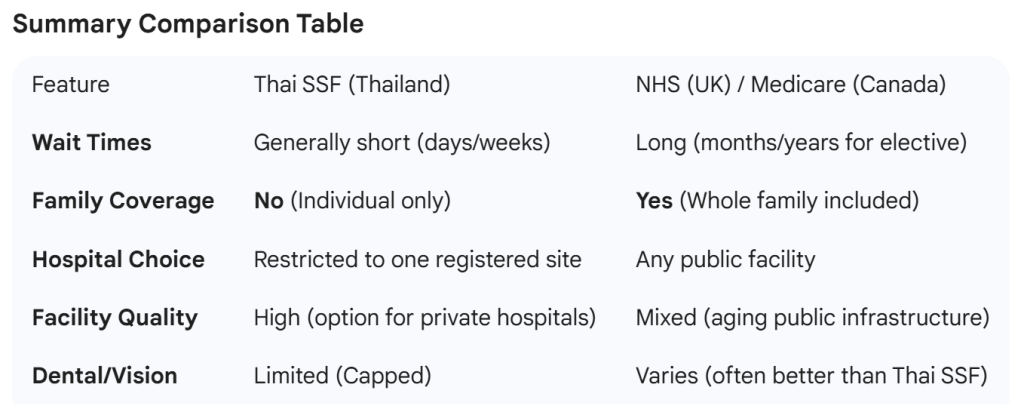
When compared to Western national health systems like the UK’s NHS, Canada’s Medicare, or Australia’s Medicare, the Thai Social Security Fund (SSF) is a high-performing but different model. It is often described as a “dual-tier” success story: it provides world-class efficiency and speed, though it lacks some of the “cradle-to-grave” breadth found in Europe.
Speed and Accessibility
Wait Times: While the UK (NHS) and Canada are currently struggling with months-long waiting lists for elective surgeries (like hip replacements or cataracts), the Thai SSF system generally moves much faster. Even in public hospitals, you can often see a specialist within days or weeks, rather than months.
Specialist Access: Thailand has a high density of specialists. While the West emphasizes the “GP Gatekeeper” model (you must see a local doctor before a specialist), the Thai system is more direct, though SSF users are still tied to their registered hospital for full coverage.
Cost and Funding Model
Contribution: The Thai SSF is a tripartite system (Employee + Employer + Government). In Western countries, healthcare is usually funded entirely through general taxation (UK) or a specific levy (Australia’s 2% Medicare Levy).
Out-of-Pocket Costs: Like the NHS, the Thai SSF is “free at the point of use” for almost all treatments at your registered hospital. However, Thailand’s dental coverage is more limited (capped at 900 THB/year) compared to the more comprehensive (though often hard to find) dental subsidies in parts of Europe.
Scope of Coverage (The “Safety Net”)
Dependents: This is a major difference. In the UK, Australia, and Canada, your “national health” coverage automatically includes your unemployed spouse and children. In Thailand, the SSF only covers the individual employee. Your family must rely on the “Universal Coverage Scheme” (the 30-baht scheme), which is excellent but has different administrative hurdles.
Portability: In Western countries, you can generally walk into any public hospital in the nation. Under the Thai SSF, you are tied to one specific hospital you chose during registration. If you go elsewhere for a non-emergency, you usually have to pay out of pocket and claim a limited reimbursement later.
Quality of Facilities
The Private-Public Hybrid: A unique feature of the Thai SSF is that you can often choose a private hospital as your primary SSF provider. This is rare in the West. If you register at a top-tier private hospital in Bangkok under SSF, the facility quality (waiting rooms, technology, service) often exceeds the aging infrastructure of the UK’s NHS.
Technology: Thailand’s major urban hospitals (both public and private) are equipped with the latest diagnostic tech (MRI, CT) that rival or exceed those in Western regional hospitals.
Thai Healthcare & Medical Benefits
This is often considered the most immediate benefit. You are entitled to free medical care at your registered hospital.
Medical Treatment: Covers outpatient (OPD) and inpatient (IPD) services, including surgery and medicine.
Dental Care: Reimbursement up to 900 THB per year for scaling, fillings, or extractions.
Health Screening: Access to annual physical check-ups and certain vaccinations.
Income Replacement (Sickness & Disability)
If you are unable to work due to illness or injury (non-work related), you can claim compensation.
Sickness: You receive 50% of your average wage. Starting in 2026, the maximum monthly payout increases from 7,500 THB to 8,750 THB.
Disability: If deemed disabled, you receive a monthly allowance for life (or a set period). For severe disability, this is 50% of your wage, now capped at 8,750 THB/month under the new ceiling.
Maternity & Child Allowance
Maternity Grant: A lump-sum payment per birth. In 2026, this increases from 22,500 THB to 26,250 THB.
Maternity Leave Pay: Female employees receive 50% of their average wage for 90 days.
Child Allowance: A monthly subsidy of 800 THB per child (for up to 3 children) until the child reaches 6 years of age.
Unemployment Benefits
If you lose your job, the SSF provides a safety net while you search for a new one.
Resignation: You receive 30% of your wage for up to 90 days.
Termination (Laid off): You receive 50% of your wage for up to 180 days.
Note: In 2026, the maximum monthly unemployment benefit rises to 8,750 THB.
Retirement (Old-Age Pension)
This benefit depends on how long you have contributed:
Pension (180+ months): A monthly payment for life. The base rate is 20% of your average salary over the last 60 months.
2026 Update: For 15 years of contribution, the minimum pension increases to 3,500 THB/month. For 25 years, it increases to 6,125 THB/month.
Lump Sum (<180 months): If you retire or leave the system before 15 years, you receive a one-time payment of your total contributions plus interest.
Death Benefits
In the event of an employee’s death, the fund provides:
Funeral Grant: A fixed amount of 50,000 THB.
Survivor Allowance: A lump sum for the family. In 2026, the maximum survivor benefit increases from 90,000 THB to 105,000 THB.
And remember these benefits are afford to anyone who is registered whether you are paying SSF on a 10K salary or a 30K salary.