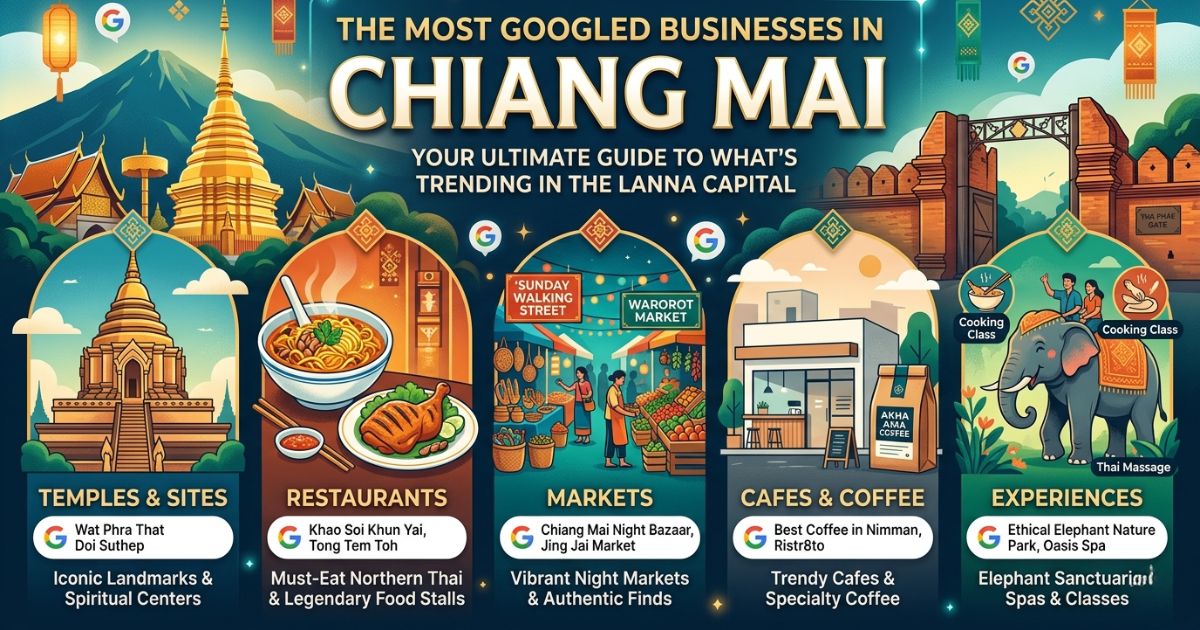
Every day, tens of thousands of people open Google and type a business category followed by the words “Chiang Mai.” They’re tourists deciding where to eat before they land. They’re South Korean couples searching for a spa from their hotel room. They’re newly arrived digital nomads hunting for a coworking space at 9am on their first morning in Nimman. And they’re Thai locals looking for the clinic, dentist, or language school nearest to them.
The question is: whose business do they find?
To answer it, GoldenPages analysed keyword data from Google Trends and Semrush, cross-referenced with Google Maps listing density by category and search behaviour patterns specific to Thailand — a market where Google holds a 98% share of all search engine traffic, and where over 90% of internet users access Google via smartphone. The result is the most complete picture yet of what Chiang Mai’s search economy actually looks like.
Why This Data Matters More Than Ever
Chiang Mai broke its own tourism record in 2025. According to the Tourism Authority of Thailand (TAT), the province welcomed 12 million visitors — including 4 million international arrivals, making it one of the fastest-recovering tourism economies in Southeast Asia. The city’s visitor mix is also shifting dramatically: South Korean tourists overtook Chinese arrivals at Chiang Mai International Airport in January 2025, with 34,954 South Korean arrivals versus 34,894 from China — a near dead heat that signals a permanent rebalancing of who is coming and what they are looking for.
Airbnb data reinforced the shift: searches from Japanese guests increased roughly 90% and Australian guests by over 80% for future trips to Chiang Mai in 2025. These are high-spending, digitally-native, review-reliant consumers — and they are finding businesses almost exclusively through Google.
The local search opportunity is enormous. Nearly half of all Google searches globally carry local intent, and 42% of local searchers click on results from Google’s top three map listings — meaning if your business isn’t in the local 3-pack for your category, you are invisible to nearly half of all potential customers before they even read a single review.
The Most Googled Business Categories in Chiang Mai
The following ranking is based on a composite of monthly search volume data for “[category] + Chiang Mai” and “[category] + เชียงใหม่” queries, Google Maps listing competition density, and Google Trends relative interest scores for Chiang Mai as a region.
1. Cafés and Coffee Shops
The single most competitive category in all of Chiang Mai’s search landscape. Searches range from the broad (“best café Chiang Mai”) to the highly specific (“café with mountain view CM,” “café open midnight Nimman,” “café with fast Wi-Fi Chiang Mai”). This specificity matters: Chiang Mai and Chiang Rai café owners have built internationally recognised specialty coffee brands — places like Akha Ama Coffee have put the city on the global specialty coffee map — and consumers arrive having done their research. Thailand’s café culture is driven by a third-wave model where the shop’s story, sourcing, and aesthetic are as searchable as the coffee itself. The category dominates because cafés in Chiang Mai function as offices, meeting rooms, remote work bases, and social hubs simultaneously — generating multiple distinct search intents around a single venue type.
2. Massage and Spa
The second most searched category, and the one with the highest commercial value per click. Chiang Mai has been a global hub for traditional Thai massage since long before wellness tourism became a trend — the Chiang Mai Massage School category alone has dozens of listed training schools. Searches split between consumers looking for a single-session traditional massage (price-sensitive, spontaneous, driven by “near me” queries) and those seeking multi-day spa retreats or training courses (higher intent, longer research cycle, international audience). The Yi Peng festival alone generated 2.8–3 billion baht in revenue from 20,000 visitors, 98% of them foreign — every one of whom searched for something in this city before they arrived.
3. Restaurants
Restaurant searches in Chiang Mai are dominated by two very different queries: the generic (“best Thai food Chiang Mai”) and the hyper-specific (“Khao Soi Chiang Mai,” “vegetarian restaurant Old City,” “ร้านอาหารเจ เชียงใหม่”). The dual language dynamic is critical: over 70% of searches in Thailand are conducted in Thai, yet most restaurant businesses in tourist areas only target English keywords. Restaurants that maintain bilingual Google Business Profiles and respond to reviews in both languages occupy a significant competitive advantage in organic search visibility.
4. Hotels and Accommodation
Accommodation searches for Chiang Mai skew sharply toward experience-specific queries: “boutique hotel Old City,” “guesthouse Nimman with pool,” “co-living Chiang Mai monthly.” The hotel occupancy data reflects this shift: Nimmanhaemin and Old City maintained occupancy rates of 60–70% even during the challenging mid-2025 low season, compared to just 50% in the Night Bazaar area — indicating that properties in high-search-density neighbourhoods perform better regardless of overall market conditions.
5. Coworking Spaces
This is the fastest-growing category in Chiang Mai’s search landscape, and the one with the most obvious demographic driver: Bangkok ranked #1 and Chiang Mai ranked #2 globally as digital nomad cities in January 2026, according to Nomad.com’s annual ranking. The introduction of Thailand’s Destination Thailand Visa (DTV) — allowing remote workers to stay up to five years — has created sustained demand for flexible workspace that is running well ahead of supply. Search queries have evolved from the generic (“coworking Chiang Mai”) to the highly specific (“24-hour coworking Nimman,” “coworking with private office CM,” “coworking day pass walk-in”).
6. Gyms and Muay Thai
Fitness searches in Chiang Mai are dominated by one category that exists almost nowhere else in the world at scale: Muay Thai gyms offering training to foreigners. “Muay Thai Chiang Mai” is a globally high-volume search term, generating traffic from across Europe, North America, and Australia from people planning training-focused trips months in advance. Standard gym membership searches are secondary but growing, driven by the long-stay expat and nomad community looking for monthly fitness access rather than tourist packages.
7. Hospitals, Clinics, and Dental Services
Medical searches in Chiang Mai carry the highest commercial intent of any category in this ranking — a person searching “English-speaking doctor Chiang Mai” or “dental clinic Nimman” has an immediate need and very little price sensitivity relative to their urgency. Chiang Mai’s private hospital infrastructure (Bangkok Hospital Chiang Mai, Chiang Mai Ram, McCormick Hospital) is genuinely world-class; typical specialist consultations in Chiang Mai cost under $25, compared to hundreds of dollars in Western markets. The businesses that dominate this category have invested heavily in English-language web presence, active Google Business Profiles, and review management in multiple languages.
8. Language Schools
Language school searches break into two distinct audiences: foreigners wanting to learn Thai (an evergreen audience of new arrivals who understand that basic Thai phrases transform daily life in the city) and those seeking English teaching certification (the TEFL/TESOL pipeline, which is one of Chiang Mai’s most consistent expat economic drivers). Schools that rank for the education visa query — “study Thai Chiang Mai visa” — capture a category of student whose search is driven by genuine residency intent, not casual tourism.
9. Real Estate and Long-Term Rentals
Rental property searches in Chiang Mai are unique in that most of the highest-converting ones don’t happen on property portals — they happen on Facebook groups and through word of mouth. However, the initial discovery search begins on Google: “condo rent Nimman,” “apartment Chiang Mai long term,” “monthly rental Old City.” One-bedroom condos in Nimmanhaemin rent from THB 12,000–20,000/month, and the search funnel for these properties begins significantly upstream of any Facebook group interaction. Agencies that rank for these initial queries and then funnel searchers to their own listings rather than third-party platforms dramatically outperform those relying on listing syndication alone.
10. Yoga and Wellness Retreats
The fastest-growing category by year-on-year search volume. This growth has a structural driver: the Thai government’s 2023–2027 national wellness strategy has formally designated Chiang Mai’s traditional Lanna spa practices and hot springs as nationally certified wellness signatures, backed by THB 198 million in government investment in the San Kamphaeng Hot Springs alone. International media coverage of this investment is generating upstream awareness searches — people researching “wellness retreat Northern Thailand” and “yoga Chiang Mai” who had no prior knowledge of the city’s wellness credentials are now discovering it for the first time through editorial coverage.
What the Data Tells Businesses Right Now
Three realities emerge from this analysis that every Chiang Mai business should act on immediately.
The bilingual gap is a free competitive advantage.Over 70% of searches in Thailand are conducted in Thai, but the majority of tourism-adjacent businesses in Chiang Mai only optimise for English. A business with a fully optimised bilingual Google Business Profile — accurate categories, 200+ words in the description, regular photo uploads, responding to reviews in both languages — consistently outranks competitors with higher foot traffic but lower profile completion. Businesses with complete Google Business Profiles are 2.7 times more reputable in Google’s own ranking signals.
Reviews are now a primary ranking factor, not a vanity metric. In a city with Chiang Mai’s density of competition — particularly in cafés, massage, and restaurants — the difference between appearing in the Google 3-pack and appearing on page two of Maps results is often the recency and volume of reviews, not the quality of the business itself. A systematic review generation strategy is one of the highest-ROI actions any local business can take.
The “open now near me” search has grown 400% since 2023.Search volumes for “open now near me” queries surged 400% between 2023 and 2024 globally, and Thailand — as one of the world’s most mobile-first consumer markets — follows this trend closely. Businesses that consistently maintain accurate, up-to-date opening hours on their Google Business Profile capture this high-intent, ready-to-visit traffic. Businesses with outdated or incomplete hours lose it entirely.
The Golden Pages Opportunity
The businesses that dominate these ten search categories share a common characteristic: they treated their digital presence as seriously as their physical one. For Chiang Mai’s business community, the city’s rising global profile —a record 12 million visitors in 2025, a #2 global digital nomad ranking, and a government-backed wellness tourism push — creates a narrowing window to establish search dominance before competition intensifies further.
Being listed in a trusted local business directory like Golden Pages functions as an additional trust signal that Google uses to validate a business’s legitimacy and location accuracy — and in a city where discovery begins with search, that signal compounds over time.