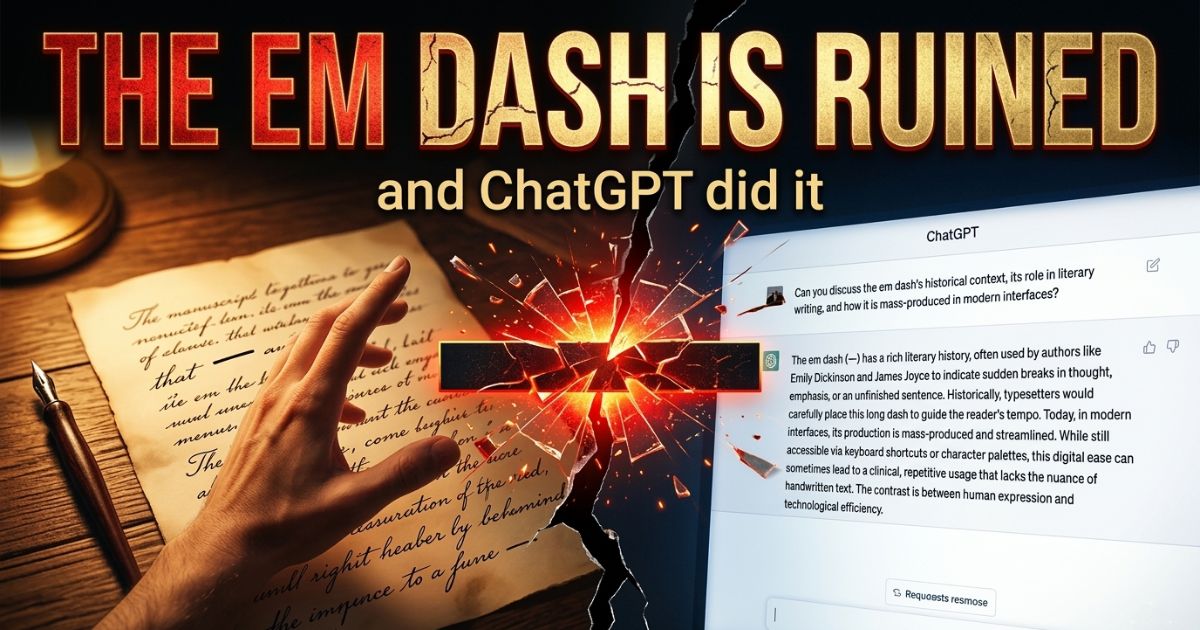
I always used the em dash. It was, for me, one of the most useful tools in written English — a mark that could hold a thought mid-flight, pivot without warning, or land a point with more weight than a comma ever could. I used it deliberately, sparingly, and with intent. It felt precise.
Then ChatGPT arrived…..
A Brief History of the Mark
The em dash has been part of written English for centuries. It takes its name from its width — equal to the letter ‘m’ in typeset text — distinguishing it from the shorter en dash (the width of ‘n’) and the humble hyphen. Early typesetters used it to indicate pauses, interruptions, and abrupt shifts in thought. It appears in the work of Emily Dickinson, who used it so frequently and idiosyncratically that it became a defining feature of her poetry — nearly 1,800 dashes across her body of work, each one doing something a full stop or comma could not.
Jane Austen used it for narrative aside and irony. Charles Dickens used it for dramatic interruption. Henry James, never accused of brevity, used it to hold subordinate thoughts inside larger ones without breaking the sentence apart. In American literature, the em dash found particular favour — looser, more conversational, more willing to let a sentence breathe mid-way through.
In formal British writing, it has always sat a little awkwardly. More informal than the colon, more emphatic than the comma, it occupied a space between the two — useful precisely because it did not quite belong to either.
Who Used It Well
The writers most associated with the em dash used it with purpose, not decoration.
Emily Dickinson made it the structural backbone of her verse. Where others used punctuation to clarify, she used it to create suspension — the reader held in mid-air between one thought and the next.
Joan Didion, one of the most precise stylists in American journalism, used it to place the personal inside the political — an aside that reframed the whole sentence. Her dashes were never accidental.
David Foster Wallace used it to replicate the fractures of actual thought — the half-finished idea, the sudden qualification, the moment where language catches up with thinking. In his hands it was almost conversational.
In business and journalism, good writers used it to separate, to emphasise, to redirect. It was the mark that said: pay attention here, this part matters.
What AI Did to It
The em dash did not change. What changed was who started using it, and how.
Large language models — ChatGPT in particular — use the em dash relentlessly. It appears in AI-generated text at a frequency that no human writer would sustain. Open any AI-written article, marketing copy, or business document and you will find it. Multiple times per paragraph. Sometimes multiple times per sentence. Not used with the deliberateness, but scattered throughout like a tic — a signal, it turns out, of automated generation rather than human craft.
The result is that a mark which once indicated stylistic intention now indicates the opposite. Readers have learned — quickly — to associate the em dash with content that was not written by a person. Whether that association is entirely fair is beside the point. Perception is reality in publishing, and the perception is clear.
If you use an em dash now, a significant portion of your readers will assume you did not write the sentence yourself.
The Problem for Those of Us Who Used It First
This is the frustration. I was using the em dash before most of my readers had heard of ChatGPT. It was part of my voice — earned, not generated. And now I must retire it, not because it stopped working, but because someone else’s tool adopted it so aggressively that it no longer reads as human.
It is the linguistic equivalent of a phrase becoming so overused it loses meaning. Except this time, it happened in under two years, and the culprit was a machine.
How to Stop Using It
If you are in the same position, the transition requires more thought than simply finding and replacing every dash. The em dash did specific work. Each use needs a different solution.
Where you used it to add emphasis or a dramatic aside, try a colon. It is more formal but it carries authority: it promises that what follows matters. Where you used it for a parenthetical thought, use actual parentheses, or restructure the sentence so the aside becomes its own clause. Where you used it to show an abrupt change in direction, try a full stop and start a new sentence. The pause becomes more emphatic, not less. Where you used it to set off a list embedded in a sentence, a comma usually works. Occasionally restructuring around a semicolon gives you the separation you were after.
The deeper adjustment is stylistic. The em dash allowed a certain looseness — a willingness to let thought interrupt itself mid-sentence. Without it, writing becomes more composed, more deliberate. Sentences either hold their structure, or they break into separate ones. There is less improvisation on the page. That is not necessarily a loss. It is a discipline.
The Honest Conclusion
The em dash is not gone. It still exists in style guides. It still has its place in fiction, in informal writing, in contexts where a human voice is unambiguous. But in professional writing, in articles, in business communications, in anything where your credibility as the author matters — it has been compromised.
Retire it for now. Not forever. But until the association fades, which may take years, every dash you use is a question mark over your authorship. And that is too high a price for a punctuation mark, however useful it once was.
Use your words. Not AI’s favourite decoration.