
จากขนมปังปอนด์ถึงซาวร์โดว์: ตลาดขนมปังไทยที่เปลี่ยนไปหลายทาง
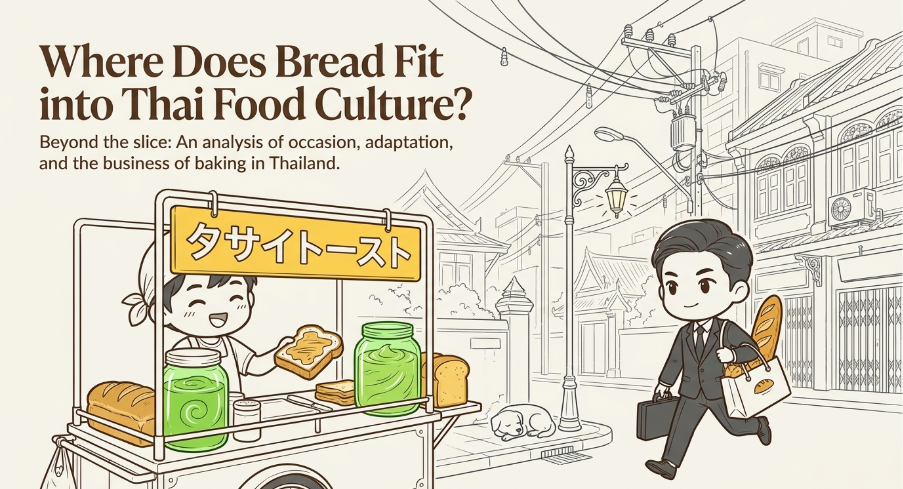
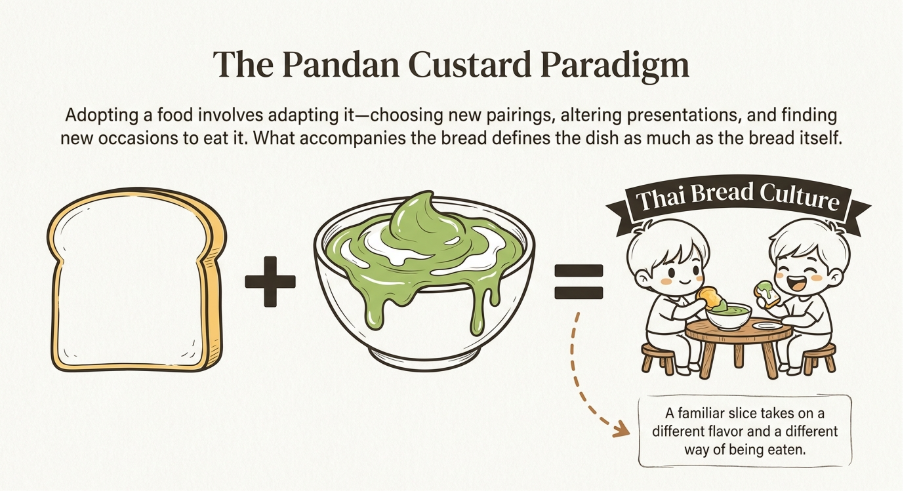
Toast served with pandan custard is a useful starting point for understanding bread in Thailand. The bread itself is still a familiar slice. But paired with sang-kha-ya, a sweet custard fragrant with pandan and rich with coconut milk, it takes on a different flavor and a different way of being eaten. What accompanies the bread helps define the dish as much as the bread itself.
This pairing illustrates how adopting a food can also involve adapting it: choosing ingredients to serve alongside it, changing its presentation, and finding occasions to eat it. A slice of bread can become part of a sandwich or a sweet treat dipped in custard. Its role changes according to how people use it.
Rather than measuring bread’s importance only by whether it replaces rice, we can look at where it fits into different meals and moments throughout the day. A food can become part of everyday life as a snack or dessert, too. Bread with pandan custard, filled buns, and sourdough sandwiches can therefore coexist, each with its own ways of being eaten and its own meanings.
The central question of this article is therefore not simply which types of bread Thai consumers are moving from and toward. It is where each kind fits into their lives: when they eat it, what they eat it with, and what they choose it instead of.
What Role Does Bread Play in Thai Eating Habits?
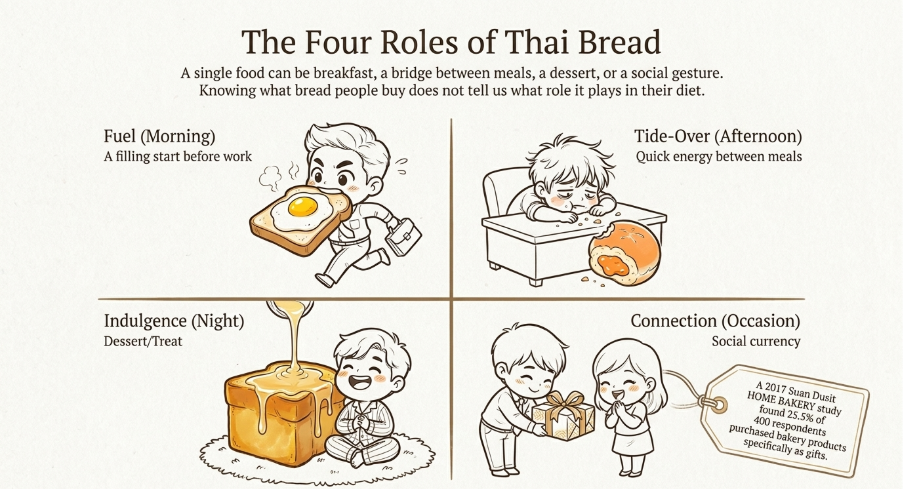
Two slices of bread with eggs in the morning, a filled bun between meals, and toast topped with condensed milk after dinner are all bread. Yet in these examples, they serve different purposes: a meal, something to tide someone over, and a dessert. Knowing which bread people buy does not necessarily tell us what role it plays in their diet.
These roles can change with the situation. A filled bun might be a snack one day and breakfast the next. Its role depends on the portion, what accompanies it, and how much time someone has for that meal.
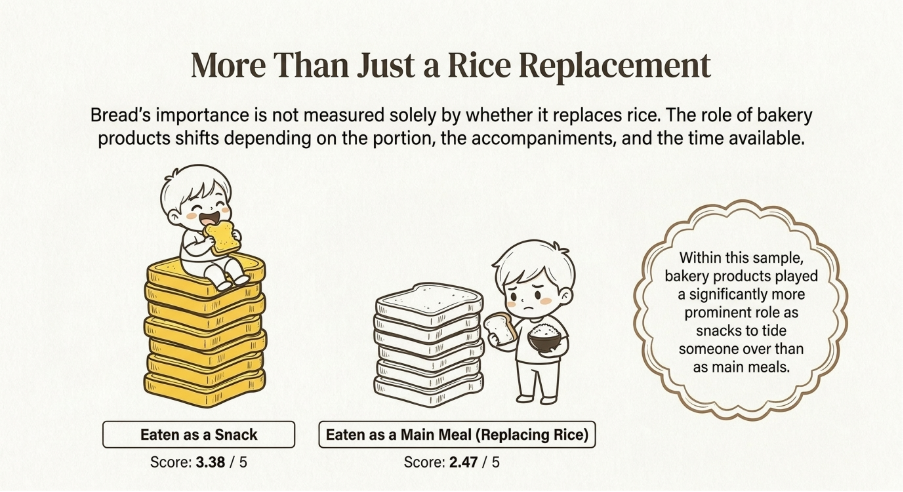
A study of 400 bakery consumers in Bangkok by Warong Phurahong published in 2022 in the Journal of Roi Kaensarn Academy, offers evidence for looking at consumption through eating occasions. On a five-point scale, respondents reported an average score of 3.38 for eating bakery products as snacks, compared with 2.47 for eating them as main meals in place of rice. Within this sample, bakery products played a more prominent role as snacks than as main meals. The study’s bakery category included cakes, pastries, bread, and cookies. Study of bakery consumption behavior in Bangkok
The historical evidence collected for this article remains limited. Most of the studies reviewed examine particular consumer groups or customers of individual shops at a single point in time. They do not track how Thai bread consumption has changed over several decades. The picture presented here therefore draws on evidence from specific settings, rather than tracing a nationwide progression in eating habits.
Another role becomes visible when we look beyond what buyers eat themselves: buying food for others. A study of customers at Suan Dusit University’s HOME BAKERY, published in 2017, reported that 102 of its 400 respondents, or 25.5%, selected gifts as their reason for purchasing. This figure covers the shop’s bakery products and does not mean these respondents bought exclusively for others. It does, however, show that bakery purchases also involve relationships between givers and recipients.
This social role offers another way to consider the Bangkok study’s finding that reported consumption scores were higher for cakes and pastries than for bread. Opportunities to give and share food could contribute to these differences alongside personal preferences. However, neither study directly tested that connection, so gift buying remains a possible explanation rather than an established reason for the higher consumption scores. Findings on the types of bakery products consumed
Bread and bakery products in Thailand therefore deserve to be understood beyond their role as staple foods. They can be breakfast, a snack between meals, dessert, or a gift. Each role brings different reasons for buying and different competitors. If the aim is to find something filling before work, bread does not simply have to win against another kind of bread. It has to be a better fit than the other foods available that morning.
What Is Changing Is Not Just the Bread, but the Eating Occasion
On a morning when someone is rushing out of the house, the question may not be whether to eat white or whole-wheat bread. It may simply be what they can grab and eat in time. A filled bun, a sandwich, sticky rice with grilled pork, and a ready-made meal can therefore belong to the same set of choices, even if supermarket shelves and market reports place them in separate categories.
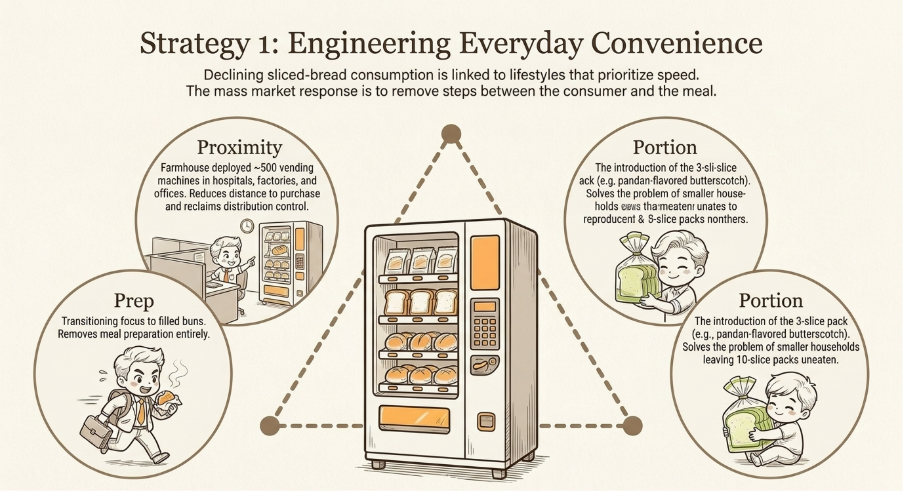
From the eater’s perspective, convenience has several dimensions: how close the food is, whether it needs further preparation, and whether they can finish what they buy. Sliced bread bought for preparing meals and a filled bun ready to eat straight from its wrapper serve different needs. The advantage lies not only in the type of flour, but also in how many steps the product removes from that meal.
Comments from Apisith Thammanomai, an executive at President Bakery, the company behind Farmhouse, reflect this view of the market. He linked declining sliced-bread consumption to lifestyles that increasingly prioritize speed and convenience. This is a producer’s observation, not survey evidence establishing what consumers are eating instead. But it raises an important question: sliced bread may be losing opportunities to be chosen, rather than simply losing favor for its taste. (Forbes Thailand, May 2025)
The expansion of bread vending machines addresses another part of this competition. Farmhouse placed machines in hospitals, factories, office buildings, and residential communities, reporting approximately 500 machines at the time of the interview. Bringing products closer to where people spend their day reduces the distance involved in buying them. It also gives the company its own sales channel as retailers introduce competing private-label products. Consumer convenience and the producer’s desire for greater control over distribution therefore meet in the same strategy.
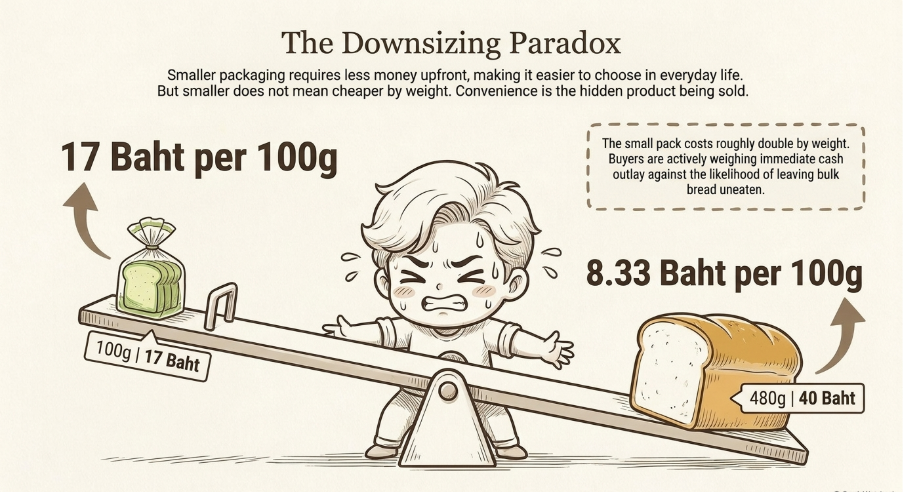
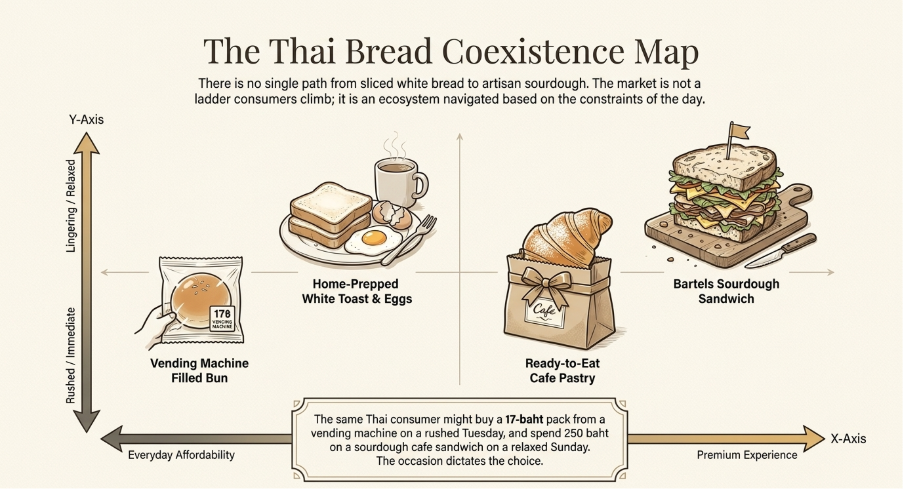
The three-slice pack addresses what happens after purchase. In April 2026, Farmhouse introduced a pandan-flavored butterscotch bread containing three slices, weighing approximately 100 grams and priced at 17 baht. Management explained that consumers had reported being unable to finish ten-slice packs and linked the smaller format to smaller households. This was an additional small-pack option, not a reduction of every sliced-bread product to three slices. (Positioningmag, April 2026) Strategically, a small pack with flavor already built in could be read as an attempt to bring sliced bread into closer competition with filled buns: shifting it from something bought and stored for meal preparation toward a more manageable, ready-to-eat pack.
Smaller, however, does not mean cheaper by weight. The new pack costs approximately 17 baht per 100 grams, while a 480-gram white loaf priced at 40 baht works out to approximately 8.33 baht per 100 grams—roughly half as much, using the prices reported in the same article. These are different recipes, so the price gap cannot be attributed to packaging size alone. What is clear is that the smaller pack requires less money per purchase, but does not provide more bread for each baht spent. Buyers must weigh the immediate outlay against value by weight and the possibility of leaving some bread uneaten.
Taken together, ready-to-eat bread, vending machines, and smaller packs can be understood as three responses to the same challenge: making bread easier to choose in everyday life. They reduce preparation, reduce the distance to purchase, and reduce the quantity that must be bought and stored. Convenience may therefore be an important force connecting changes in products and sales channels, without those changes necessarily beginning with a desire to eat a different kind of bread.
Competition does not end with “Which bread is better?” It also involves “What fits the time available, the money to spend, and the hunger at that moment?” And when those conditions differ, the market does not have to move in a single direction.
One Market, Two Directions
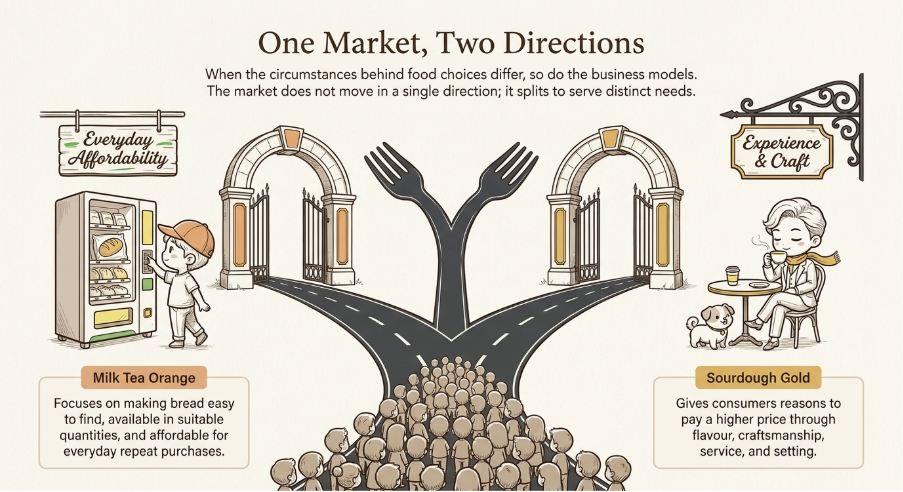
When the circumstances behind food choices differ, so do the products and services businesses offer. The cases examined in this article suggest at least two approaches. One focuses on making bread easy to find, available in suitable quantities, and affordable for everyday purchases. The other gives consumers more reasons to pay a higher price, through both the product and the experience surrounding it.
In the mass market, commercial pressure lies behind efforts to keep prices affordable. President Bakery’s sales revenue fell by 5.94% in 2025. Meanwhile, a report from the Thai President Foods group attributed declining bakery sales to stronger competition and selling-price reductions following lower costs for key raw materials. This indicates pressure on revenue, but does not mean the quantity consumed fell at the same rate. (President Bakery Public Company Limited: Management Discussion and Analysis for 2025; Thai President Foods Public Company Limited: Minutes of the 2026 Annual General Meeting of Shareholders) Affordability therefore involves competition and cost management, as well as the message communicated to customers.
Product prices also show that offering more choice does not necessarily mean moving into a premium price range. According to Farmhouse prices reported by Positioning in April 2026, a large white loaf cost 40 baht for 480 grams, while a whole-wheat loaf cost 44 baht for 500 grams. Adjusted to the same weight, the whole-wheat option cost only about 5.6% more. By comparison, a 330-gram traditional sourdough loaf listed on Makro PRO at 89 baht when checked on September 9, 2026, cost considerably more by weight.
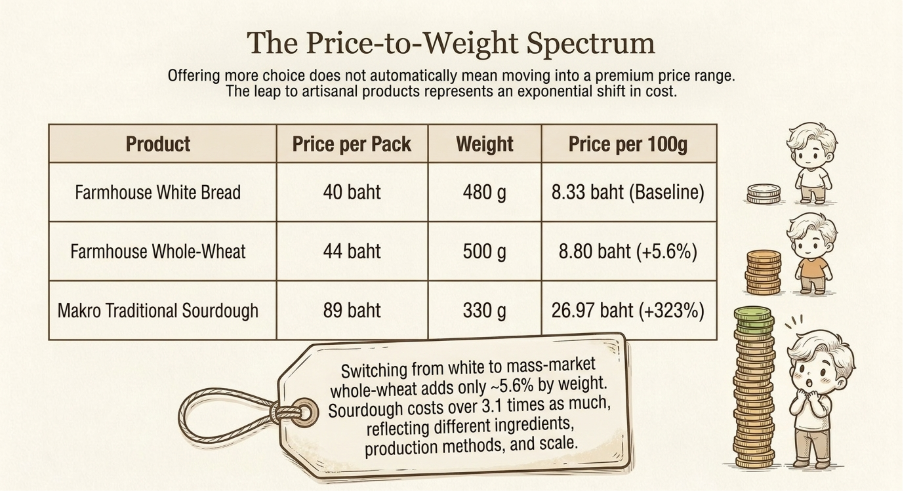
Prices per 100 grams are calculated from the listed prices and weights. The Farmhouse and Makro prices come from different dates and sales channels. (Positioningmag, April 2026; Makro PRO, checked September 2026)
In this comparison, switching from white to whole-wheat bread adds relatively little to the price by weight, while the sourdough costs approximately 3.1 times as much as the whole-wheat loaf. However, these are three individual products, not a picture of prices across the entire market. Nor should sourdough sold through Makro automatically be treated as representative of artisan bakeries. The figures show that consumers encounter choices at substantially different price points. Establishing how much of the difference comes from ingredients, production methods, scale, or brand positioning would require cost data.
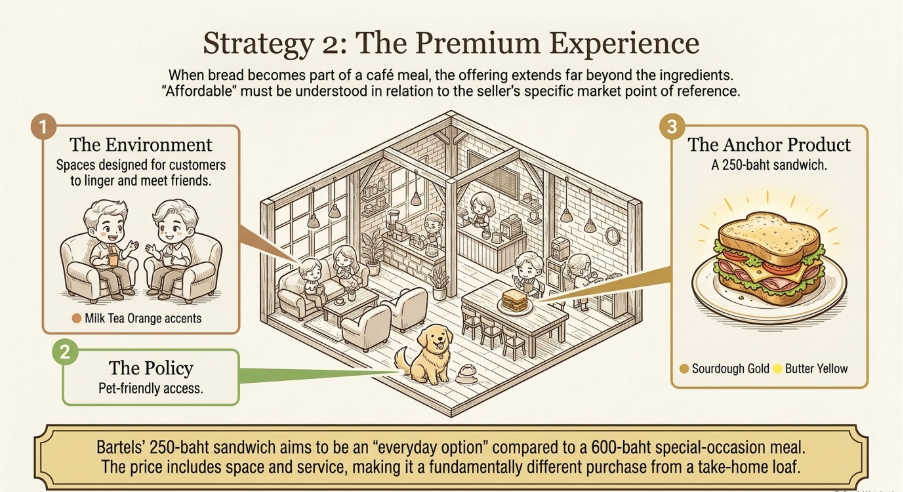
When bread becomes part of a café meal, the offering extends further beyond the product itself. In TODAY Bizview’s interview with Bartels, concrete features include spaces designed for customers to stay longer, a pet-friendly policy, and a neighborhood café concept built around coffee, meeting friends, and eating. The price of a meal therefore includes space and service, which makes it a different purchase from bread taken home to eat.
“Affordable” must consequently be understood in relation to the seller’s point of reference. Bartels’ founder explained that most sandwiches were priced at around 250 baht, comparing them with special-occasion meals where a sandwich might cost 600 baht. His aim was to make the restaurant an everyday option for its customers. But that affordability belongs within the restaurant and café market in which the business competes; it does not describe the purchasing power of every consumer.
These two approaches are therefore best used as a framework for understanding business strategies, rather than as a fixed boundary between consumer groups. One emphasizes repeat purchases within constraints of price and convenience. The other adds to what customers receive from a meal to support a higher price point. Yet the available evidence does not track how much these customers overlap or move between markets. The presence of more expensive sourdough on shelves is not evidence that Thai consumers are abandoning sliced bread. Nor does a price gap observed today establish that premium-market prices are rising over time.
Across these differences, one word is used to add value to bread on both retail shelves and café menus: “health.” The next question is how closely that promise matches what is actually in the bread.
When Health Becomes the Language of Selling Bread
On the bread shelf, words such as “whole wheat,” “multigrain,” “unbleached,” and “organic” may appear so close together that they seem to communicate the same thing. In cafés, “sourdough” and “naturally fermented” can create a similar impression of food chosen with health in mind. Yet these terms describe different things. Some identify ingredients, others describe production methods, and some refer to standards with a specific scope. Reading them all as shorthand for “healthy” can lead us to assume more than they actually promise.
In nutritional terms, whole grains retain the bran, germ, and endosperm in roughly the proportions found in the original kernel, even after milling. Whole wheat is one type of whole grain. White bread, by contrast, uses flour from which much of the bran and germ has been removed, so it generally provides less fibre. But finished breads also differ in their flour proportions and other ingredients. Brown colour or a scattering of seeds is therefore not enough to establish nutritional value. (Nutrition Bulletin, 2026)
There is evidence supporting the benefits of eating wholegrain foods, but it does not cover every bread recipe. Many studies examine several types of wholegrain food or total intake across the category. Applying those findings to every loaf labelled “whole wheat” is the first form of oversimplification: turning evidence about a food category into an assurance about an individual product, without asking how much whole grain or fibre that product contains. (Nutrition Bulletin, 2026)
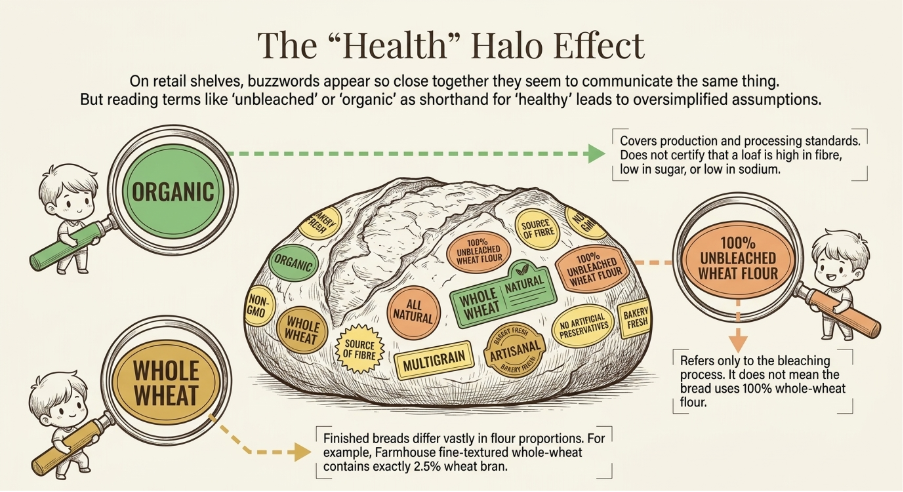
Food structure matters too, although it offers no simple rule. A meta-analysis by Cai and colleagues, covering 25 crossover trials with 369 participants, found that the structure of starchy foods, including cellular integrity and particle size, affected blood glucose responses after eating. However, the review was not limited to bread. A separate trial by Mete and colleagues found no evidence that flour particle size affected glucose or insulin responses in the population studied. The appropriate conclusion is therefore that we need to know more than the name of a bread before predicting its effects on the body. (Cai et al., 2021; Mete et al., 2021)
Back on Thai shelves, the gap between a product’s name and its details becomes tangible. Product information for Farmhouse’s fine-textured whole-wheat bread states that it contains 2.5% wheat bran. Another Farmhouse whole-wheat product is described as using “100% unbleached wheat flour.” The latter statement concerns bleaching; it does not mean the bread uses 100% whole-wheat flour. Nor can the 2.5% bran figure be compared directly with the proportion of bran in a wheat kernel without knowing its calculation basis. These examples do not establish whether either product is nutritionally better or worse. They show that different statements answer different questions. Buyers need to read the ingredients alongside the amounts of fibre, sugar, and sodium, rather than relying on the product name alone.
Health language is not entirely a collection of unverifiable advertising claims, however. Thailand has a “Healthier Choice” symbol with nutrient criteria specifically for bread, as well as rules governing nutrition claims such as “high in fibre.” These have a defined, verifiable scope. They do not mean that a product is entirely whole grain or guarantee a lower blood glucose response than every other bread. A specific mandatory Thai standard for using the name “whole wheat” could not be confirmed from the documents examined for this article. That uncertainty should not be turned into a claim that no rules exist.
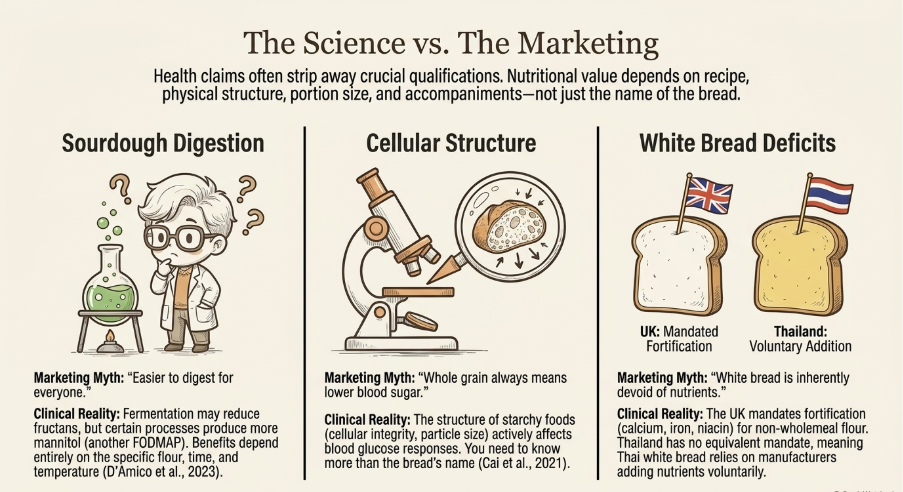
“Organic” also needs to be read within its proper scope. Organic standards cover production, processing, and product handling. They do not certify that a loaf is high in fibre, low in sugar, or low in sodium. The value of a production system is a separate question from the nutritional composition of the finished bread, although both can matter to a buyer. (National Bureau of Agricultural Commodity and Food Standards)
For sourdough, the name leaves out the details of fermentation: the flour, microorganisms, time, and temperature involved. Some experiments have found benefits under particular conditions, but those findings are insufficient to establish clinical advantages for every sourdough recipe. Fermentation may, for example, reduce fructans, which can contribute to digestive symptoms in some people. Yet certain processes also produce more mannitol, another member of the FODMAP group. “Fermented” therefore does not guarantee that a bread will suit everyone. (D’Amico et al., 2023)
This is the second form of oversimplification: turning “may offer benefits under certain conditions” into “this type of product offers definite benefits.” Once qualifications about the recipe, population, and process disappear, statements such as “sourdough is easier to digest” or “sourdough causes a smaller blood sugar rise” sound like inherent properties of the bread. The review evidence does not support such blanket assurances. (D’Amico et al., 2023)
The argument that “white bread is not inherently unhealthy” requires the same care. The United Kingdom mandates the addition of calcium, iron, thiamin, and niacin to non-wholemeal wheat flour covered by its regulations. This review did not identify an equivalent Thai requirement, and a 2024 ASEAN report did not list mandatory wheat-flour fortification for Thailand. That difference does not prove that Thai white bread is nutritionally inferior: manufacturers may add nutrients voluntarily. It does mean that conclusions about vitamins and minerals in British bread cannot be transferred to Thai products without checking their formulations and labels.
Ultimately, one slice and four slices are different quantities, while bread eaten with eggs and vegetables provides a different combination of nutrients from bread eaten with sweet jam. Nutritional value depends on the recipe, physical structure, portion size, production process, and what accompanies it. It cannot be judged by the words “whole wheat,” “sourdough,” or “white bread” alone. An advantage in one respect is not an overall health guarantee, just as the absence of a particular advantage does not make a food worthless.
For sourdough, flavour, craftsmanship, time, and the experience of eating remain legitimate sources of value. The issue is how health claims are used to explain or justify those qualities. The next question is how sourdough has acquired meaning and found a place in the ways people in Thailand eat.
Sourdough: Another Foreign Food Finding a Thai Identity
Before sourdough became a bread that some consumers sought out for health reasons, it was something one seller’s customers found difficult to eat. In an online sourdough community post dated 15 October 2025, the seller recalled that customers several years earlier were unfamiliar with it, particularly its crust, which prompted joking complaints about losing their teeth. By the time of the post, however, the seller believed growing interest in health had helped sourdough sell better.
This account reveals a negotiation between the qualities of a food and the expectations of those eating it. A crust that a baker might take pride in could be an obstacle for some customers, while a healthy image offered a reason to give it a chance. For this seller, health opened the door to the market. Yet that was not the first step in Bartels’ account of its menu strategy, which began with approachable dishes before introducing options positioned as healthier. The distinction is whether people need to believe in sourdough’s benefits before trying it, or first encounter the bread through a meal they already want to eat.
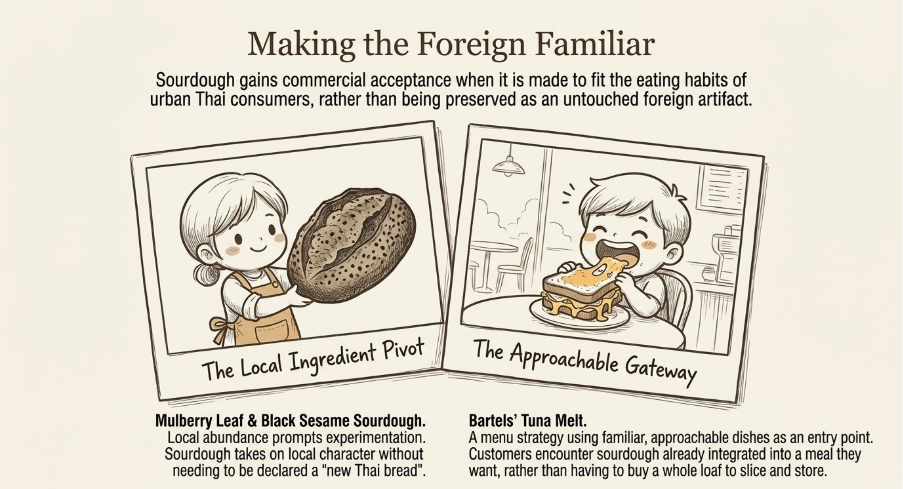
Between these two routes, bakers are also changing what goes into the loaf. Another member of the online community shared a mulberry-leaf and black-sesame sourdough, explaining that an abundance of mulberry leaves had prompted the experiment. This small detail shows that sourdough is not necessarily treated as a foreign recipe that must be preserved unchanged. In an individual baker’s kitchen, it can take on locally available ingredients and become something different.
Online communities make these experiments visible and shareable. A photograph of a loaf does more than announce a successful bake; it can also explain what the baker chose to add and why. Members encounter both models to follow and possibilities for adaptation. Mulberry leaves and black sesame allow sourdough to acquire a local character through everyday ingredients, without anyone needing to declare that they are inventing a new kind of Thai bread.
In the café business, Bartels offers another example of how familiarity can be built. The business opened its first branch in Bangkok’s Sukhumvit area in 2020, during the early stages of the COVID-19 pandemic. In an interview with TODAY Bizview, founder Nicolai Bartels Thomsen explained that the restaurant used approachable dishes such as the Tuna Melt as an entry point, then gradually introduced other options with a stronger health positioning as customers became familiar with the brand. Sourdough thus reached customers as a sandwich they could order and eat immediately. They did not have to begin by buying a whole loaf and working out how to slice, store, or serve it. (TODAY Bizview, 4 April 2026)
The community seller described health as a reason customers became willing to try something unfamiliar. Bartels described using an approachable meal to lead customers towards other choices. This difference may reflect distinct purchasing situations: one person deliberately seeks out sourdough, while another simply wants a meal and encounters sourdough on the menu. That is a possible explanation, not evidence that the two customer groups are separate. The interview also identifies health as part of the restaurant’s positioning from its early days. The difference may therefore lie in the sequence of the sales approach, rather than a choice between health and taste.
A Tuna Melt is not Thai in origin. But making sourdough fit life in Thailand does not have to involve Thai ingredients alone. The way it is served and the place where it is eaten matter too. Bartels aims to be a neighbourhood café where customers can linger, meet friends, and bring their pets. Bread becomes part of both a meal and time spent together. However, the interview reported that five of the business’s approximately twelve Thai branches were in Phuket, without specifying the proportions of Thai and foreign customers. Expansion within Thailand therefore cannot, by itself, be treated as evidence of adoption by Thai consumers. (TODAY Bizview, 4 April 2026)
Taken together, these cases suggest one route to commercial acceptance: sourdough can sell when it is made to fit the eating habits of urban consumers in Thailand, not simply because it is sourdough. A healthy image may encourage a first try, familiar ingredients create room for adaptation, and sandwiches and cafés place the bread within recognisable meals and activities. Its value emerges from the relationship between what sellers offer and how people use it in their lives.
This brings us back to bread served with sangkhaya, the custard dip at the beginning of this article. Becoming part of Thai food culture does not require changing a food’s origins. It can happen through new pairings, adapted recipes, and ways of eating that fit people’s lives. Sangkhaya, mulberry leaves with black sesame, and the Tuna Melt are not the same story. But they reveal a similar process: a foreign food begins to belong when the people making and eating it can make it their own.
Conclusion: There Is No Single Path from Sliced Bread to Sourdough
Telling the story of Thailand’s bread market as a straight line from white bread to whole wheat and finally to sourdough would make for a simple narrative. But it would miss the central point. The arrival of new options does not mean consumers are all moving in the same direction, and the growth of premium bread is not, by itself, evidence that people who once bought packaged loaves are switching to artisan bread.
The cases examined in this article suggest at least two directions of adaptation. One focuses on making bread convenient to buy, easy to finish, and affordable. The other adds value through flavour, craftsmanship, service, and setting. Income helps determine which options buyers can access, while eating occasions shape the qualities they seek. A snack during a commute, a gift, and a meal shared with friends may therefore involve different competitors and purchasing criteria. These changes can coexist without forming a ladder that consumers climb from inexpensive bread to more expensive loaves.
Health is both a legitimate consumer concern and a language businesses use to create value. These roles need to be distinguished. A product’s name does not guarantee its overall nutritional quality, just as a higher price does not guarantee greater health benefits. Flavour, craftsmanship, and experience remain valid reasons to pay more, without needing health claims to justify them.
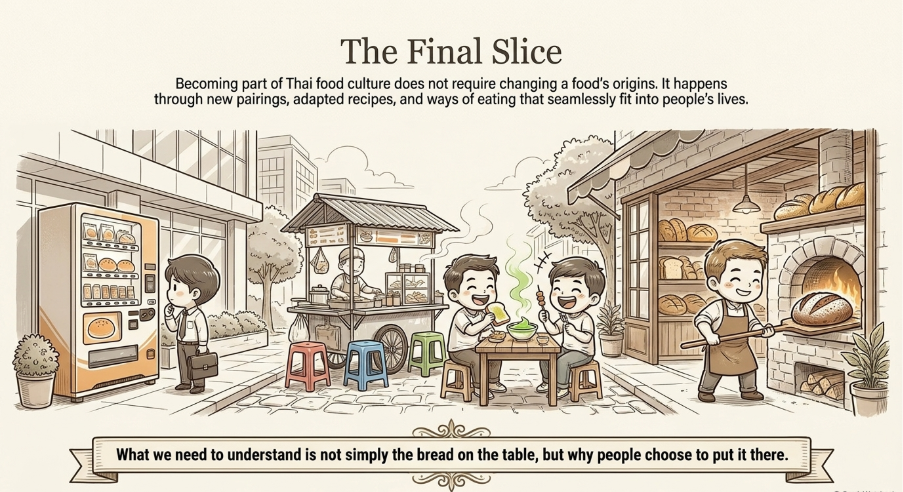
What remains missing is the evidence needed to connect these pictures. The Thai studies examined here focus on purchasing factors and the marketing mix. Although some include information about meals or gift purchases, they are insufficient to track who is replacing one food with another. The available sales data by product category also lack the continuity needed to test those shifts. Future surveys should ask when people eat bread, what it replaces, whom they buy it for, and how these practices have changed, alongside producer data that clearly distinguish sales volumes from prices. What we need to understand is not simply the bread on the table, but why people choose to put it there.
