
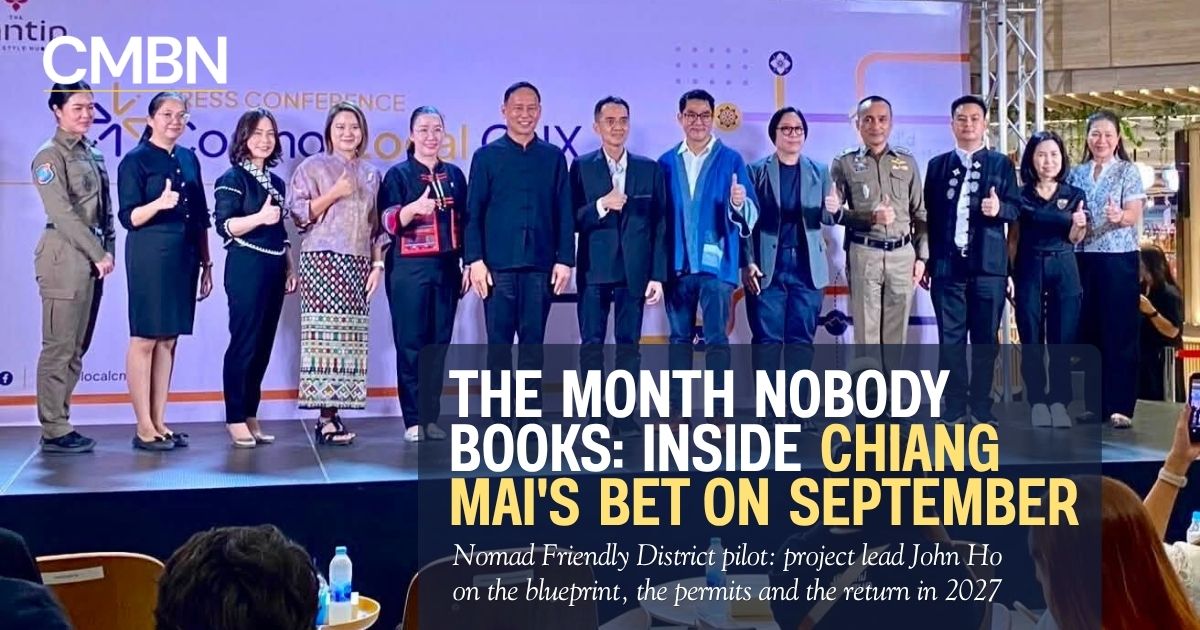
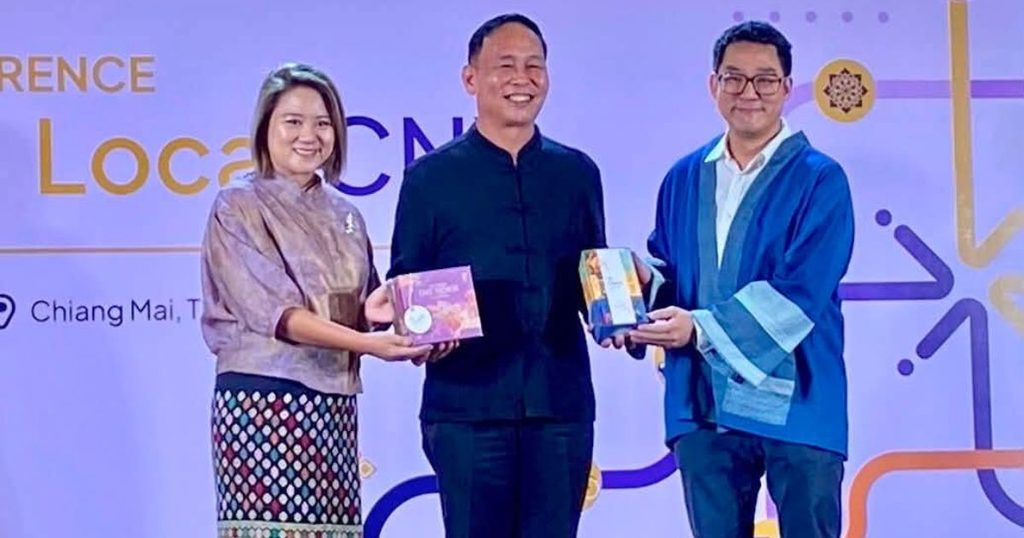
On 1 September at Pantip Lifestyle Hub Chiang Mai, Deputy Governor Boonlue Thammatharanurak launched Cosmo Local CNX 2026 alongside Pisan Suwannathada of Pantip Lifestyle Hub, Arisa Nimmanhaemin of Anusarn Co., Ltd., and project lead John Ho, who spoke to CMBN this week. The month they picked is the emptiest one on the city’s calendar, and the intention is to come back to it every year.
September is Chiang Mai’s quietest month and its most available. Tables are free, desks are open, accommodation is plentiful and the mountains are green. The launch doubles as the public rollout of a Nomad Friendly District model, meaning a neighbourhood organised around long-staying remote workers and the local businesses they trade with, and San Pa Khoi and Wat Ket are named as the pilot area.
CMBN interviewed project lead John Ho on 3 September about what the month leaves behind, whether it returns in 2027, and what the municipality still has to decide. His answers run through this briefing.
What Cosmo Local CNX 2026 is
Cosmo Local CNX 2026 is a pop-up village running from 1 to 28 September 2026 in and around Wat Ket and San Pa Khoi, Mueang Chiang Mai. Four small coliving cohorts spend the month working alongside local residents and businesses, and everything converges on a public Main Week from 23 to 28 September. The province expects more than 300 participants across the month.
| Dates | 1 to 28 September 2026 |
|---|---|
| Main Week | 23 to 28 September 2026, open to anyone with a pass |
| Location | Wat Ket and San Pa Khoi, Mueang Chiang Mai |
| Expected participants | More than 300 across the month, per the province. Coliving cohorts run at roughly 10 to 15 people per track |
| Main Week passes | Purple Pass 350 US dollars, Gold Pass 500 US dollars, Local Pass 5,500 baht for Thai residents with Thai ID |
| Language | English throughout |
| Repeat | Intended as an annual September event, per project lead John Ho |
| Backers | Sponsors are Anusarn Building, Alt_, Bangkok Hospital Chiang Mai, Colive Fukuoka, Genki, Nomads for Impact, the Northern Digital Enterprise Association (NDEA), the Program Management Unit for Area Based Development (PMU-A), ShakeSphere, SafetyWing and the Faculty of Arts and Architecture at Rajamangala University of Technology Lanna. Partners and hosts include Pun Pun, Slow Food CNX, digi-cnx, the MarTech Association and Sasin |
| Website | cosmolocalcnx.com |
The aim is to grow Chiang Mai from a nomad destination, a place people come to live cheaply for a while, into a nomad friendly district, where visitors trade with the local economy and leave something behind. When the month ends, the network carries over to Colive Fukuoka in Japan, which is a project sponsor.
Four tracks run in parallel through the month, each a cohort of roughly 10 to 15 people living and working together:
- AI for Chiang Mai, applying AI tools to city and business problems
- Food That Nourishes Us, linking food, sustainable agriculture and local knowledge
- Solopreneur, a month of mentorship and deep work for first-time founders
- Nomad Futures Lab, a research track writing a Nomad Friendly District blueprint with the community that lives there
The cohorts are small on purpose, which is what allows the local pairing to be real rather than nominal. The figure of more than 300 is the province’s expectation for the month as a whole, and Main Week is where most of it lands.
The plan is annual, and the month is fixed
Asked directly whether the event comes back, Ho confirmed to CMBN that Cosmo Local CNX is intended to run every year, and to run in September.
Yes we want this to be an annual event. And we want it to be in September. Because it’s a low season month. So we want this to be an economic booster for the city, in a long run when we can scale it.
John Ho, project lead, speaking to CMBN
That is the sentence with the most commercial weight in the whole announcement. Year one is small enough that no operator should rebuild a month around it, and a recurring fixture in a fixed month is a different proposition, because inventory, staffing and rates can be planned against a date that returns. The difference between the two is what separates a discount month from a season.
Why the timing is the opportunity
Chiang Mai’s remote-work economy runs on a concentrated calendar. October through February brings thousands of nomads and carries the SEO Conference, the Cross Border Summit and the Nomad Summit. The months either side have capacity to spare, and September has the most of all. Venues, cafes, serviced apartments and coworking operators hold an asset that sits idle for those weeks, and a reason to fill it is worth more than any amount of discounting.
Ho has argued publicly that this is a design problem rather than a weather constraint, and he points at Bansko in Bulgaria. Bansko was a winter ski town until its nomad festival gave people a reason to be there in June. Attendance has climbed every year since 2020, from about 100 people to more than 800 in 2025. This June it passed 1,000 from more than 50 countries, according to the Bulgarian News Agency. Bulgaria amended its immigration law in 2025 to let digital nomads apply for long-term residence permits. A summer season now exists in Bansko that did not exist before.
The long-horizon version of the same logic is Austin, which became Chiang Mai’s sister city in 2023. A Greyhill Advisors study commissioned by SXSW put the 2024 festival’s impact on the Austin economy at 377.3 million US dollars. That figure includes SXSW’s own operational spending of 98.5 million, and in-person attendance was 47,661. Austin started from a small music festival in 1987 and took decades to reach that.
Year one in Chiang Mai will be modest against those numbers. What the city has is a month with almost no competing demand, a district with room to grow into, and visitors who stay four weeks rather than four days.
Why San Pa Khoi and Wat Ket
Wat Ket sits across the Ping from the Old City, with a trading history running back through Chinese merchants and river commerce, a good stock of boutique hotels and riverfront restaurants, and room to take considerably more visitors than it currently does. San Pa Khoi market anchors the local end of it.
Ho has written about the Web3 pop-up city that he says brought more than 2,000 people to Chiang Mai in October 2024. Roughly 700 of them came into Wat Ket, where he hosted them, and by his account the effect on riverside businesses was immediate. The demand exists when people are given a reason to come, and the piece he wanted to add was the local connection, so that the relationships outlast the month.
The reference point he works against is Nimman. In a written account of how the district initiative came about, Ho lists Porto, Bali, Barcelona and Nimmanhaemin Road as the versions of unmanaged growth he wants to avoid, with rising rents and residents who end up as spectators in their own neighbourhood. The stated goal is a district where the economic benefit reaches Thai businesses and residents, and where development happens with community input rather than to the community.
What happens when the month ends
The blueprint goes to a committee with the governor’s office behind it. Asked what survives when the cohorts leave, Ho told CMBN that the Nomad Futures Lab document will be submitted to the Nomad Friendly District working committee, and that the governor’s office assigns it from there to the relevant agencies to work out how the projects get developed. That structure already exists. By Ho’s account the governor convened the agencies, the initiative now sits inside the governor’s working group, and that inclusion opened funding conversations that were closed to a private operator working alone.
Two of the sponsors matter to that route. The Northern Digital Enterprise Association, founded in 2015, advises the governor’s office on technology and software matters, which puts a sponsor inside the channel the blueprint travels through. The Faculty of Arts and Architecture at Rajamangala University of Technology Lanna is also a sponsor, and Ho separately described university researchers working alongside him on the district conversations.
The infrastructure attached to it is specific. Ho has named public coworking space that anyone can access, a learning centre in Wat Ket and possibly a maker space, all of which need public funding pathways rather than private capital.
The community half runs in parallel and started well before September. Ho was asked how the project knows it is developing the district the right way, and put local involvement first.
We’ve already done several town halls and we’re continuously talking to locals in the district to understand their needs with university researchers and myself to make sure this is not just a responsibility of the government agencies.
John Ho, speaking to CMBN
Permitting is the open question, and Ho did not dress it up when CMBN asked what the province and the municipality need to get right.
This has to do with Tessaban (municipality). We have communication channels with them but honest answer is I don’t know. We can only keep trying.
John Ho, speaking to CMBN
For any operator weighing what the pilot delivers on the ground, that is the part to watch rather than the attendance figure.
What local operators can do with it
Traders in Wat Ket and San Pa Khoi. The arithmetic is worth doing before anyone reorganises a month around this. Four cohorts at roughly 10 to 15 people each puts something like 40 to 60 extra residents in the district through the first three weeks, which is a steady trickle rather than a surge, and they are living here rather than visiting, so the spend is groceries, laundry, lunch and a desk. The bulk of the 300 lands in Main Week from 23 to 28 September, and those six days are the ones to staff and stock for.
The Main Week venues show where it concentrates. The hackathon is at the Mövenpick, the Nomad Futures Lab exhibition runs all week at Punthip Plaza, the potluck is at the Old Chiang Mai Cultural Center and the Solopreneur session is at Cult Caffeine. Extended hours across those six days, English menus, card payment and a current Google Business Profile are the cheap preparations, and all of them keep working after the month ends. Our guide to Google Business Profile for Chiang Mai SMEs covers the basics.
Residents and traders with a view on the district. The town halls are the route in, and the research track is writing down what comes out of them. A business that wants public coworking space, better footpaths or a learning centre in Wat Ket has a document going to the governor’s working group with room in it.
Businesses with an operational problem worth solving. The Claude Impact Labs Hackathon on 26 and 27 September is two days of applied AI work aimed at Chiang Mai’s civic and creative communities. Local problems are the raw material, and bringing one is the simplest way to take part.
Food producers and growers. The food track connects producers, sustainable agriculture and Northern Thai culinary knowledge, and Pun Pun, Slow Food CNX and Farm to Truck are all involved. Small producers have a direct route in.
Employers and anyone looking for partners. The keynote line-up brings in Amarit Charoenphan, Jon Jandai of Pun Pun, George Siosi Samuels and Benjamin Hies, and the audience around them is founders and operators.
Businesses watching the cost. Thai residents with valid ID pay 5,500 baht for the Local Pass, against 350 US dollars for the standard pass, and the access is the same.
The numbers worth tracking
Attendance in September is the headline figure. The measures that show whether the model works arrive later, in repeat visitation in 2027, in hotel and coworking occupancy across the quieter months either side of high season, and in what the working committee actually commissions once the blueprint reaches the agencies. Those are the measures the organisers are aiming at.
The Fukuoka link runs on the same logic, and Ho set out the thinking behind it to CMBN. Colive Fukuoka has spent four years working to bring more remote workers into the city, Ho was invited there as a speaker, and he describes the alignment between the two projects as a shared requirement that the impact of nomads is net positive for locals. He has previously taken Chiang Mai’s deputy mayor to Fukuoka to see a city-enabled version of it running. A recurring flow of people between two cities compounds year on year in a way a single festival cannot, and building that flow is the more ambitious half of the project.
Bansko built a summer, and Chiang Mai is starting on a September.
Frequently Asked Questions
When is Cosmo Local CNX 2026?
It runs from 1 to 28 September 2026. Main Week, the public-facing part, runs 23 to 28 September.
Where is Cosmo Local CNX held?
In and around Wat Ket and San Pa Khoi, Chiang Mai’s riverside district on the east bank of the Ping, named as the pilot Nomad Friendly District. Individual events are spread across the Mövenpick Hotel, Punthip Plaza, the Old Chiang Mai Cultural Center and Cult Caffeine.
Who is behind Cosmo Local CNX?
Project lead John Ho of Alt_Coliving, with provincial government backing. Sponsors are Anusarn Building, Alt_, Bangkok Hospital Chiang Mai, Colive Fukuoka, Genki, Nomads for Impact, the Northern Digital Enterprise Association, the Program Management Unit for Area Based Development, ShakeSphere, SafetyWing and the Faculty of Arts and Architecture at Rajamangala University of Technology Lanna. Partners and hosts include Pun Pun, Slow Food CNX, digi-cnx, the MarTech Association and Sasin.
Will Cosmo Local CNX run again in 2027?
Ho told CMBN that the intention is an annual event held in September, chosen because it is a low season month, and that the long-run aim is an economic boost for the city as the event scales.
What happens to the Nomad Futures Lab blueprint?
It goes to the Nomad Friendly District working committee. The governor’s office then assigns it to the relevant agencies to determine how the projects in it get developed. Ho has named public coworking space, a Wat Ket learning centre and possibly a maker space among the infrastructure being sought.
How many people are expected to attend?
The province expects more than 300 participants across the month, from markets including Japan, Malaysia, Korea, Vietnam and the Philippines. The four coliving cohorts are smaller by design, at roughly 10 to 15 people each.
How much does it cost to attend Main Week?
The Purple Pass is 350 US dollars and the Gold Pass is 500. Thai residents with valid Thai ID buy a Local Pass at 5,500 baht for the same access as the Purple Pass.
Can local Chiang Mai businesses take part?
Yes. Main Week is open to pass holders rather than restricted to the coliving cohorts, the final day is participant-led, and the AI, food and business programming is built around local involvement. Several town halls have already run in the district.
What is a Nomad Friendly District?
A neighbourhood set up with infrastructure, programming and business support aimed at long-staying remote workers, designed to connect them with local residents and businesses. Wat Ket and San Pa Khoi is Chiang Mai’s pilot, and it sits with a working committee under the governor’s office.
Sources: Chiang Mai Provincial Public Relations Office, 1 September 2026. Interview with project lead John Ho, 3 September 2026. Additional background from his published account of the Nomad Friendly District initiative. Programme, venue and pricing detail verified against cosmolocalcnx.com. Bansko attendance figures from the Bulgarian News Agency, June 2026. SXSW figures from Greyhill Advisors, reported by the Austin Monitor.
