

I wake up at 5 am with five fully formed business ideas. I always have. Before AI, I wrote them down in shorthand and moved on. Now, before breakfast, I can have a 12-page plan, a budget model, a competitor analysis, and a launch sequence drafted. The question I had to ask myself is: am I building more, or am I just planning more?
The Problem Has a Name
Psychologists call it the planning fallacy. Proposed by Daniel Kahneman and Amos Tversky in 1979, it describes our tendency to underestimate the time, cost, and risk of a future task while overestimating the benefits. We focus on best-case scenarios. We ignore what history tells us about similar projects. We plan with optimism and execute with friction.¹
That bias existed long before AI. What AI has done is dramatically lower the cost of entering the planning phase. And when something becomes cheaper and faster, we do more of it.
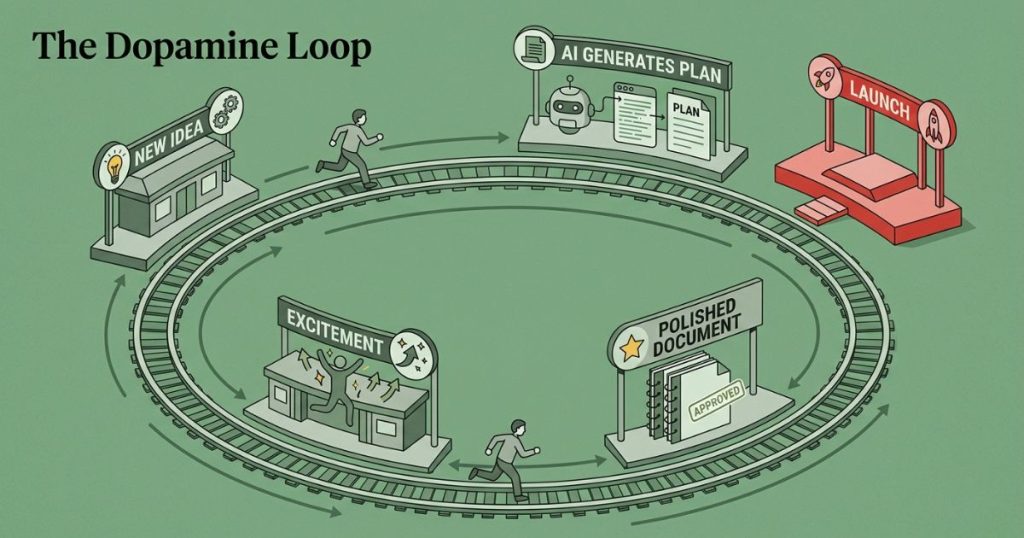
Add to this what neuroscientist Kent Berridge’s research describes as the brain’s “wanting” system: dopamine does not fire when you achieve something. It fires when you anticipate achieving something. The thrill is in the seeking, not the landing.² Every new idea, every AI-generated plan, every beautifully structured objective triggers that anticipation cycle. It feels productive. The brain registers it as progress. And then a new day brings five more ideas.
6% of executives anticipated productivity gains from AI. 77% of employees said AI increased their workload. 71% of AI-using workers reported burnout.
Upwork Research Institute, 2024
Productivity research is pointing at something similar at the organisational level. A 2025 study tracking over 10,000 developers found that while individuals using AI tools wrote more code and completed more tasks, companies did not see measurable improvements in delivery velocity or business outcomes.³ Output went up. Results did not follow.
The gap between output and outcome is exactly where the ideation trap lives.
What AI Actually Changed
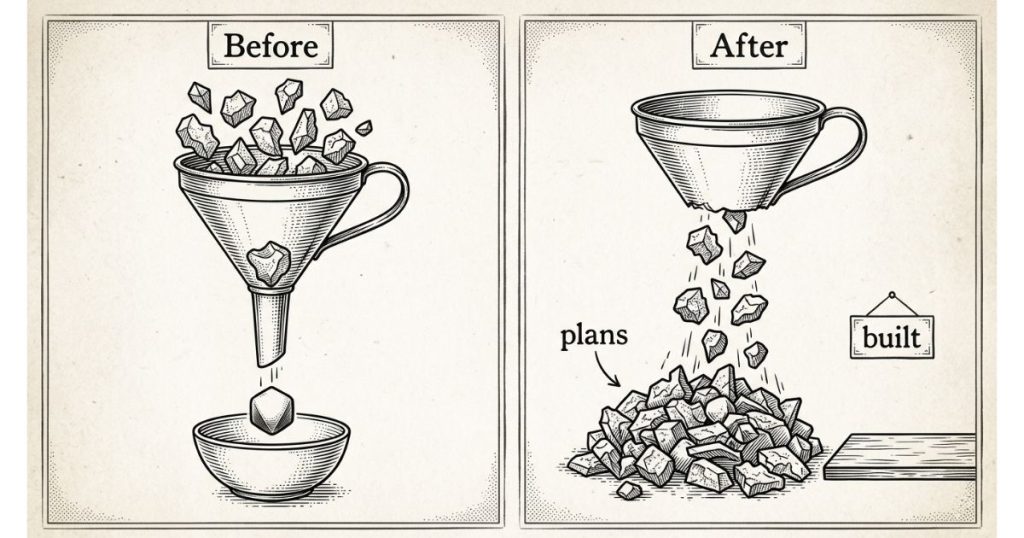
Before AI tools like Claude, ChatGPT, and Gemini, developing a serious business plan required real effort: days of research, multiple drafts, financial modelling from scratch. That friction was annoying. It was also a filter. Most ideas did not survive the effort required to test them properly. The weak ones fell away before they consumed serious time.
AI removed that friction almost entirely. A half-formed thought at 5 am can be a 20-page strategy document by 8 am. The idea feels real because it looks real. It has sections, headings, financial projections, a risk register. But the document is not the business. The map is not the territory.
“Despite AI ideas being scored higher than human ideas before execution, their scores dropped significantly more than human ideas after execution.”
Stanford / Princeton research on LLM-generated versus human research ideas, 2025⁴
This is a critical finding. AI is very good at generating ideas that look compelling. It is less reliable at generating ideas that survive contact with reality. And when the cost of generating a polished-looking plan is near zero, the natural filter of effort disappears entirely.
The Substitution Effect
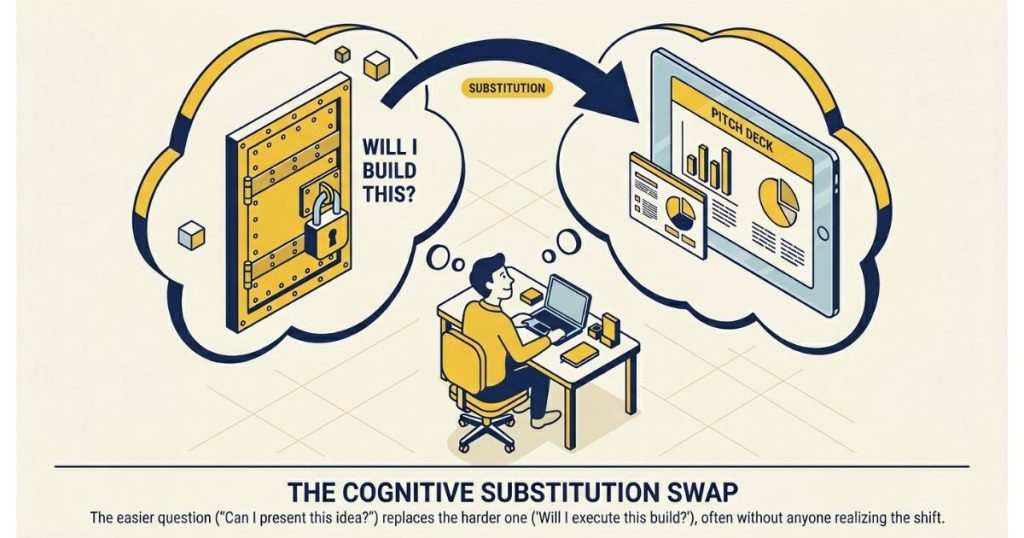
There is a subtler problem underneath this. Psychologists use the term substitution to describe what happens when the brain replaces a hard question with an easier one and does not notice the swap. The hard question is: will I build this? The easier question is: what would this look like if I built it? AI answers the second question brilliantly. The brain accepts that answer as a proxy for the first.
The result is what I call productivity theatre: the detailed plan, the drafted pitch deck, the budget model, the marketing framework. All real work. None of it the actual thing. And because it took real effort to produce, it feels like meaningful progress, even when no execution has begun.
Kahneman and Tversky also identified that people take what they called an “inside view” when planning: they focus on the specific project in front of them, its unique features, its exciting possibilities, rather than asking how similar projects have performed historically.⁵ AI-generated plans are built almost entirely from inside-view thinking. They are optimised for the best case. They are not calibrated against your past execution rate.
A Self-Diagnosis Worth Running
Here are three questions worth sitting with honestly.
Has your execution rate increased since you started using AI? Not your planning output. Not the number of documents you have produced. The number of ideas that have moved from plan to market.
Are you revisiting the same idea in different forms? If you have planned the same business concept three times in eighteen months with slightly different structures, that is not iteration. That is the loop.
Is AI helping you build, or helping you feel like you are building? There is a difference. One produces an asset. The other produces a document about an asset.
How Not to Fall Into the Trap
This is not an argument against AI. These tools are genuinely powerful when used correctly. The solution is not to stop generating ideas. It is to build a system that forces ideas through a harder gate before they receive serious development time.
- Separate idea capture from idea development. Write the idea down in two sentences. Stop there. Put it on a list you review once a week, not once an hour. The idea does not earn development time simply because it arrived. Most ideas look weaker after 48 hours of distance. Let the filter work.
- Set a “one active project” rule. You can generate as many ideas as your brain produces. You are only allowed one in active development at a time. When that one is at a defined milestone or handed off, the next idea earns its turn. This is uncomfortable. That discomfort is the point.
- Ask the outside-view question before you build the plan. Kahneman’s fix for the planning fallacy is called reference class forecasting: look at how similar ideas performed historically, not how this specific idea looks today.⁶ Before using AI to plan a new venture, ask: how many similar ventures have I started? How many are operating? What was different about those?
- Use AI to stress-test, not just to build. Most people use AI to develop ideas: write the plan, build the budget, draft the pitch. Turn it around. Ask AI to find the flaws, list the reasons it will fail, identify what you are missing, and compare it against alternatives. Use it as a devil’s advocate before you use it as a co-founder.
- Define what “built” means before you start. A plan is not built. A document is not built. Before you spend any time developing an idea, write one sentence that defines what success looks like in 90 days. If you cannot define it clearly before you start planning, the idea is not ready. Most are not.
- Review your idea archive with an execution lens. Every three months, go back through the list. Count what is live, what is abandoned, and what has been planned more than once. The pattern will tell you something honest about where your energy is actually going. Most people avoid this review. That avoidance is data.
The Honest Conclusion
AI tools are not the problem. The dopamine loop that makes planning feel like building is not new either. What is new is that we now have an extraordinarily capable tool that meets us exactly at the point where we are most vulnerable: the moment between the idea and the work.
Used well, AI can compress the real work: the research, the financial modelling, the legal review, the drafting. That is where the genuine productivity gain lives. Used carelessly, it compresses the planning of work that never begins, at a speed that makes the illusion harder to see.
The question every builder using AI tools should ask regularly is not “what am I planning?” It is “what am I executing?” If those two lists do not overlap, the tool is not the problem.
You are doing the planning. You still have to do the building.
References
1. Kahneman, D. & Tversky, A. (1979). Intuitive prediction: Biases and corrective procedures. TIMS Studies in Management Science, 12, 313–327.
2. Berridge, K. C. & Robinson, T. E. (1998). What is the role of dopamine in reward? Brain Research Reviews, 28(3), 309–369.
3. Faros AI (2025). The AI Productivity Paradox Report. Analysis of 10,000+ developers across 1,255 teams.
4. Schellaert, W. et al. (2025). The Ideation-Execution Gap: Execution Outcomes of LLM-Generated versus Human Research Ideas. arXiv:2506.20803.
5. Kahneman, D. & Lovallo, D. (2003). Delusions of success. Harvard Business Review, 81(7), 56–63.
6. Flyvbjerg, B. (2008). Curbing optimism bias and strategic misrepresentation. European Planning Studies, 16(1), 3–21.
