It is not just about safety. It is also about your taxes.
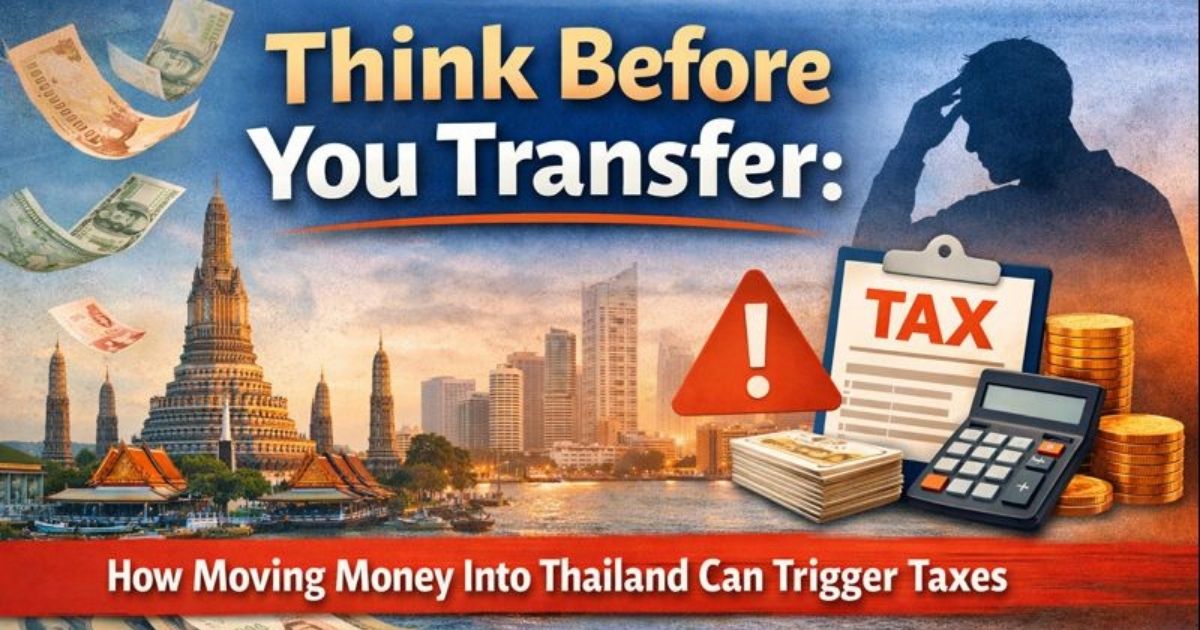
Many foreigners living in or moving to Thailand transfer money here to buy property, support their family, or fund their day-to-day life. What is often overlooked is that the way money is transferred into Thailand can have tax consequences. The issue is not whether Thailand allows money to come in. Banks and authorities are used to foreign funds. The real question is how that money is classified once it arrives.
If you are a Thai tax resident, meaning you spend 180 days or more in Thailand in a calendar year, foreign income brought into Thailand may be subject to Thai personal income tax. This depends on when the income was earned and when it is transferred, though the rule about previous year earnings being tax free is not as straight forward as you hear on social media. Moving a large sum into Thailand without proper planning can raise questions later when you file your tax return or when a bank or authority asks for supporting documents.

This becomes particularly relevant when money is transferred to buy property. Foreigners buying a condominium must transfer funds from overseas in foreign currency, and this is a normal and well-established process. From a legal perspective, this is straightforward. From a tax perspective, however, the authorities may want to understand whether the funds are income, long-term savings, or capital accumulated in previous years. If the source of funds is clear and properly documented, the tax risk is usually limited. Problems tend to arise when the origin of the money cannot be easily explained or when the timing of income and transfers does not align with declared income.
For those married to a Thai national, the situation requires even more careful planning. Transfers between legally married spouses can often be structured as gifts, which are generally exempt from gift tax under Thai law. However, the source of the funds still matters. If money transferred by a Thai spouse originally came from the foreign spouse, the authorities may still ask how the money was generated. Simply moving funds through a spouse’s account does not automatically remove tax exposure unless the structure and documentation are clear.
There is also an important difference between transferring personal funds and transferring money as a formal investment. Funds brought into Thailand as part of an investment, such as capital injected into a company or a documented business transaction, are typically treated differently from personal income. When structured properly, investment transfers can reduce uncertainty and make future reporting much simpler.
Marriage to a Thai national does not remove tax obligations, nor does it automatically make overseas income tax free. It can, however, affect how money is classified and how transfers are treated if planned correctly. The key is to think ahead rather than trying to explain the situation after the money has already arrived.
The main takeaway is simple. Thailand is not trying to stop money from entering the country, but once it arrives, you may be asked to explain what it is. Understanding the tax treatment before transferring significant sums, especially for property purchases, can prevent confusion, stress, and unexpected tax exposure later. A short discussion and some planning in advance often make all the difference.
Thai personal income tax rules are changing, and many long-term residents and business owners are now required to file and declare overseas income. Small decisions, such as how and when you transfer money into Thailand, can have a big impact on your tax position.
If you are unsure whether you need to file, how to declare overseas income, or how to structure transfers for property purchases or family support, feel free to reach out to the LAN CONSULTING team.
We assist residents in setting up their tax profile, preparing filings, and making sure everything is done correctly and on time.
CONTACT: LAN CONSULTING
lone.andersen@lanbusinessconsulting.com
Tel: +66 6 249 33140