The Modern Content Engine: How to Build Authority in 2026 Without Burnout
If the first steps of building a business in 2026 are about understanding trust and identity, the next step is entirely about execution. But here is the truth: the old advice to “blog daily” or “post everywhere” is a fast track to exhaustion.
It is definitely not about spending hours writing about topics you do not care about just to please an SEO tool. That is the quickest way to fall into the Startup Failure Trap.
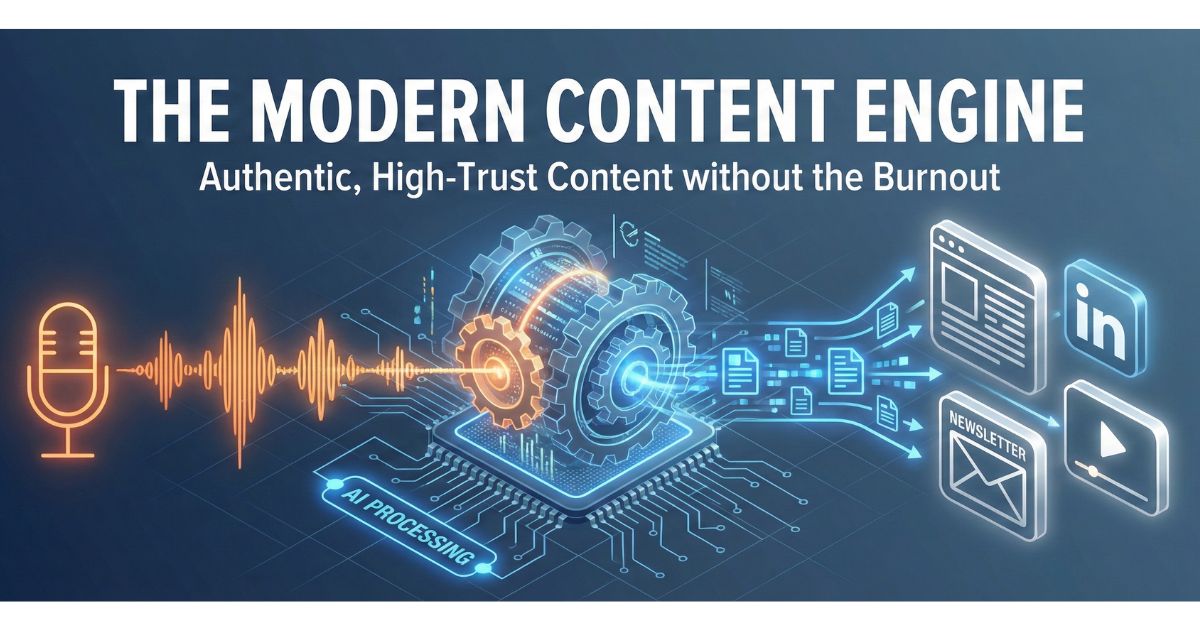
This article is about building the Modern Content Engine. It’s a system that many SMEs, Start-ups and founders sorely need! It produces trustworthy, expert content without stealing your evenings or requiring you to become a full-time writer.
Welcome to the engine that allows you to work with AI rather than fighting against it.
The Content Problem Most SMEs Don’t Know They Have
Small businesses in Chiang Mai are rarely short on ideas. They are usually short on time, templates, and clarity.
Most founders approach content the wrong way. They wait until inspiration strikes and then try to write in large, exhausting bursts. They worry that everything has already been said, so they say nothing at all. This lack of consistency is a major hurdle in effective website marketing strategies.
Meanwhile, AI search engines (like SearchGPT and Google’s AI Overviews) are hungry for content that is lived, specific, human, and locally relevant. This is exactly the content SMEs are best at producing, yet it is the kind they produce the least.
The reason is simple: They do not have a system for filtering out the noise and focusing on output.
What the Modern Content Engine Actually Is
The Modern Content Engine is a three-part system that turns your daily experience into structured content using a combination of AI assistance and your own expertise. It is built on three pillars:
The Input Layer: Your unique expertise and “lived” experience.
The Output Layer: Structured, multi-format content.
This system works because AI becomes the assistant rather than the author. You remain the source of judgment, voice, and insight and avoid the generic fluff that leads to generative AI backlash.
The SME Superpower: Voice Notes
The most liberating truth for any business owner is that you do not need to write. You need to talk.
SMEs are overflowing with expertise, but they generally lack the desire to sit and type. This is why the foundation of your content engine is the daily voice note.
It only takes two or three minutes. You can do it on the way to your shop, after a client session, or while sipping coffee. The moment you solve a problem or notice a pattern, record it. This supports a problem solving mindset shift that unlocks not just sales, but endless content ideas.
From Voice Notes to Published Content: The Workflow
Here is the workflow that transforms your spoken insights into powerful assets.
Step 1: Capture Speak instead of writing. Record micro-insights, questions you receive, or stories from your day. This is the essence of storytelling for brands.
Step 2: Transcribe Use a tool like Notion AI, Otter, or Google Recorder to turn that audio into text. Speed matters more than perfection here.
Step 3: Structure Feed the transcription into your AI assistant. Ask it to turn the text into a structured outline with headings that answer specific customer questions.
Step 4: Expand & Humanize This is where you add your specific examples. If you are discussing regulations, mention the Thailand Board of Investment or specific local contexts. AI helps with the polish, but the insight remains yours.
Step 5: Format for GEO (Generative Engine Optimization) Have AI rewrite sections clearly and concisely so they are easy for search engines to read.
Step 6: Publish Depending on the category, publish this as a blog post, a LinkedIn update, or share it within the Chiang Mai Business Network.
Step 7: Repurpose This is where you gain leverage. Ask AI to turn that one article into a FAQ, a video script, or a newsletter. This efficiency is the core of Time Management for Entrepreneurs.
A Real Example: The Chiang Mai Consultant
Consider a consultant who helps business owners navigate Thai legal processes. She is knowledgeable but invisible online.
Instead of forcing herself to write long articles, she begins recording two-minute voice notes after each client session. She talks about what founders misunderstand about business security tips or why registration delays happen.
Those notes become transcripts.
Those transcripts become structured outlines.
Those outlines become helpful, specific content.
Weeks later, people begin telling her they found her through AI search summaries. She did not have to become a “content creator.” She simply externalized the expertise she already had.
The True Goal: “Calm” Marketing
You are not building content just to fill a feed. You are building understanding.
By adopting this engine, you move away from frantic posting and toward a calmer marketing. You are building a body of knowledge that reflects who you are and what you solve.
That body of knowledge becomes your visibility engine. It works not because you gamed the system, but because you finally built one worth recommending.