You probably think about one platform when you think about being found. Usually Google. Sometimes Facebook. Occasionally Instagram.
The reality is more complicated, more fragmented, and more urgent than you realise.
Today, there is no single place where your customers go to look for you. There are many. Each platform has a different strength, a different weakness, and a different type of search behaviour attached to it. Being on one is not enough. Being absent from several is a commercial problem you may not even know you have.
I often search for businesses here in Chiang Mai. Searching for a plumber, a gardener, gate motor – you know the drill. I have a FB account, IG and YouTube, that’s it. So how do I find your business? Not on FB unless I happen to be scrolling in a group and someone has asked for something I am looking for. Have you tried searching for a service on FB?
As a business we all want to be found by our potential customers. Right now, business owners mostly rely on FB groups, TikTok reels, a few post boosts and people recommending them. From the searchers side they get a few hits and that’s where they go.
Here is my assessment of every major platform people use to find a business, what each one does well, what it cannot do, and why none of them alone solves your discovery problem.
Google: Still the Starting Point, But No Longer the Whole Journey
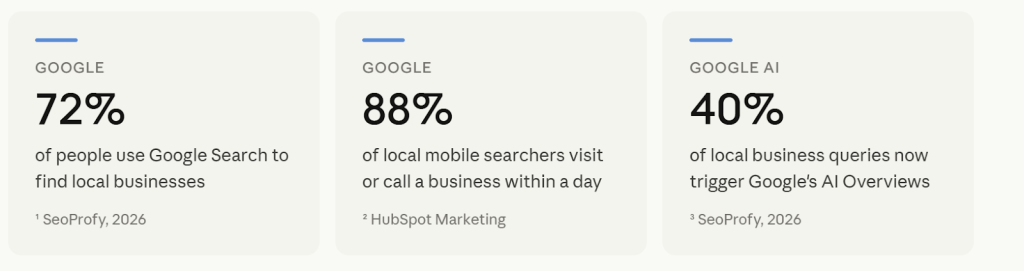
Google remains the default for most people starting a search. Around 72% of people use Google Search to find local businesses¹, and 88% of consumers who conduct a local search on their smartphone visit or call a business within a day². That is high-intent behaviour. The person searching is ready to act.
But Google only surfaces what Google knows about. And Google knows about businesses that have claimed their profile, maintained consistent information across the web, gathered reviews, and built some form of digital presence beyond a static website.
If you have done none of those things, you do not appear. Not because your business does not exist. Because Google has no reliable data to surface you.
40% of local business queries now trigger Google’s AI Overviews³, meaning the answer appears at the top of the page before any traditional search results. If your business is not in a structured, verified source that AI can cite, you will not appear in that answer either. You are invisible not just in the old search results but in the new ones too.
What Google does well: High-intent, transactional search. Someone who knows what they need and is ready to act.
What Google cannot do: Surface your business if you have not built a digital footprint. Find you if your data is incomplete, inconsistent, or absent.
Facebook: Community Discovery, Not Structured Search
Facebook positions itself as a search engine driven by social intent, with users actively using it to look up brands, research local businesses, and find answers from communities⁴. That is the aspiration. The reality on the ground is different.
Try typing “recruitment agency Chiang Mai” into the Facebook search bar. What comes back is a mixed, unreliable set of results combining pages, groups, posts, and profiles with no consistent structure or verification. Facebook search works reasonably well if someone already knows your business name. As a category discovery tool, it is weak.
Try this on your FB feed and see what comes up.
Where Facebook genuinely works for local discovery is through groups. Someone posts a question. The community replies. Recommendations surface through conversation, not algorithm. This is valuable but it is slow, dependent on timing, and heavily influenced by who happens to see the post at the right moment. If you are not active in local groups, not being recommended by existing customers, and not generating community conversation, you are absent from this channel entirely.
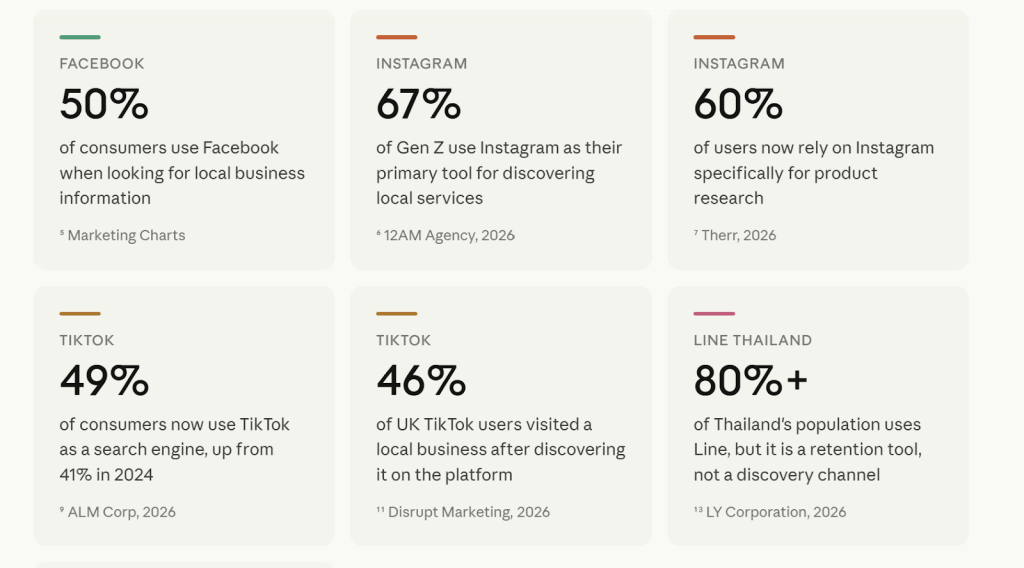
Around half of consumers use Facebook when looking for local business information⁵. However most of that usage is social discovery through community, not structured search through the platform’s own tools. AND we all know that no one actually uses the search function in the groups so the recommendation is a fleeting instance in time that only a few people see.
What Facebook does well: Word of mouth at scale. Community-driven recommendations. Reaching people who are already in your network or your community.
What Facebook cannot do: Reliably surface your business to someone searching by category who has no prior connection to you or your customers.
Instagram: Visual Discovery for the Right Kind of Business
Instagram has become a meaningful discovery channel, particularly for younger audiences. 67% of Gen Z and 54% of Millennials now use Instagram as their primary tool for discovering local services⁶.
The mechanism is visual. Someone scrolls, sees a place, sees a product, sees a service demonstrated in a post or reel, and follows up. 60% of users now rely on Instagram specifically for product research, a 16% increase from the previous year⁷.
But Instagram discovery is heavily skewed towards businesses with a visual story to tell. Restaurants. Cafes. Gyms. Salons. Retail. Hospitality. If your business is photogenic, active, and consistent on Instagram, you have a genuine discovery advantage.
If you run a recruitment agency, you do not. Neither does an accounting firm, a legal practice, a logistics company, or most B2B service businesses. Instagram can work for you as a credibility signal, a way to show the human side of your organisation, but it is not where your potential clients are going to find you through category search.
TikTok is where people find you. Instagram is where they follow and buy from you⁸. If Instagram works for your business category, it works well. If it does not, no amount of posting changes the fundamental mismatch between the platform’s discovery model and the type of search your customers are doing.
What Instagram does well: Visual discovery for lifestyle, hospitality, food, beauty, and retail businesses. Building trust and credibility once someone has already found you.
What Instagram cannot do: Surface your service business reliably through category search. Reach customers who are not already searching in a visual, interest-based way.
TikTok: The Fastest Growing Search Channel with the Biggest Limitations
TikTok’s growth as a search platform is real and significant. 49% of consumers now use TikTok as a search engine, up from 41% in 2024⁹. Google’s own internal research found that 40% of young users now turn to TikTok or Instagram for things they would previously have searched on Google¹⁰.
TikTok’s discovery model is different from every other platform. It does not wait for someone to search for you. It puts content in front of people based on what it predicts they will find interesting. When someone does search, it returns video results showing a place, a product, or a service being experienced in real time. In the UK, 46% of TikTok users have visited a local shop, restaurant, or attraction after discovering it on the platform¹¹.
TikTok has also launched a local feed that surfaces nearby content based on location. This is a meaningful development if you operate from a physical location.
But TikTok has structural limitations that matter specifically for the Chiang Mai business market.
First, the demographic skew. TikTok’s primary audience is young. If your customer is searching for a corporate accountant, a recruitment agency, a legal firm, or a business consultant, they are typically not starting that search on TikTok. The platform’s strength is lifestyle, food, beauty, local experiences, and consumer products. For B2B and professional services, the audience match is poor.
Second, the conversion problem. The top challenge reported by business owners using TikTok is converting engagement into actual sales¹². Discovery on TikTok is real. The path from that discovery to a commercial transaction very often is not.
Third, and most relevantly for a market like Chiang Mai: TikTok rewards content volume and consistency. If you do not have the resource to produce regular video content, you will not build search visibility on the platform, regardless of how good your service is.
What TikTok does well: Top of funnel discovery for consumer-facing businesses. Visual, experience-based categories. Reaching younger audiences who are actively using it as a search tool.
What TikTok cannot do: Reliably serve professional and B2B service searches. Convert discovery into enquiry without a clear follow-up pathway. Deliver results if you cannot sustain regular video content production.
Line: The Platform Everyone Uses and Nobody Searches
If you operate a business in Thailand, you almost certainly use Line. So do your customers. So does everyone else.
Line is used by 54 million people in Thailand, more than 80% of the country’s population¹³. That is not a social media platform competing for attention alongside Facebook and Instagram. That is infrastructure. In Thailand, Line is where people message their family, pay their bills, order food, communicate with their bank, and interact with government services. It is the operating system of daily Thai life.
Which is exactly why it does not work as a discovery tool.
Line is a relationship platform. You do not go to Line to find a business you do not already know. There is no meaningful category search. No one types “recruitment agency Chiang Mai” into Line and expects useful results. The platform was not built for that and does not function that way.
What actually happens is this. Users discover brands through other channels first, then turn to Line to communicate once they have made a decision¹⁴. The discovery happens on Google, on Facebook, through a directory, through a recommendation. Line comes after. It is where the conversation starts once the customer has already found you, not before.
This matters because many Thai businesses invest significant time building their Line Official Account presence and assume it is helping them get found. It is not. It is helping them serve and retain customers they already have. That is valuable. But it is a different job entirely.
More than 70% of Thai Line users follow at least one brand or business account¹⁵. Once someone finds you and follows your account, Line becomes one of the most direct and effective communication channels available in this market. Promotions, customer service, repeat purchase, loyalty. Line handles all of it well.
But none of that helps the stranger who does not know your name and is searching for the service you offer right now.
What Line does well: Customer communication, retention, chat commerce, promotions to existing followers, and direct customer service. For businesses embedded in the Thai market, it is an essential relationship tool.
What Line cannot do: Help anyone discover you. There is no search journey that starts on Line and ends with a new customer finding your business for the first time.
The distinction is simple but important. Line sits at the end of the discovery chain, not the beginning. Build your Line presence, but do not confuse it with being findable. Those are two different problems, and Line only solves one of them.
The Gap All Platforms Share
Here is what every platform above has in common when it comes to finding your business.
They are all interest-based or network-based. They surface what their algorithm predicts someone will engage with, or what that person’s network has already interacted with. None of them are built to give your potential customer a complete, structured, verified picture of what businesses exist in a specific category in a specific location.
TikTok and Instagram can show people great places, but they cannot reliably show what is available right where your customer is, right now¹⁶. They might see a stunning video from a city they will never visit or discover your competitor three days after you would have been the better choice.
Facebook groups surface what the community happens to mention at the moment someone asks. Google surfaces what has been optimised for Google. Line handles the conversation after the decision is already made. None of them tell your potential customer what simply exists, is operating, and is available to serve them today.
This is the gap that a verified local directory fills. Not as a replacement for any of these platforms. As the structured layer underneath all of them.
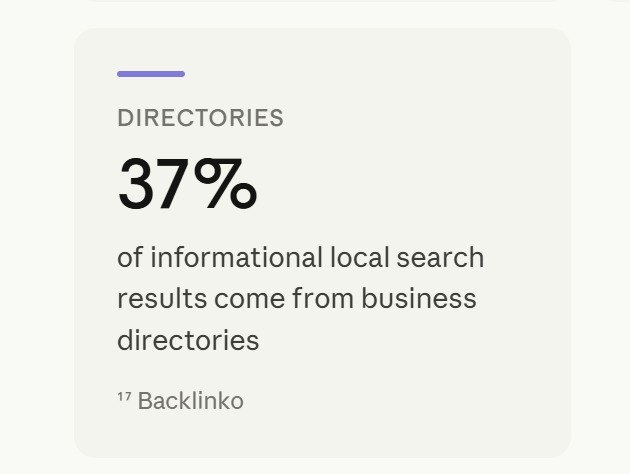
For informational local search terms, business directories account for 37% of organic search results¹⁷. Directories are not obsolete. They are a significant and growing part of how people verify and discover businesses, and they are precisely the kind of structured, citable source that AI systems draw on when generating answers.
When someone asks an AI tool which recruitment agencies operate in Chiang Mai, the AI does not check TikTok. It does not scroll a Facebook group. It does not search Line. It draws on structured, verified sources it can cite with confidence. A human-researched directory is exactly that kind of source.
What This Means for You
The question is not which platform to choose. It is which combination of platforms matches where your specific customers are searching, and whether you have the verified, structured foundation underneath that makes all of them work better for you.
If you run a restaurant, you need Instagram and TikTok. If you run a recruitment agency, you need Google and a verified directory. If you run a co-working space, you need both. If you run a legal firm, you need Google, a directory, and a LinkedIn presence. The mix changes by your category. The foundation does not.
That foundation is consistent, accurate, verified information in a trusted source. Everything else you build online sits on top of it. If the foundation is missing, the rest works less well than it should.
The Directory That Did Not Exist for Chiang Mai. Until Now!
I have been searching Chiang Mai’s business landscape category by category. What I found is a city with a strong, diverse, active business ecosystem and almost no verified, structured infrastructure to make it findable.
What was missing was a directory researched by people who operate here, covering every major business category, verified for accuracy, and built to be the kind of trusted source that both people and AI tools can rely on.
That is what we have built.
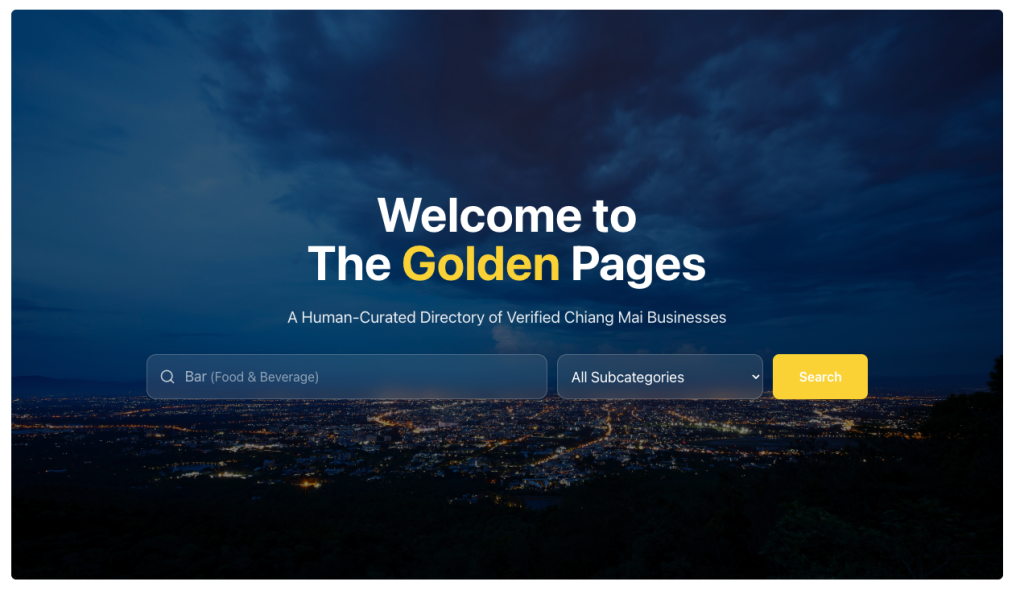
The Golden Pages Chiang Mai does not replace Google. It does not replace your Facebook group presence or your Instagram account. It is the layer that makes all of them work better, because it captures the businesses that none of them currently surface.
I found businesses that Google missed. I found operating companies invisible to every social platform. I found services that Chiang Mai residents need and cannot currently locate through any standard channel.
Golden pages by CMBN is putting them in one place.
The Golden Pages Chiang Mai launches 22nd April. Free listings are open now.
If you want to be found, this is where you start.
The CMBN Golden Pages launches 30th of April.
References
¹ SeoProfy, Local SEO Statistics 2026 ² HubSpot Marketing, Local SEO Statistics ³ SeoProfy, Local SEO Statistics 2026 ⁴ Sprout Social, Facebook SEO 2026 ⁵ Marketing Charts, Where Consumers Get Info About Local Businesses ⁶ 12AM Agency, Why Is Instagram Good for Marketing in 2026 ⁷ Therr, Social Search Is Replacing Google 2026 ⁸ 12AM Agency, Why Is Instagram Good for Marketing in 2026 ⁹ ALM Corp, TikTok as Search Engine 2026 Data ¹⁰ ALM Corp, TikTok SEO 2026 ¹¹ Disrupt Marketing, TikTok Updates 2026 ¹² ALM Corp, TikTok as Search Engine 2026 Data ¹³ LY Corporation, LINE for Business Thailand 2026 ¹⁴ Fortune International Thailand, LINE Users in Thailand 2025 ¹⁵ Fortune International Thailand, LINE Users in Thailand 2025 ¹⁶ Therr, Social Search Is Replacing Google 2026 ¹⁷ Backlinko, Local SEO Statistics