

Thailand’s nominee crackdown, and what it means for founders on both sides of the table
A few years ago, a foreign entrepreneur wanted to open a restaurant in a beach town. He found a local agent who promised to have the company running within two weeks, and the agent delivered. The Thai shareholders on the registration were the agent’s uncle, his sister, and his mother, none of whom had ever set foot in the restaurant, and none of whom received a share certificate, a shareholders’ agreement, or so much as a copy of the company’s memorandum.
When it came time to show that the family had actually paid in their 51 percent of the two million baht in registered capital, there was no money to show, because there had never been any money. The agent’s accountant solved that the way these things usually get solved: the capital was booked into the company, then lent straight back out again to a director. On paper, the company was compliant. In reality, three people who had never discussed running a business now legally owned the majority of one, and at least one of them didn’t fully understand what they had signed.
This is not a rare story. It is closer to the default setup used by agents who understand company registration but not company operation. This is exactly the kind of structure the Thai government has spent the last year building the tools to find.
What Thailand Actually Means by “Nominee”
Under the Foreign Business Act, a “nominee” is a Thai national who holds shares in a company on someone else’s behalf, so the company looks Thai owned on paper while a foreigner actually controls it and takes the economic benefit. It doesn’t matter whether the nominee is a professional fixer’s relative, a rice farmer paid a small fee, or a Thai spouse who never intended to be one. The law looks at who genuinely put in the money and who genuinely makes the decisions, not whose name sits on the share register. If the Thai shareholder is there to satisfy the paperwork rather than to own shares and run part of the business, the arrangement is illegal, full stop.
What the Law Actually Lets You Do
Here is what tends to get lost in the panic: the 51/49 split isn’t a workaround, it’s the actual rule, and there is nothing wrong with a foreigner holding 49 percent of a genuine Thai company. The Foreign Business Act splits business activities into three lists.
List 1 is closed to foreigners entirely, covering things like media, rice farming, and land trading.
List 2 needs Cabinet level permission and covers activities touching national security or culture.
List 3, where most restaurants, retail shops, consulting firms, and hospitality businesses sit, is open to foreigners who obtain a Foreign Business License, a real approval process, not a nominee workaround.
And if you want majority or full foreign ownership, there are legitimate roads to it. BOI promotion can grant a qualifying company 100 percent foreign ownership. The US Thai Treaty of Amity gives American citizens the same in most sectors, provided the ownership is genuinely American, no nominees allowed here either. We’ll cover exactly how those two routes work, and what it takes to qualify, in a follow up piece. The point for now is simply this: if you’re structuring around 49 percent because you assume it’s your only option, it usually isn’t. It’s worth finding out which door actually fits your business before anyone hands you a stand in shareholder.
Same Split, Three Different Companies
A 51/49 company holding a villa with no staff, no income, and no activity is a different animal from a 51/49 company running a real business with a foreign investor sharing in genuine profit and loss, and both of those are different again from a 51/49 company where the foreigner holds a work permit and actually runs the place day to day. All three are legal on paper. Only two of them are legal in substance, and the third needs to be able to prove it, because “the foreigner runs everything” is also, on its own, one of the eight things investigators are trained to look for.
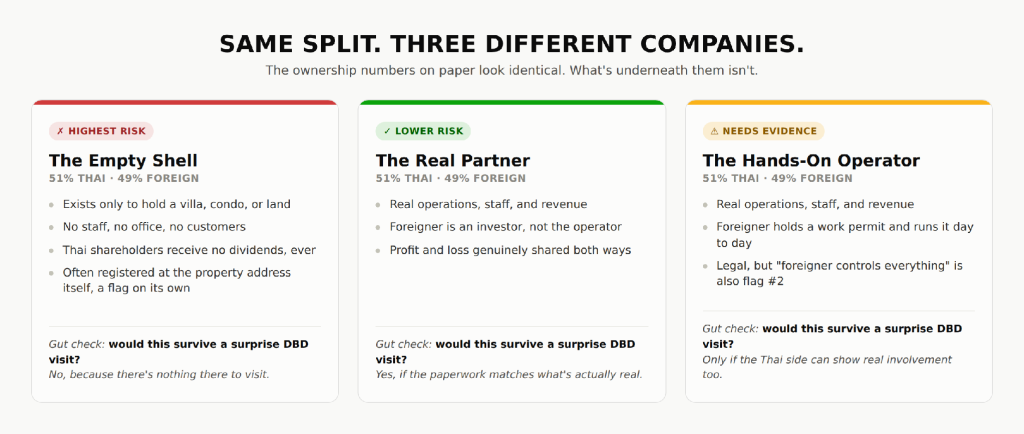
And this isn’t only a 51/49 problem. A company can be 100 percent Thai owned, with no foreigner anywhere on the share register, and still trip the same control test if a foreigner on a work permit is the one actually running it day to day, making the real decisions while the Thai owner stays passive. The indicator that matters there is control, not equity, and it doesn’t care whether a foreigner holds a single share.
The Eight Things Investigators Actually Check
The Department of Business Development works from eight main indicators to spot a nominee structure. Read on their own they sound abstract. Here is what each one actually looks like once a business is running.
| What Authorities Check | What It Looks Like in a Real Business |
|---|---|
| 1. Do Thai shareholders have the money? | Bank statements, declared income, and loan history should show they could genuinely afford their stake, not that the “investment” appeared and vanished the same week. |
| 2. Who actually runs the place? | Hiring, firing, supplier contracts, bank access, and day to day decisions all tracing back to one person with no Thai involvement is a flag, no matter what the share register says. |
| 3. Are there side agreements? | Powers of attorney, pre signed share transfers, or “loan” documents that quietly hand control back to the foreigner undo whatever the share register claims. |
| 4. Do Thai shareholders see any real money? | No dividends, ever, to the people who supposedly own the majority is hard to explain away. |
| 5. Does the same name show up everywhere? | The same Thai individual as a shareholder in ten or twenty unrelated companies, sharing an address, with no real involvement in any of them, reads as a rented name, not an investor. |
| 6. Is the company just holding an asset? | A company that exists solely to hold a villa, a condo, or land, with no other activity, is the easiest structure to unwind, because there is no operating business to point to as evidence of anything else. |
| 7. Is there an actual business here? | Real staff, a real office, real customers, and real tax and VAT filings are what separate an operating company from a shell. Shells draw by far the most scrutiny. |
| 8. Do the shareholders understand what they own? | A shareholder who cannot explain what the company does, does not know the value of their own shares, or says they signed “as a favour” is giving investigators exactly what they need. |
Two Very Different Kinds of Business Own the Same Problem
Not every 51/49 company carries the same risk and lumping them together is where a lot of the current anxiety comes from. A company set up purely to hold a piece of property for a foreigner’s personal use is, structurally, close to indefensible under points 6 and 7 above. There’s no business to point to, no revenue, and no reason for a Thai majority shareholder to exist except to satisfy the ownership rule. An operating business, a restaurant, a dive shop, a design studio, a consultancy, is a different case entirely, if the Thai shareholders are real investors or real operators and the paperwork backs that up. If you’re not sure which category your company actually falls into, that’s worth finding out before an inspector does.
When the Majority Shareholder Is Family
A lot of foreigners in Thailand run their business through a Thai spouse or an adult child rather than a stranger found through an agent, and it’s worth being direct about this: family ownership is not automatically a nominee arrangement, and the law doesn’t treat it as inherently suspicious. A Thai wife or child who is genuinely a business partner, who has a say in decisions, who shares in the profit, and who understands what she owns, is simply a majority shareholder, exactly as the law intends.
The risk shows up when the same eight questions above get asked of a family member and the answers look identical to a stranger’s: no real involvement, no real income from the business, no ability to explain what the company does. Love and trust inside a family don’t change what an investigator is measuring. If your wife or your son is the majority shareholder on paper, it’s worth being able to answer, honestly, whether they’d pass points 2, 4, and 8 above.
The Person Whose Name Gets Used
Almost everything written online about this topic is written from the foreigner’s side of the table: what the foreigner risks, what the foreigner should avoid. There’s a second person in every nominee arrangement, and they usually carry more of the real world consequence with less of the legal understanding. That second person is the Thai national whose name sits on the share register, often with no real stake, no real say, and no real understanding of what they’ve signed.
As of August 1st this year, the Department of Business Development started requesting bank statements directly from Thai nationals who co invest with foreigners, comparing what they declared as their investment against what actually moved through their accounts. This isn’t a future risk, it’s happening now, rolling out first across the provinces where foreign investment is heaviest, including Phuket, Chonburi, Chiang Mai, and the Bangkok metro area. The numbers from the first batch of provinces alone are striking: more than 18,000 companies flagged as very high risk, and another 14,000 flagged high risk, out of roughly 120,000 companies under review nationally.
Most of us have heard of, or know, a Thai person with almost no income who is somehow a shareholder in ten or more companies, often a relative or acquaintance of an agent, sometimes a rice farmer was paid a small fee for the use of their name. As the DBD’s records digitise and cross reference against tax and welfare data, that person becomes findable in a way they never used to be, and the consequences land on them personally, not just on the foreigner’s business. A young shareholder on paper can find themselves unable to get a student loan, because they appear, officially, to already own a stake in a two mor more million baht company. Someone receiving a state welfare or disability payment can lose it entirely, because the same records show them as a company shareholder, regardless of whether they’ve ever seen a baht of the company’s money.
None of this is about stopping ordinary Thai people from investing in businesses. It’s aimed squarely at stopping a rice farmer from being the fall guy for someone else’s company.
How Do You Know If Your Company Is at Risk?
Most foreign owned businesses in Thailand were never built to deceive anyone. They were built quickly, by an agent who was good at registration and never asked whether the shareholders understood, could afford, or benefited from what they were signing. The gap between “technically registered” and “actually defensible” is often down to missing paperwork: a missing shareholders’ agreement, a missing dividend history, a missing paper trail for the capital that was supposedly paid in.
Before DBD’s checks reach your province, or your shareholder’s name, it’s worth finding out where you actually stand. LAN Business Consulting can run an independent review of your company’s structure and financials against exactly the eight points above and tell you plainly whether what you have would hold up. If it wouldn’t, better to know now than to find out from an official investigation.
Get an independent review of your company’s structure and financials from LAN Business Consulting.
