
When most people hear the word “investment” they picture the same short list, bitcoin, gold, an ETF, or a slice of a listed company. All perfectly valid, all easy to explain in a sentence, and all things you can already research a thousand times over elsewhere. This article is about a different category, ones that quietly build wealth without a ticker symbol or a company attached at all, ones where the underlying asset is something you can actually walk up to and touch, a tree, a herd, a harvest.
Thailand has a longer history than most people realize in this space, and it is exactly the kind of territory CMBN thinks its members should have on their radar.
Owning the asset instead of owning the company
The single biggest shift to make is this. In a conventional investment you own a claim on a company’s future profits. In the models below you own the underlying productive asset itself, and a specialist operator does the work of growing, tending and harvesting it on your behalf, taking a fee or a share of the output rather than a share of a business.
That distinction matters practically as well as conceptually. If you own shares and the company fails, your claim is often near worthless. If you own the trees or the animals themselves, the physical asset still exists even if the operator managing it changes, though a poorly managed asset carries its own risks, which is exactly why due diligence on the operator matters more here than almost anywhere else.
Trees as an asset class
Thailand has become a genuine hub for a specific style of agricultural investment. Buy a set number of trees, a company plants, tends and harvests them for you, and you take a share of what the harvest sells for. It has grown well beyond a single crop.
- Agarwood, known in the trade as oud, is probably the best known example. The Aquilaria tree produces a resin used in luxury perfumery that can sell for tens of thousands of dollars per kilogram once distilled into oil, and Thailand hosts several operators running managed Aquilaria plantations for this purpose.
- Kynam, a rare and self inoculating variety of the same Aquilaria family, commands a premium over standard agarwood because it triggers its own resin production naturally, rather than needing the artificial inoculation ordinary agarwood trees require.
- Durian and mango plantations follow a similar pattern in Thailand, though some are structured as straightforward company shareholdings rather than direct tree ownership, a useful reminder that both models exist side by side in this market.
- Kratom, a leaf from a tree in the coffee family native to Thailand, offers something a little different again, a monthly leaf harvest rather than a once every few years wood or fruit harvest, so income can start flowing sooner and more steadily once the trees mature.
In every case the buyer owns the tree, or a defined block of trees, not a share in the company managing them. All backed up by purchase and management agreements with the plantation.
The herd, without the land
An idea worth putting alongside trees, buying into a herd rather than a plantation. Foreigners cannot own land in Thailand, which rules out the more familiar route of simply buying a smallholding, but owning livestock carries no such restriction, since an animal is a movable asset rather than real property.
This model already works elsewhere. In South Africa, a company called Livestock Wealth lets investors buy into cattle directly, a share of a herd, a pregnant cow, a calf, with a partner farmer supplying the land and doing the husbandry, and the investor cashing out when the farmer buys the animal back at the end of the term. It has built several thousand investors and paid out tens of millions of rand in profits since 2015.
Nothing quite like it appears to exist yet at scale in Thailand, which is arguably the opportunity rather than the obstacle, a herd based model built specifically around the land ownership problem foreign investors here actually face.
The old school parallel, futures
For anyone who has traded commodity futures before, there is a direct Thai equivalent worth knowing about. The Thailand Futures Exchange, TFEX, lists rubber futures, unsurprising given Thailand is the world’s largest natural rubber producer and exporter. Two versions trade, a standard cash settled contract, and a second version that actually delivers the physical rubber at expiry rather than just settling the price difference in cash.
That physical delivery contract is about as close as Thailand gets to a straightforward pork belly future, a paper contract against a real physical commodity, traded through a licensed exchange rather than a private company’s own scheme.
Why this isn’t shares, and what that means
None of the tree or herd models described above are securities in the legal sense. Buying trees or animals and paying someone to manage them is structured as a private sale and service contract, buy the asset, pay a management fee, share in the proceeds, not a claim on a company’s equity or profits. Thailand’s Securities and Exchange Commission regulates the licensing of anyone soliciting or advising on securities investment specifically, and these arrangements sit outside that framework altogether.
That cuts both ways. On one hand it means no listing requirements, no prospectus, no drawn out regulatory approval before a scheme can launch, which is part of why this space can move quickly and offer the returns it does. On the other hand it also means there is no SEC oversight sitting behind the promises made, no regulator to complain to if a harvest never materializes. The due diligence a broker or a fund prospectus would normally do for you, checking the operator’s track record, visiting the site, asking hard questions about what happens if the manager disappears, becomes entirely the investor’s own job. That is exactly why CMBN encourages members to do their own homework on any operator before committing capital, and why meeting one in person, as below, is a good place to start.
Come and meet one
The best way to understand this kind of investment is to meet someone running one. This month we’re opening our own doors for the first time, hosting the CMBN lunch at our offices, with a presentation beforehand from Kelvin Baird, director of International Plantation Solutions (Thailand), who grows both Kratom and Kynam on his own plantation in Ko Kha district, Lampang.
Kelvin’s own story is a useful reminder of what to look for in an operator. He was an investor in agarwood trees himself for six years, with a plantation company in Johor Bahru, Malaysia, before ever becoming an operator. He has since consulted on similar Kynam, Gaharu and durian plantations across Malaysia and Indonesia supporting roughly 1,000 investors. Kelvin visits his Lampang plantation around ten times a month to personally oversee planting, monitoring and harvest.
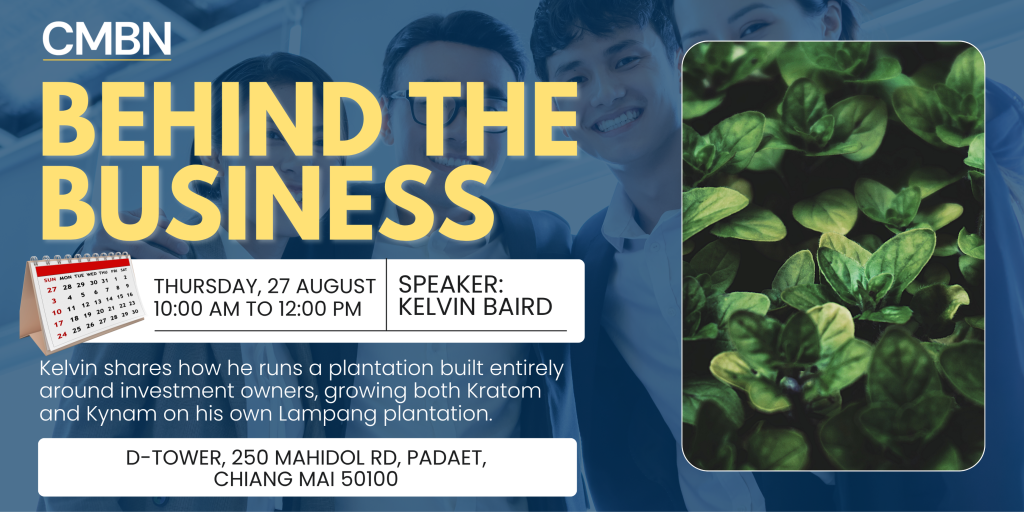
| JOIN US AT CMBN, AUGUST 27TH Come see the CMBN office and enjoy this month’s catered lunch, with a morning presentation from Kelvin Baird beforehand for anyone who wants to hear it.The presentation is open to anyone curious about alternative investment, and to all CMBN members for the lunch regardless of whether investing is on your mind. Presentation is free to attend, please book as spaces are limited. Lunch requires booking and prepayment of 350 THB. Please contact us to reserve your seat. Email cmbn@chiangmaibusiness.net or gee@chiangmaibusiness.net |
