

ธุรกิจที่อยู่ระหว่างผู้ป่วยต่างชาติกับโรงพยาบาลไทย
A Family’s Decision
Imagine a family from the Gulf considering medical treatment in Thailand for their young child with a long-term condition. This is a fictional scenario, but the questions they face are real.
They find several hospitals online, each offering specialist care and international patient services. Yet choosing a hospital is only the beginning.
How can they compare treatment estimates? Who will coordinate medical records, appointments, and communication across borders? And what happens when their child returns home and still needs ongoing care?
A medical facilitator, a company that helps patients choose and arrange treatment abroad, appears to offer a solution.
But major hospitals such as Bumrungrad already coordinate much of the patient journey within their own services. The hospital pages reviewed for this article, however, did not offer comparisons with competing providers.
That distinction raises three questions: What additional value can a medical facilitator provide? Who pays for it? And who is accountable when something goes wrong?
Before Travel: Who Helps Patients Choose?

Before booking their flights, the parents sit together, looking through hospital websites in Thailand. Their child needs ongoing medical care, and choosing the right hospital feels like a decision they cannot afford to get wrong.
Should they trust a hospital website, a recommendation from someone they know, or a company offering to help them choose?
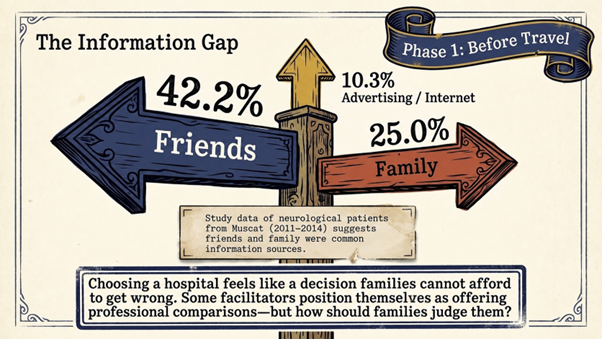
Personal networks may matter more than expected. A study of 116 neurological patients at one hospital in Muscat who travelled abroad between 2011 and 2014 found that 42.2% obtained information from friends, 25.0% from family, and 10.3% from advertising or the internet. The study covered multiple destinations, not Thailand alone, and is not representative of Gulf patients generally.
The parents could also contact hospitals directly. As of October 2026, Bumrungrad International Hospital advertised complimentary medical coordination covering records, treatment estimates, appointments, and third-party payers. Samitivej Children’s Hospital offered pre-arrival teleconsultations, coordinators, and interpreters.
Yet neither hospital’s reviewed service pages offered comparisons with competitors.
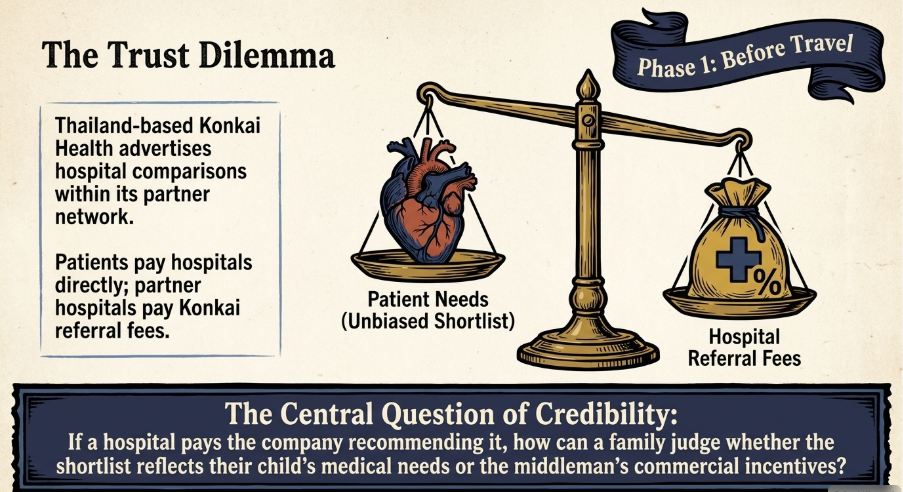
This is where a medical facilitator enters the picture. Thailand-based Konkai Health advertises hospital comparisons within its partner network. One plastic-surgery page offers quotes from two or three hospitals, although that does not establish the same service for other conditions.
Konkai states that patients pay hospitals directly, while partner hospitals pay it referral fees.
For the parents, this introduces another question: if a hospital pays the company recommending it, how can they judge whether the shortlist reflects their child’s needs or commercial incentives?
Our review found no evidence that referral fees actually influence Konkai’s recommendations. But the question remains central to the value and credibility of medical facilitation.

During Care: Who Pays the Middleman?
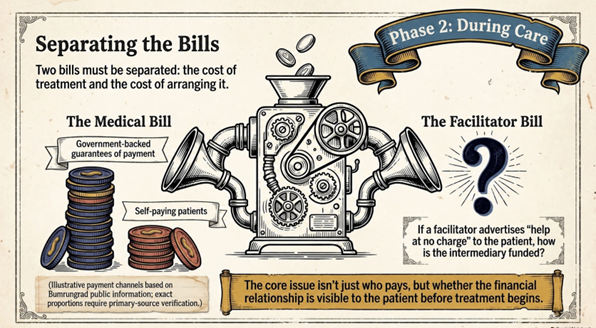
The parents have found a facilitator offering help at no charge. But if they pay nothing for the service, who pays the company?
Two bills must be separated: the cost of treatment and the cost of arranging it.
Medical treatment may be funded by patients, insurers, or governments. At Bumrungrad, executives reported in 2026 that approximately 75% of its Middle Eastern patients had government-backed guarantees of payment, while 25% were classified as self-paying. These figures describe one hospital, not the Gulf market as a whole.
The facilitator’s income is a separate question.
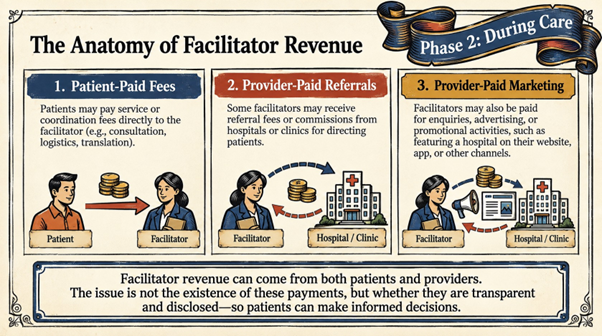
One model is patient-paid. India-based Medtu Care publishes a $1,000 fee for coordinating treatment in India, payable in three stages. It states that patients pay hospitals separately and that it accepts no hospital commissions.
Another model is provider-paid referral fees. Thailand-based Konkai Health says partner hospitals pay it for referrals. The pages reviewed did not establish the commission rate or precisely when payment is triggered.
An undated online referral-agent agreement from Thailand Medical Travel, operated by Australia’s Nuar Pty Ltd, describes hospital referral fees ranging from 6.5% to 20%, with a share going to referring agents. This is one company’s agreement template, not evidence of actual payments or an industry-wide rate.
A third model charges providers for patient enquiries. Bookimed’s August 2026 Finance Policy describes clinic-paid commissions alongside a separate advertising arrangement: clinics can pay per enquiry for offers labelled “Ad”. The company says these promotions do not alter its organic rankings.
For the parents, these models raise different questions. Who funds the intermediary? When does it earn money? And can the family see those relationships before accepting a recommendation?
Payment arrangements do not automatically prove biased advice. The documents reviewed do not establish whether referral fees change the recommendations patients receive. Yet payment linked to completed treatment could create one possible incentive to favour proceeding over advising against travel.
The issue is not simply whether the facilitator charges the patient. It is whether the financial relationship is visible and whether the recommendation can be trusted.
For this family, that matters before treatment begins, and even more if plans change.
After Returning Home: Where Dose Care End?
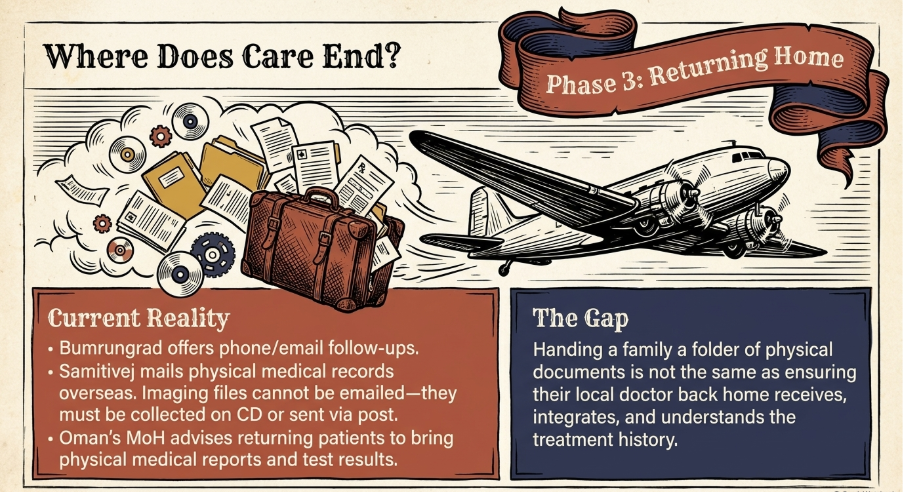
Back home, the parents unpack their child’s medical papers. Treatment in Thailand may have ended, but managing a long-term condition has not. They wonder: does their doctor at home know what happened?
Thai hospitals already offer aftercare. Bumrungrad says its coordinators follow up by phone or email after patients reach home. Samitivej says medical records can be mailed overseas, but imaging files cannot be emailed: they must be collected on CD or sent by post.
For the family, receiving records is not necessarily the same as ensuring their doctor receives and understands them.
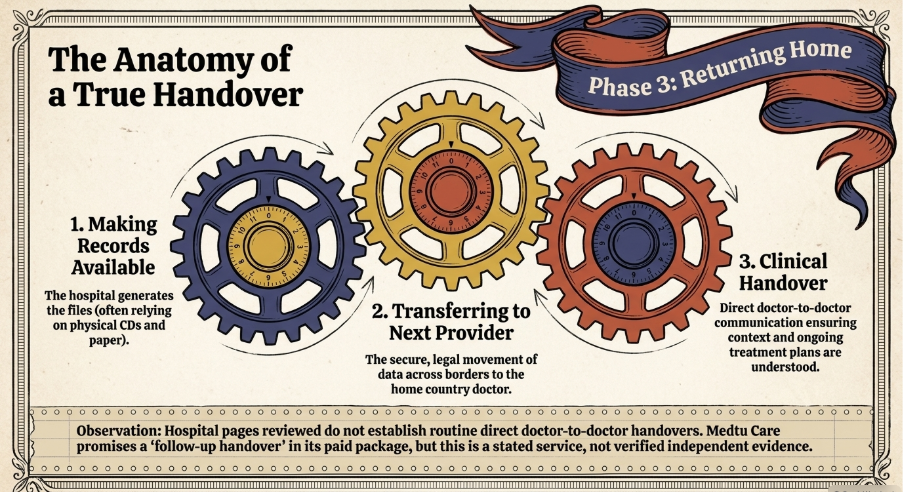
Continuity involves three separate steps: making records available, transferring them to the next provider, and completing a clinical handover. The hospital pages reviewed do not establish whether doctors in patients’ home countries routinely receive a direct handover.
Oman’s Ministry of Health advises returning patients to contact their treating doctor promptly and bring medical reports and test results.¹ Its overseas-treatment FAQ does not clarify whether this guidance covers self-funded patients.
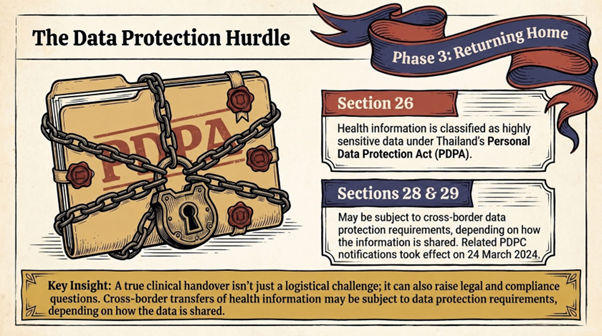
Cross-border transfers of health records can also raise data-protection requirements under Sections 28 and 29 of Thailand’s PDPA, depending on who transfers the information and the applicable legal conditions.
India-based Medtu Care, meanwhile, promises a “follow-up handover” in its publicly described paid package. This is a company-stated service, not independent evidence of completed handovers.
For the parents, the question is no longer who arranged treatment abroad. It is who ensures the next doctor has what they need to continue caring for their child.
When Things Go Wrong: Who Is Responsible?
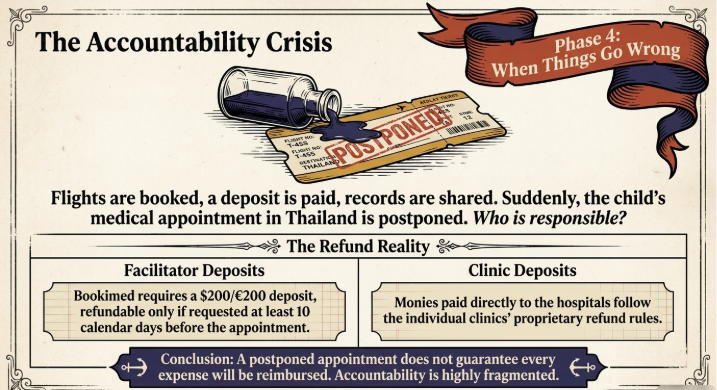
Imagine the parents receive a call: their child’s appointment has been postponed. Flights are booked, a deposit paid, and medical records shared. Who should they call and who is accountable?
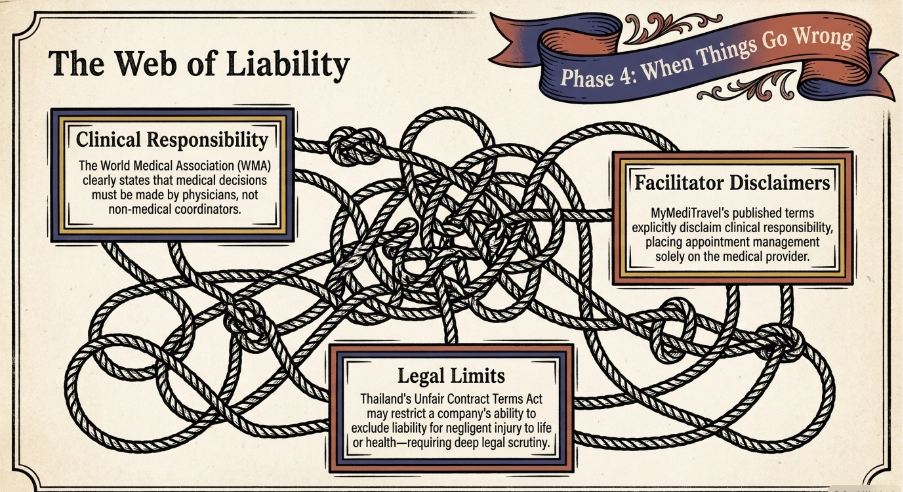
Responsibility depends on the service and what went wrong. The World Medical Association states that medical decisions should be made by physicians, not non-medical coordinators. MyMediTravel’s published terms disclaim clinical responsibility and place appointment management with the medical provider.
Deposits create another distinction. Bookimed’s published terms describe a $200/€200 deposit paid to Bookimed, refundable when requested at least ten calendar days before the appointment. Deposits paid directly to clinics follow the clinics’ own refund rules. A postponed appointment does not necessarily mean every expense will be reimbursed.
The child’s medical records raise further questions. Under Thailand’s PDPA, health information is sensitive data (Section 26), while Sections 28–29 govern certain transfers abroad, potentially including the sharing of records with doctors overseas. Related PDPC notifications took effect on 24 March 2024.
Contractual disclaimers may also have limits. According to commentary on Thailand’s Unfair Contract Terms Act, exclusions of liability for negligent injury to life or health may be restricted. How these provisions apply to foreign-registered intermediaries requires further legal examination.
For the parents, accountability means knowing who handles medical decisions, appointments, payments, and sensitive records before something goes wrong.
This analysis draws on publicly available documents and does not constitute legal advice.
Limitations of the Evidence
This analysis has important limitations. Much of the evidence comes from hospitals’ and facilitators’ own websites, published terms, and service descriptions rather than independently verified performance. The available figures describe individual hospitals or limited patient samples and should not be treated as market-wide estimates. The review also found no direct evidence that medical facilitators deliver measurable additional value compared with hospital services. The opportunities discussed below are therefore questions for further investigation, not established market gaps.
Conclusion: Where Is the Real Opportunity?
Back home, the family has more than a folder of medical records. They still have questions. Was the hospital recommended because it suited their child’s needs? Who would help if plans changed? And would their doctor at home have the information needed to continue care?
The three hospitals reviewed for this article already advertise substantial international-patient support, although their services differ. Medical facilitators must therefore demonstrate what they can add beyond arrangements patients can access directly.
That value might involve transparent hospital comparisons, clearer financial relationships, defined responsibilities, or better coordination across borders. None has yet been established as an unmet market need.

A study of 116 Omani neurological patients who travelled abroad found that friends and relatives were prominent sources of information. It did not establish the role of commercial facilitators. Could specialised coordination reach patients who need additional support? And would similar questions arise outside Bangkok? Both remain untested.
For the family, a reliable intermediary would need to offer more than bookings or airport transfers. It would need to demonstrate how its services support informed decisions and continuity of care.
If there is a business opportunity, it may lie in making the patient journey more transparent, accountable, and connected and proving that this creates value.

References
Al-Asmi, A., Al-Jabri, F. S., Al-Amrani, S. A., Al Farsi, Y., Al Sabahi, F., Al-Futaisi, A., & Al-Adawi, S. (2024). Medical tourism and neurological diseases: Omani patients’ experience seeking treatment abroad. Oman Medical Journal, 39(3), e628. https://doi.org/10.5001/omj.2024.69
Bookimed. (2026a, August). Finance policy. https://us-uk.bookimed.com/page/finance-policy/
Bookimed. (2026b, August). Payment and deposit terms. https://us-uk.bookimed.com/page/payment-and-deposit-terms/
Bumrungrad International Hospital. (n.d.). Medical travel guides. Retrieved October 21, 2026, from https://www.bumrungrad.com/en/medical-travel
Konkai Health. (n.d.-a). Plastic surgery prices in Thailand. Retrieved October 21, 2026, from https://www.konkai.health/articles/plastic-surgery-pricelist-thailand
Konkai Health. (n.d.-b). World-class medical care in Thailand—arranged for free. Retrieved October 21, 2026, from https://www.konkai.health/
Konkai Health. (2026, February 23). Terms of service. https://www.konkai.health/terms-of-service
Medtu Care. (n.d.). Our fees, published. Retrieved October 21, 2026, from https://www.medtu.care/fees/
Ministry of Health, Sultanate of Oman. (n.d.). Directorate of treatment abroad FAQ [Arabic-language frequently asked questions]. Retrieved October 21, 2026, from https://www.moh.gov.om/en/directorate-of-treatment-abroad-faq/?p=3
MyMediTravel. (2024, January 19). Terms of use. https://www.mymeditravel.com/about/terms-of-use
Personal Data Protection Act, B.E. 2562 (2019) (Thailand). https://www.ocs.go.th/searchlaw/law-index/item/224
Personal Data Protection Committee. (2023). หลักเกณฑ์การให้ความคุ้มครองข้อมูลส่วนบุคคลที่ส่งหรือโอนไปยังต่างประเทศตามมาตรา 28 แห่งพระราชบัญญัติคุ้มครองข้อมูลส่วนบุคคล พ.ศ. 2562 พ.ศ. 2566 [Criteria for the protection of personal data transferred abroad under Section 28 of the Personal Data Protection Act]. https://data.go.th/en/dataset/dataset_11_0515
Samitivej International Children’s Hospital. (n.d.-a). International patient services. Retrieved October 21, 2026, from https://www.samitivejhospitals.com/about-us-children/international-patient-services
Samitivej International Children’s Hospital. (n.d.-b). Medical records & pharmacy information. Retrieved October 21, 2026, from https://www.samitivejchildren.com/en/patient-resources/aftercare/medical-records-and-pharmacy-information
World Medical Association. (2018, October). WMA statement on medical tourism. https://www.wma.net/policies-post/wma-statement-on-medical-tourism/
