
On 25 September, the Real Estate Information Center presented a table of Chiang Mai’s foreign condominium buyers that contradicts this month’s national headlines. Foreign nationals took ownership of 379 units in the province between January and June 2026, up from 318 a year earlier. Over the same six months, foreign transfers across Thailand fell 8.8% to 6,533 units. The figures matter to anyone buying, selling or letting a condominium in the city, because they show a buyer base moving away from dependence on China towards a wider mix of countries.
The Real Estate Information Center (REIC) is the research arm of the Government Housing Bank and compiles Land Department transfer records into regular market reports. Its figures count ownership transfers registered at the Land Department, which happen when a building is finished and handed over, so they record completions rather than the day a buyer signed.
A condominium unit is the one form of property a foreign national can own outright in Thailand, up to 49% of the floor area of any single building. The Chiang Mai table was presented by Ms Sitthiphen Sitthatthaphong, Assistant Director of the REIC Research and Innovation Department, at the seminar REIC Property Intelligence 2026: Northern Region Insights and Outlook 2027.
The same briefing reported that condominium sales in Chiang Mai rose 49.4% in the first half of the year. Transfers of new condominium units grew by almost 50% in number and almost 80% in value, and REIC credited foreign demand and buyers moving into the city for that recovery. REIC estimates the city’s unsold condominium stock will clear in about 39 months at the current pace.
MARKET POSITION
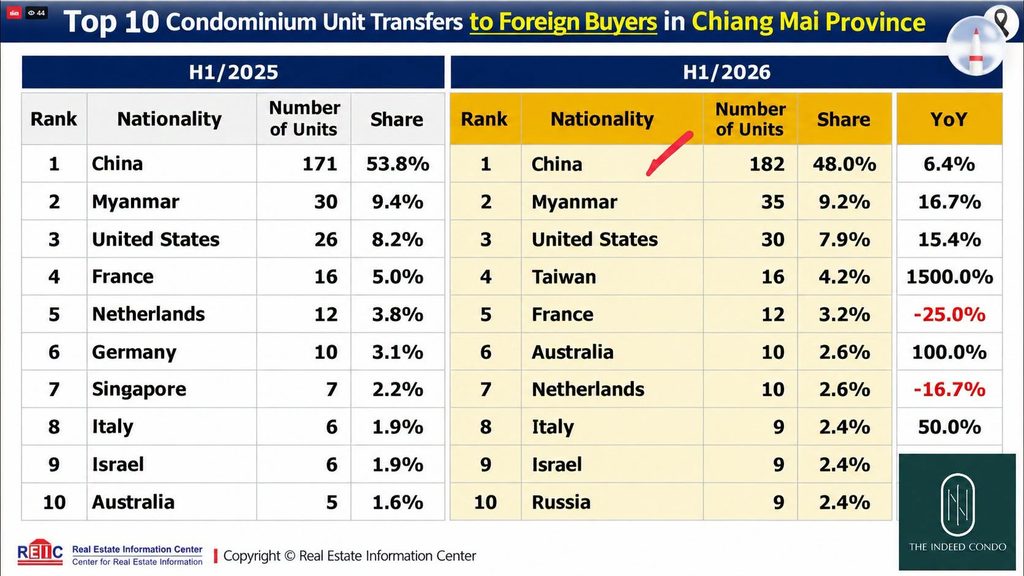
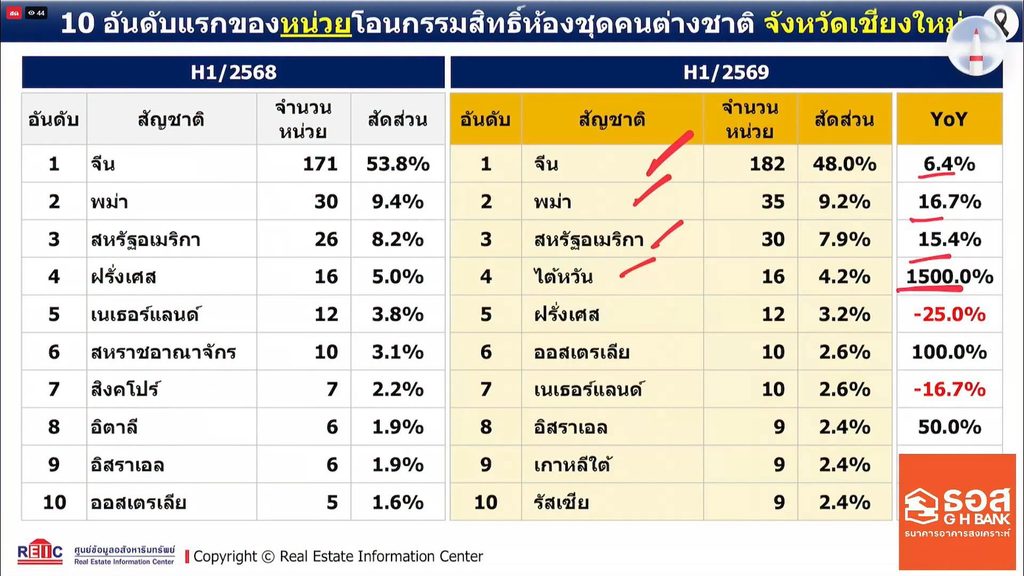
China remains the largest group of foreign buyers in Chiang Mai, with 182 units in the first half of 2026, but its share fell from 53.8% to 48.0%. Myanmar (35 units) and the United States (30) hold second and third place, as they did a year earlier. Taiwan rose to fourth with 16 units, and South Korea and Russia entered the top 10 with nine each. The United Kingdom, Singapore and Italy, all in the 2025 top 10, fell out of it.
| Nationality | Units, Jan to Jun 2025 | Units, Jan to Jun 2026 | Change |
|---|---|---|---|
| China | 171 | 182 | +6.4% |
| Myanmar | 30 | 35 | +16.7% |
| United States | 26 | 30 | +15.4% |
| Taiwan | 1 | 16 | +1,500% |
| France | 16 | 12 | -25.0% |
| Australia | 5 | 10 | +100% |
| Netherlands | 12 | 10 | -16.7% |
| Israel | 6 | 9 | +50.0% |
| South Korea | Outside top 10 | 9 | Not shown |
| Russia | Outside top 10 | 9 | Not shown |
Condominium units transferred to foreign buyers in Chiang Mai, top 10 nationalities in the first half of 2026. Source: REIC slide presented 25 September 2026.
Across Thailand, Russia is the fastest-rising group, with 842 units transferred in the same six months, up 50.4% and concentrated in Phuket and Chonburi. A foreign-owned unit nationally averaged 4.3 million baht and 43.9 square metres, and the Chiang Mai slide reports units only, not value.
KEY FINDINGS
Chiang Mai grew while the national market contracted
Foreign condominium transfers in Chiang Mai rose by 19% while the national total fell 8.8%. The province’s share of all foreign condominium transfers in Thailand rose from 4.4% to 5.8%. REIC attributes the national decline to slower growth at home and abroad, which has led overseas buyers to delay large purchases.
China holds first place but supplied less than a fifth of the growth
Chinese buyers added 11 units, 18% of the city’s net increase of 61. Nationally, units transferred to Chinese buyers averaged 3.8 million baht and 38.2 square metres. A 2025 study of 38 Chinese families with children at 23 Chiang Mai international schools found they had relocated whole households, not only their children, to escape educational and social pressure in China.
Buyers from outside China drove the growth
Transfers to all other nationalities rose from 147 units to 197, an increase of 34%. Nationalities below the top 10 roughly doubled their combined total, from 29 units to 57. That spread leaves the city less exposed to a downturn in any single source country.
Myanmar buyers increased in Chiang Mai while falling nationally
Myanmar transfers in Chiang Mai rose from 30 units to 35. Nationally, Myanmar buyers took 279 units in the first quarter of 2026, against 439 in the first quarter of 2025. Myanmar spending on Thai property, including in Chiang Mai, has risen every year since the 2021 coup, and Colliers has pointed to the city’s closeness to Myanmar as part of its appeal.
Western European demand weakened
French transfers fell from 16 units to 12 and Dutch transfers from 12 to 10. The United Kingdom, with 10 units in 2025, and Italy, with six, dropped out of the top 10. Buyers from nearer Asian markets took their places, led by Taiwan, which rose from one unit to 16. The slide does not show how many projects account for that rise, and a single handover of units in one building is enough to produce it.
CHIANG MAI CONTEXT
Chiang Mai competes on what it costs to live in rather than on holiday rentals, and its international school fees run about USD 5,800 to 8,700 a year, against more than USD 30,000 in Bangkok. Seoul and Taipei are the two leading international routes from Chiang Mai International Airport, and four airlines fly direct to Taipei.
In the fifth phase of the national crackdown on nominee ownership, investigators screened all 33,144 companies registered in the province, flagged 4,741 foreign-owned firms and raided 18 locations. A condominium held freehold in a foreign buyer’s own name, within the 49% quota, sits outside that crackdown, although the Department of Business Development is now extending its checks to companies that buy condominium units on behalf of foreign owners.
The buyers arriving in Chiang Mai now come from a wider spread of countries than a year ago, and any agent, developer or lawyer still marketing to Chinese buyers alone is marketing to a buyer base that has already changed.
SOURCES
Sources and methodology
Unit counts by nationality come from the REIC slide shown at the northern region seminar, reported by Prachachat Turakij and Krungthep Turakij on 25 and 26 September 2026. REIC did not state a Chiang Mai total, so CMBN derived totals of 318 and 379 units from China’s count and percentage share and checked them against the other rows. Every Chiang Mai total, share and growth rate in this report rests on those derived figures, rounded as shown. National figures come from REIC’s report on foreign condominium transfers for the second quarter and first half of 2026, as published by InfoQuest, The Nation, Thai PBS World and Krungthep Turakij, with first-quarter nationality figures from TrueID News and The Bangkok Insight. Supporting context comes from Myanmar Now, The Nation, a 2025 study in SAGE Open, The China-Global South Project, FlightsFrom, FlightConnections, Thai PBS World and Thairath. The slide does not give transfer values for Chiang Mai, and the year-on-year changes for South Korea and Russia were covered by an on-screen logo in the stream. Research was carried out between 25 and 27 September 2026.
