
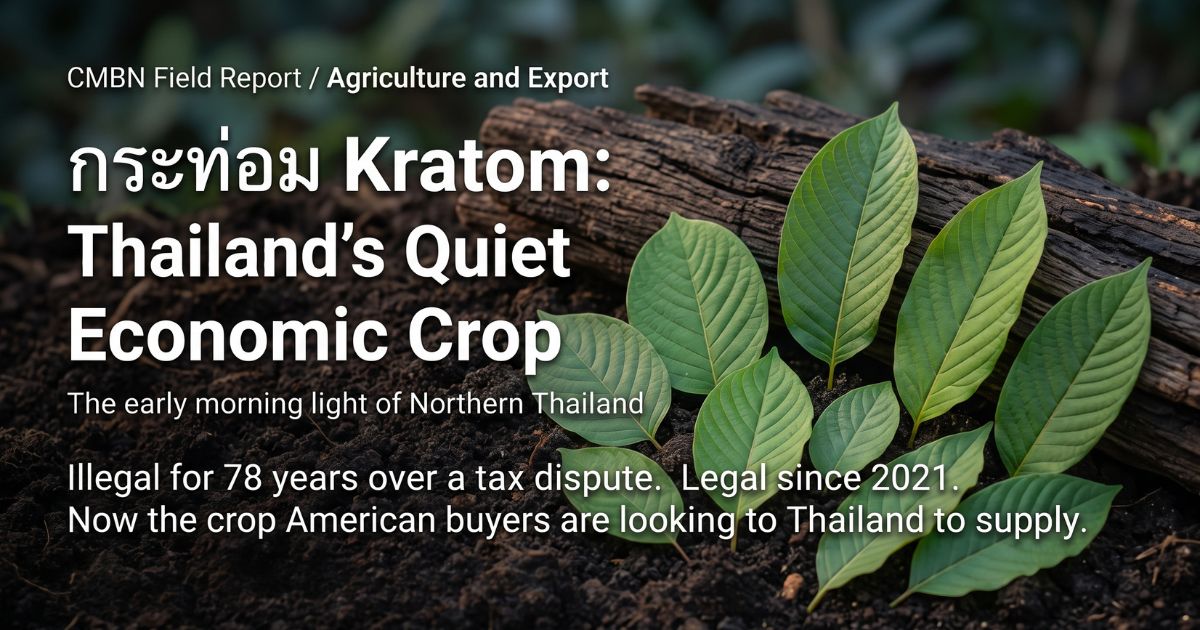
Walk through the herb section of Warorot Market on any weekday morning and something has changed. On several of the older stalls, tucked between the dried galangal, the bundles of lemongrass, and the jars of tamarind paste, there are small packets of dried leaves and a powder the colour of green tea, with a handwritten sign in Thai and sometimes a rough English translation alongside it. Kratom. Legal since 2021, now sitting openly next to the ginger and the holy basil, as if it had never been anywhere else.
For many people in this city, it is still unfamiliar. Kratom is not a northern plant. Ask most Chiang Mai residents about it and the reaction is often a vague recognition: something from the south, something that used to be illegal, something associated with a particular kind of person in a particular kind of place. That reputation is worth examining. The business story developing around kratom in northern Thailand is being shaped by people who understand where it came from, and who are moving quickly to position the north as something new.
Where kratom comes from
Kratom is a tree. Its scientific name is Mitragyna speciosa, and it is a close relative of the coffee plant. At low doses it works just like a strong cup of coffee: stimulating, sharpening focus, reducing the feeling of tiredness. At higher doses the effect shifts, and it becomes calming, pain-relieving, and sedating. The same plant, the same leaf, with different effects depending on how much you take and which type of leaf you are using.
For centuries, the plant has grown widely across southern Thailand, Malaysia, and Indonesia. Farmers, fishermen, and rubber tappers chewed the fresh leaves to get through long days of physical labour in intense heat. Traditional healers brewed it into tea and used it for fever, pain, coughs, and muscle ache. In Muslim communities across the southern provinces of Pattani, Yala, and Narathiwat, where alcohol is not permitted, kratom tea was served as a communal drink at social gatherings.
This pattern is not uniquely Thai. Every civilisation that required sustained physical labour in harsh conditions developed a local plant that helped people get through the day. In the Andes, indigenous communities chewed coca leaves for altitude fatigue and endurance, a practice going back thousands of years that had nothing to do with the extracted substance that later created the international drug crisis. Across South and Southeast Asia, betel and areca nut were chewed for the same reasons: mild stimulation, hunger suppression, and a shared social ritual that marked the rhythm of working life.
In East Africa, khat filled the same role. Across the Americas, tobacco. Every culture found its own plant, shaped by whatever grew in the soil around it, but the underlying need was identical: something to help people work harder, rest better, or simply get through the day together. Kratom was Thailand’s version of that same story. It was not exotic or recreational. It was simply useful, woven into daily life the way coffee is woven into ours now, and carrying the same social weight that betel still carries across much of Asia today.
The law that changed everything
In the 1940s, something political happened that shaped kratom’s reputation for the next eight decades. At the time the Thai government was collecting significant tax revenue from opium. Farmers across the south, many of whom could not afford opium and had no particular interest in it, were using kratom instead. Not because kratom and opium produce the same effects, they do not, but because kratom was free, it grew on their land, and it worked well enough for the purposes they needed it for. The government saw this as a problem. Every kratom leaf chewed by a farmer was revenue that did not flow to the state, and as long as kratom was freely available, it kept a ceiling on how many people would ever turn to opium, and opium was where the tax revenue sat.
In 1943, the Kratom Act was passed and the plant was declared illegal. Overnight, something that farming communities had used for generations became a criminal matter. A farmer with kratom leaves on his property could be arrested. The reasoning was not complicated: the law had very little to do with public health and everything to do with protecting a tax base.
That law stayed in place for 78 years. Across three or four generations of rural Thai families, people carried criminal records for using a plant their grandparents had grown freely and their parents had used without question. Many continued using it anyway, because in communities where the village healer had prescribed kratom tea for pain and fever for as long as anyone could remember, the idea that it belonged in the same category as dangerous narcotics was simply not credible.
The reputation kratom carries today was shaped not by doctors or researchers but by a revenue calculation made by a government ministry in 1943, and the stigma that followed outlasted the law that created it by decades.
What the leaf is: the three types
Kratom leaves are not all the same, and the difference is not about which tree they come from. It is about when each individual leaf is picked. The same tree carries leaves at different stages of maturity at the same time, and the colour of the vein running through each leaf shows where it is in that cycle. Experienced farmers harvest selectively, reading vein colour, leaf size, and stem texture to decide which leaves to pick for which product. There are three main types.
White vein leaves are the youngest, harvested early in the plant’s growth cycle. They produce a stimulating effect, similar to a strong cup of coffee: energy, focus, and reduced fatigue without the jitteriness that too much caffeine can bring. This is the type that farmers traditionally used to start a long working day.
Green vein leaves sit in the middle of the maturity cycle, and the effect reflects that middle ground. Green kratom offers a mild lift in energy and mood with some physical ease, making it the gentlest introduction for someone who has never used it and the type most likely to appear in the cafe and wellness products now emerging in Chiang Mai.
Red vein leaves are the most mature, harvested later and often processed through an additional drying or fermentation stage. The result is calming rather than stimulating: red kratom is most associated with pain relief, muscle relaxation, and sleep, and it was the type favoured by traditional healers for medicinal use. It also carries the highest concentration of the active compounds that regulators pay closest attention to.
The colours are not added or artificial. They come from the leaf itself, from the age of the plant at harvest and how it is handled afterwards. This is also why growing conditions matter. Different soil, different altitude, and different temperature ranges produce different profiles in the leaf, which is why northern Thailand, with its cooler nights, higher elevation, and mineral-rich mountain soil, is now attracting serious attention from kratom operators who understand that where a plant grows shapes what it becomes.
That is the story the south built over centuries. The north is just beginning to write its own.
Kratom today: not just a leaf
The popular image of kratom is a farmer chewing a leaf in a field. That image belongs to a different era. What is being traded today is a commercial product range that would be familiar to anyone who has worked in the health supplement or wellness industry.
At the base of the product range is dried and powdered leaf, the raw material that overseas buyers import by the tonne. Above that sits a growing range of processed products: kratom tea bags, ready-to-drink beverages, liquid extracts, capsules, and tablets. In southern Thailand, street stalls sell kratom syrup by the glass alongside fresh leaf tea, the same way a coffee cart sells espresso alongside whole beans. In Chiang Mai, some of the dispensaries that built their retail format around cannabis have pivoted to kratom as cannabis regulations tightened sharply through 2025. Online platforms carry licensed Thai kratom products for domestic delivery, and the export framework introduced in 2025 has opened the door to international shipping for operators who hold the right licences.
A kratom tree needs two to three years from planting before it produces leaves in sufficient volume for commercial harvest. After that, what you harvest and when depends entirely on what you are producing. White vein leaves come from the youngest growth and can be picked earlier in the cycle. Red vein requires patience: you are selecting the most mature leaves on the tree, which means waiting longer between harvests of that specific type. The farmer who wants consistent red vein production is managing a harvest schedule, not just waiting for a season. That harvest rhythm, compounding across multiple cycles per year from the same trees, is what makes an established plantation significantly more attractive economically than an annual crop that pays once.
The product range is still developing. Most of the global market still trades in powder and raw leaf, but the fastest growth is happening further up the value chain. Capsules, tablets, and beverages are where the premium pricing sits, where consumers get a consistent and measurable dose, and where product travels cleanly through regulated export channels. Thai operators who are thinking about this market at the manufacturing level, rather than just the farming level, understand that the real margin is not in the raw commodity but in what you do with it before it reaches the buyer.
Who buys it
The global kratom consumer is predominantly American. The United States accounts for roughly 41 percent of global market share, a market valued at around USD 2 billion in 2025, serving an estimated 1.7 million regular users who spend close to USD 880 each per year. These are committed buyers purchasing a product they use regularly, often as a substitute for prescription pain medication or as a daily energy supplement.
Competing products exist: kava for relaxation, CBD for pain, and prescription alternatives for withdrawal management. But none of them replicate what kratom does across all three use cases simultaneously. That combination is what drives loyalty in this consumer base and what makes supply reliability so commercially important to American buyers.
The consumer profile matters for Thai exporters because it shapes what the market actually wants. The American kratom buyer skews toward middle-aged adults managing chronic pain, fatigue, or the aftermath of opioid dependency. They are experienced users who have formed preferences around strain, product type, and brand. They read lab test results. They notice inconsistency between batches. They will pay more for a product they trust, and they will move away from a supplier who delivers variable quality without warning.
Europe represents the second significant market at around USD 357 million, though it is fragmented across 27 jurisdictions with very different legal positions. The Netherlands is the continental hub, generating an estimated USD 80 to 120 million annually while handling the majority of European import volume through Rotterdam. Germany follows as the largest consumer market, though a 2025 court ruling now requires operators to hold a licence before selling commercially. The United Kingdom and France maintain complete bans. Belgium joined them in June 2024.
Within Thailand, the domestic market has always existed. In the south, kratom stalls and street vendors have been part of daily life for generations, operating quietly through the decades when the plant was technically illegal and continuing openly since legalisation in 2021. What has changed is not the demand but the legitimacy: sellers no longer operate in the shadows, products can be labelled and standardised, and the market can now be measured and supplied commercially. The Thai consumer is a very different buyer from the American one: the price point is lower, the product is simpler, and the cultural relationship with the plant is embedded rather than acquired. Both markets matter, but they require entirely different product and pricing strategies.
The segment growing fastest globally is not bulk powder. It is high-value processed products: capsules, extracts, and ready-to-drink beverages. Online sales now account for 53.8 percent of the extract market. But the opportunity is not limited to manufacturers. The kratom value chain has multiple entry points, each with its own commercial logic.
The farmer grows and harvests the leaf. The raw material producer dries, processes, and tests the leaf to a consistent standard, confirming alkaloid levels, particle size, and the absence of contaminants, so that overseas buyers know exactly what they are purchasing. The product manufacturer converts it into capsules, extracts, or beverages to a consistent, lab-tested, FDA-registered standard. The exporter manages licensing, documentation, and international logistics. The retailer, whether a physical store, a wellness operator, or an online platform, builds the brand relationship with the end consumer. Each layer adds value. Each layer has margin. A Thai operator competing on raw leaf price is fighting Indonesia on Indonesia’s terms. A Thai operator who controls two or three layers of that chain is building something that cannot easily be replicated, and where brand trust rather than commodity price becomes the primary driver of repeat business.
Where the competition sits, and why Indonesia’s position is changing
To understand the opportunity for Thailand, you need to understand how completely Indonesia has dominated this market until now.
Indonesia’s West Kalimantan province alone cultivates kratom across 11,384 hectares, supporting an estimated 200,000 farming households who collectively export between 300 and 500 tonnes every month. The Indonesian kratom economy generates around USD 100 million in annual export revenue. Kalimantan supplies over 70 percent of the world’s kratom leaf exports. Sumatra adds significant additional volume. Between them, Indonesian provinces have supplied close to 95 percent of global demand for decades, almost entirely directed at the American market since domestic consumption of kratom is prohibited inside Indonesia.
That structure is now under pressure from the Indonesian government’s own regulation. In September 2024, Indonesia introduced formal export controls requiring exporters to hold registered status and export approval, alongside processing standards requiring powdered kratom under 600 microns. These regulations tightened further in early 2025. The intent was to support domestic value-add and protect supply sustainability. The effect for international buyers was reduced flexibility in sourcing and a forecast wholesale price increase of between 100 and 400 percent for crushed leaf.
American importers reacted quickly. Supply chain diversification became a priority. The question being asked across the US kratom industry in 2025 was straightforward: who can supply consistent, quality-controlled kratom at scale, with a clear legal framework and reliable shipping? Indonesia was no longer the only answer by default.
Thailand is the obvious candidate, and not only because of geography. Thailand has a government that has actively promoted kratom as an export crop, a regulatory framework built for commercial trade rather than retrofitted from a narcotics law, and cultural familiarity with the plant going back centuries. It also has something Indonesia does not: a legal domestic market that creates a foundation of processing infrastructure, quality standards, and product development that pure export-focused producers lack.
The constraint for Thailand is volume. Indonesian production dwarfs Thai cultivation at present. Closing that gap takes time, land, and investment. But the buyers are not waiting for Thailand to match Indonesia’s scale. They are looking for a credible second source, a reliable supplier who can deliver quality product consistently, even if the volumes are initially smaller. That is a position Thailand can occupy now, without needing to match what Indonesia has built over decades.
Malaysia adds another dimension to this picture. Kratom grows natively across northern Malaysia and has been cultivated there for generations. Growing the trees remains legal. Everything else, picking the leaves, processing them, selling or transporting them, is prohibited under the Poisons Act 1952. The result is a significant volume of kratom moving informally across the Thai-Malaysian border, which is already affecting supply in southern Thailand. Malaysia’s government is actively discussing legalisation, with senior ministers framing kratom as an economic crop opportunity. If that happens, a third substantial producer enters the legitimate market. For Thailand, that is another reason to move quickly while the regulatory advantage still holds.
| Watch point: Sugano Matha, MP for Yala Province in Thailand’s deep south bordering Malaysia, and member of the Prachachat Party, called for kratom to be reclassified as a narcotic in August 2025. The concern is linked to the practice of mixing kratom with cough syrup and other substances, known locally as ‘4×100’, a problem most acute in the southern border provinces. This debate has not produced any legislative change as of mid-2026, and the Kratom Plant Act framework remains stable. Operators in the legitimate, licensed, GMP-compliant space are not the target of this debate, but it is worth monitoring as Thailand heads into its next political cycle. |
Kratom: legal status across Asia
Understanding where kratom is legal, and where it is not, matters for anyone thinking about this market commercially. Thailand’s regulatory advantage is real, but it exists within a regional landscape that is still shifting. Malaysia is moving toward reform. Indonesia has tightened its export controls. Several other countries where kratom grows natively have no commercial framework at all. The boxes below give a current picture of where each country stands as of mid-2026. For operators building supply chains, export relationships, or product sourcing strategies, this is the starting point.
| Indonesia Legal to grow / Export now restricted The world’s largest producer. Cultivation legal and widespread, particularly in West Kalimantan and Sumatra. Domestic consumption prohibited. Export legal but subject to formal controls introduced in September 2024 and tightened in early 2025, requiring registered exporter status, export approval, and processing to powdered form under 600 microns. Wholesale prices forecast to rise 100 to 400 percent as a result of the new controls. |
| Thailand Fully legal and regulated Fully legal under the Kratom Plant Act 2022. Adults may grow, possess, and consume without a licence. Commercial cultivation, processing, and sale require Thai FDA registration. Export requires a five-year licence from the Office of the Narcotics Control Board at THB 5,000 per application. The only country in the region with a complete commercial and export framework in place. |
| Malaysia Trees legal / Leaf illegal Growing kratom trees has never been prohibited by law. Everything that happens after the leaf is picked is illegal under the Poisons Act 1952: possessing, using, processing, selling, transporting, importing, and exporting. Enforcement focuses on processing and sale rather than cultivation. Government reform discussions are active at senior level. No change in law as of mid-2026. |
| Myanmar Illegal Prohibited under the 1993 Narcotic Drugs and Psychotropic Substances Law. Kratom grows natively and traditional use continues in rural communities, but the political situation following the 2021 military coup makes any legislative reform unlikely in the foreseeable future. |
| Philippines Legal / No commercial framework Kratom grows natively and is not prohibited. No commercial export framework or government policy exists to develop it as a crop. The previous government’s aggressive drugs war created a regulatory climate that has discouraged any large-scale development. Small volumes move informally. |
| Papua New Guinea Legal / No commercial framework Kratom grows natively and is not prohibited. No commercial export infrastructure or government policy exists to develop it as an export crop. Potential future player if the government chose to act, but no signs of movement as of 2026. |
| Cambodia Technically legal / Inconsistent enforcement Kratom is not formally prohibited but enforcement is inconsistent. Authorities have been reported seizing supplies. No commercial export activity of note. The legal ambiguity makes it an unreliable source for international buyers. |
| Vietnam Illegal Kratom is prohibited. No commercial activity. Traditional use continues in some rural communities but operates entirely outside the law. |
| Singapore Illegal Kratom and its active compounds are classified as Class A controlled drugs under the Misuse of Drugs Act. Possession, use, and sale carry severe penalties. No exceptions. |
Growing kratom: what the crop offers a farmer
A kratom tree needs two to three years from planting before it produces leaves in sufficient volume for commercial harvest. After that initial establishment period, the economics change significantly. A two-week harvest cycle means a farmer with a productive stand of trees is earning from the same plants continuously rather than waiting for an annual cycle. Yield per tree varies depending on age, size, and growing conditions, but multiplied across an established plantation and compounded over multiple harvests per year, the output rhythm is one that most annual crops cannot match.
Input costs are real, though they vary considerably by farm management approach. Commercial plantations deal with a familiar range of tropical crop challenges: caterpillars that feed on leaves, fungal infections that cause brown spots and leaf damage, and insect pests including spider mites, whiteflies, and aphids. Responsible operators use organic pesticide programmes built around neem oil, insecticidal soap, and similar low-chemical inputs. This matters for two reasons: Thai FDA product standards require clean raw material, and several US states now legally require third-party testing for pesticide residue, heavy metals, and microbial contaminants before products can be sold on their market. Suppliers who cannot produce a clean certificate of analysis do not get into those markets. Well-managed mature trees develop some natural pest resistance over time, but younger plantations and high-yield cultivation require active crop management throughout.
For northern Thailand, the agricultural case has an additional dimension. The conditions that make the north different from the south, cooler nights, higher altitude, and mineral-rich mountain soil, are the same conditions that influence the alkaloid profile of the leaf. Research coordinated through the Narcotic Crops Survey and Monitoring Institute in Chiang Mai has confirmed that growing environment affects leaf quality in measurable ways. Northern kratom is already being positioned by some vendors as a distinct product with its own profile, following the same commercial logic that turned northern Thai coffee and Chiang Rai tea into premium categories separate from generic commodity production.
Mr. Pornchai Padmindra, CEO and founder of Dr. Kratom Bio and Dr. CBD, and President of the Thai Industrial Hemp Trade Association, led outreach events across northern and central northern Thailand in 2025, including Chiang Rai and Kamphaeng Phet, meeting directly with farmer networks. The company trained farmers on cultivation standards, harvest timing, and export readiness, and committed to purchasing their output at fair prices. That outreach was not charity. It was a buyer securing future supply from regions it believes will produce a differentiated product. That is the commercial signal that serious northern operators should read carefully.
| Dr. Kratom Bio Dr. Kratom Bio is one of Thailand’s leading kratom exporters, operating an integrated business covering cultivation support, raw material purchasing, extraction, processing, and export. The company is led by Mr. Pornchai Padmindra, CEO and founder, who also established Dr. CBD, one of Thailand’s largest nutraceutical businesses, and serves as President of the Thai Industrial Hemp Trade Association. The company reported exporting over 1,800 tonnes in the first half of 2025 alone. Dr. Kratom Bio has partnered with Duncan MacRae, founder of Kratom.com and one of the largest kratom extract distributors in the United States, giving it a direct channel into the American premium market. Its outreach to northern and central northern farmers is part of a deliberate strategy to build a diversified supply base across Thailand, extending beyond the established southern provinces. |
How much is Thailand growing today
The honest answer is that precise national cultivation figures for Thailand are not yet publicly available in a verified form. The Office of the Narcotics Control Board and the Thai FDA hold registration data for commercial cultivation, but a consolidated national acreage figure has not been published in any source this article can verify. The figures in this section should be treated as directional until confirmed with the ONCB directly.
What we do know is the shape of Thai cultivation. The bulk of it sits in the south: Surat Thani, Phang Nga, Krabi, Trang, Ranong, Chumphon, Nakhon Si Thammarat, and Narathiwat are the established provinces. Narathiwat in particular has restarted formal cultivation since legalisation, drawing on deep traditional knowledge and proximity to Malaysian supply networks. Indonesian operators have also moved into southern Thailand directly, cultivating kratom on Thai soil to access the Thai regulatory framework and its export licence pathway.
Commercial kratom farming in the north is still in its early stages compared to the established southern provinces. Chiang Rai is the province attracting the most active commercial interest, with organised buyer outreach already under way. Chiang Mai’s role is more likely to be in processing, product development, and export logistics than in primary cultivation, given land use patterns and the presence of the business infrastructure needed to move product from farm to international market.
The comparison with Indonesia is instructive even without a precise Thai figure. Indonesia’s West Kalimantan alone covers 11,384 hectares under kratom cultivation. Thailand is not close to that number today. But Indonesia built that over decades of unregulated growth without a domestic commercial framework. Thailand is building from a different starting point: regulated, quality-controlled, and oriented toward premium positioning from the beginning. The ceiling for Thai production is not set by what Indonesia has done. It is set by how much land Thai farmers are willing to commit to a crop that now has a clear legal channel to one of the world’s most valuable herbal markets.
What this means for Chiang Mai operators
Kratom is a legal agricultural export crop in Thailand, and the market it serves is a legitimate, established consumer base in the United States and Europe. Indonesian farmers have supplied that market at scale for decades without difficulty. Thai operators entering this space are not doing anything unusual. They are joining a global agricultural supply chain with clear demand, willing buyers, and a functioning regulatory framework on the Thai side.
The cautions are specific rather than general. Building a consumer-facing brand in markets where kratom occupies a legal grey zone at state level requires careful navigation of advertising restrictions and payment processing limitations that apply at the American retail end of the chain, not to Thai farmers or bulk exporters. Operating in northern Chiang Mai, where the plant is less culturally familiar than in the south, means that community relationships and local communication matter. And as with any regulated agricultural export, documentation, licensing, and product testing are non-negotiable. These are operational considerations, not reasons to hesitate.
The entry points are distinct and do not require vertical integration. A farmer growing and harvesting leaf for sale to a processor has a straightforward commercial model with no unusual complexity. A processor converting raw leaf into tested, graded bulk material for overseas buyers is operating a clean industrial business. A manufacturer producing FDA-registered capsules, extracts, or beverages for export is working in the health supplement sector with a defined regulatory path. Each layer stands on its own. An operator does not need to own the whole chain to build a viable and profitable business in this market.
What every entry point shares is a requirement for rigour. FDA recalls in 2024 and 2025 flagged heavy metals, Salmonella contamination, and undisclosed synthetic compounds in kratom products sold across the United States. While most of those failures occurred at the American processing and packaging stage, they trace back directly to raw material quality at source. Thai operators supplying clean, consistently tested raw material are not just meeting a standard. They are removing the primary variable that causes American processors to fail their own compliance checks. The category will be punished for shortcuts. Thai operators have an opening to compete on quality, not just price, and that framing fits the Chiang Mai business community’s established positioning across coffee, cacao, and wellness.
Kratom will not be the headline story for Chiang Mai business in 2026. Cannabis dominated that space. After decriminalisation in 2022, more than 18,000 shops opened across Thailand in what felt, at the time, like an economic transformation. By early 2026, over 7,000 of them had closed after failing to meet the compliance standards introduced when the government restricted cannabis to medical use only. The operators who had invested heavily in a market without a stable legal foundation paid the price. Kratom has been built on a different logic from the start: legislation before commerce, quality standards before market expansion, and a government that has consistently framed it as an agricultural export crop rather than a lifestyle product. For operators in this community who are ready to move carefully and build properly, the opportunity is real and it is open now.
Sources
Thai FDA. Kratom Plant Act B.E. 2565 (2022) and subsequent ministerial regulations, including 2025 amendments to permissible mitragynine intake levels and export framework.
Office of the Narcotics Control Board (ONCB). Export licensing framework and consignment notification requirements, 2025.
Formichella and Sritawat Attorneys at Law. Thailand’s Kratom Regulations: A Comprehensive Overview, 2026.
Tilleke and Gibbins. Thailand Decriminalizes Kratom in Amended Narcotics Act, 2021.
EZ Kratom / Coherent Market Insights. Regional kratom market statistics and global market valuation, 2024-2025.
Maximize Market Research. Global Kratom Market Size and Forecast, January 2026. Market value USD 2.56 billion in 2025, forecast USD 7.79 billion by 2032 at 17.2% CAGR.
Prince of Songkla University / PubMed Central. Seasonal and geographic variation in alkaloid content of kratom in Thailand, 2023.
Narcotic Crops Survey and Monitoring Institute, Chiang Mai. Fieldwork on northern Thailand alkaloid profiles.
Nation Thailand. Dr. Kratom Bio farmer outreach events, Chiang Rai and Kamphaeng Phet, May and June 2025. CEO Mr. Pornchai Padmindra, company-reported export volumes 2025.
Thai.news / IDPC. 4×100 mixing debate and political watch points, August 2025 and February 2026.
The Thaiger / Bangkok Post. Sugano Matha MP statement on kratom reclassification, August 2025.
Siam Legal / Nation Thailand. Thailand cannabis recriminalisation, shop closures, and regulatory tightening, 2025-2026.
Indonesia Ministry of Trade. Permendag No. 20 and 21 of 2024. Kratom export regulations effective September 2024, tightened 2025.
ANTARA News. Indonesia kratom export volumes, West Kalimantan, 2025.
ScienceInsights / Amazing Botanicals. Historical and ethnobotanical records of kratom use in Southeast Asia.
Kratomit.eu. Top kratom-producing regions ranked by volume, 2026.
UUM Journal of Legal Studies. Enforcement status of the Poison Act 1952 against kratom offences in Malaysia, 2020.
EUKRATOM / Powder Rooms. Kratom legal status by European country, updated 2025.
Kats Botanicals / Kratom Spot. Kratom leaf maturity, vein colour classification, and harvest timing.
US FDA. Kratom product recalls and import detentions, 2024-2025.
