
Per-pet spending has risen more than sixfold among owners who treat animals as family, and the additional baht is not flowing where the industry assumes.
Thailand’s pet market is growing, but not because there are more pets
A single pet in a Thai household now generates more than six times the annual spending it did under an older model of ownership. That figure, rather than the rising number of animals, is reshaping the market.
The growth of Thailand’s pet market is usually explained by population. More households keep animals, so the market expands. That account is accurate and incomplete.
The stronger engine is spending per pet. Budgets once concentrated on food and basic care now extend to premium nutrition, preventive healthcare, services, and products that owners believe improve their animals’ quality of life.
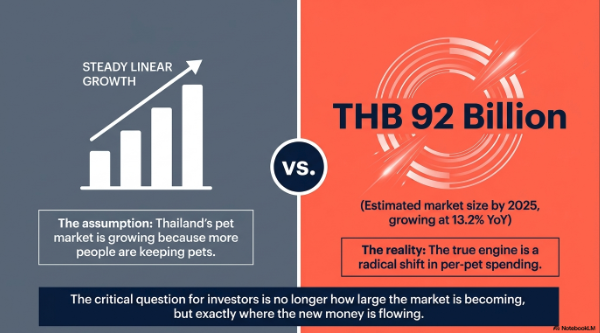
The result is a market expanding several times faster than the broader economy. ttb analytics estimates it will reach approximately THB 92 billion in 2025, a rise of 13.2 per cent year on year, before passing THB 100 billion in 2026.
Market size is the smaller question. The larger one is where the new money flows, because the answer changes how we judge which businesses are growing, which are falling behind, and where the real opportunities sit.
What drives the growth: pets are no longer just pets
Pet humanisation has become shorthand for the whole industry, but its economic meaning is precise. It describes a change in how owners see their animals, from something to be fed and kept alive to a member of the family that deserves the best available care. When that status changes, spending changes with it.
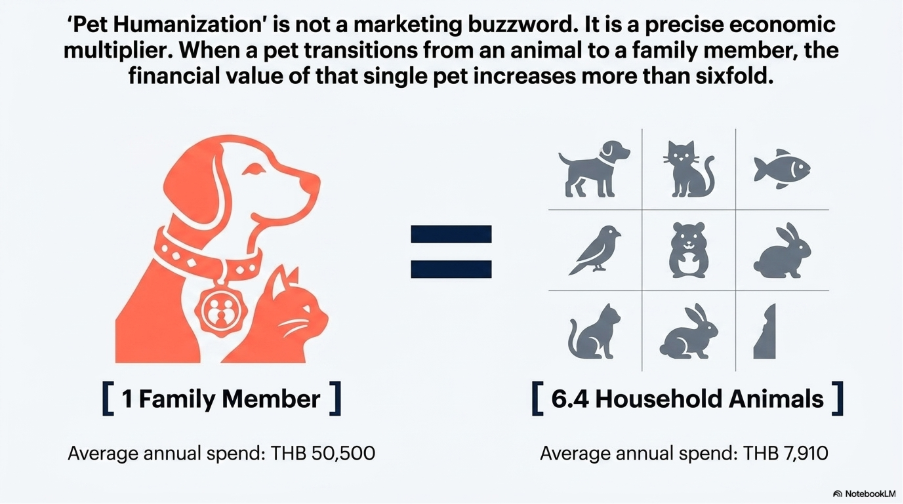
The figures ttb analytics uses to compare traditional ownership with humanisation show the scale of the difference. Average annual spending rises from approximately THB 7,910 per pet to THB 50,500 per pet, a gap of more than six times.
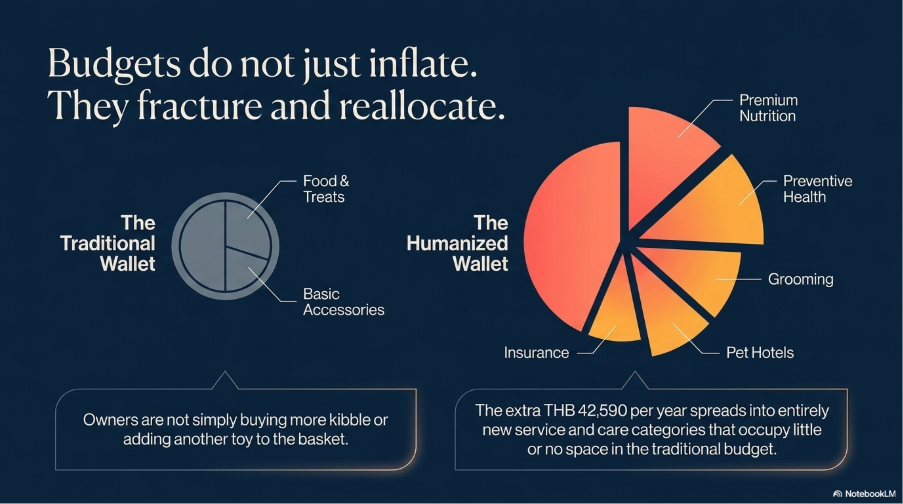
The size of the increase is not the whole point, because owners are not only spending more, they are reallocating what they spend. Under traditional ownership the budget sits on food, treats, basic accessories, and treatment once an animal falls ill, while grooming, pet hotels, preventive checks, and health monitoring occupy little or no space in the wallet.
Once a pet becomes a family member, the budget does not simply grow. It spreads into new categories, from premium nutrition and vaccinations to annual health checks, care services, products that reassure owners their pets are well, and, more recently, pet insurance. The shift is from spending that keeps a pet alive to spending that gives it a better life.
Pet population growth alone therefore cannot explain the market. One animal today generates several times the economic value it did in the past, depending on whether its owner treats it as an animal in the household or as a member of the family, and once the status changes the money does not reach every business equally.
Where the new money goes
The additional money does not spread evenly across categories. Comparing traditional ownership with humanisation shows the extra THB 42,590 spent per pet each year following a distinct pattern.
| Spending category | Traditional ownership (THB/pet/year) | Pet humanisation (THB/pet/year) | Incremental spend (THB) | Share of incremental spend |
|---|---|---|---|---|
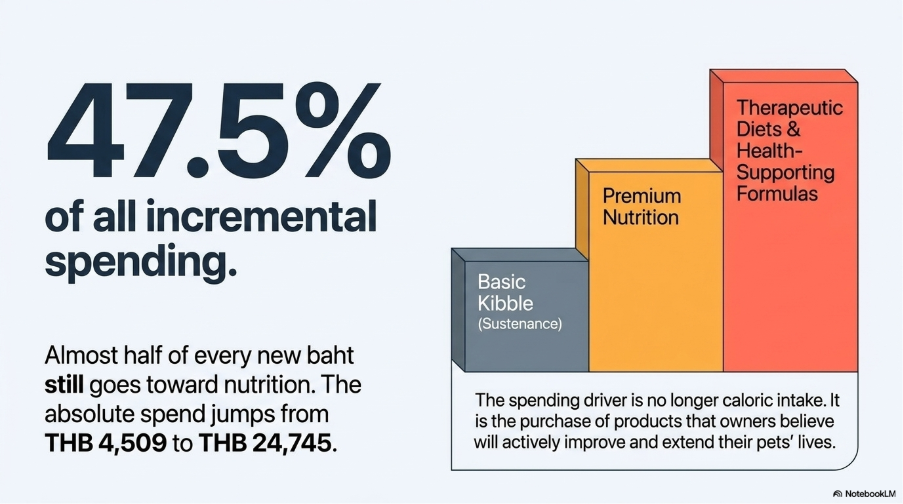
| Food & treats | 4,509 | 24,745 | +20,236 | 47.5% |
| Healthcare | 1,898 | 13,130 | +11,232 | 26.4% |
| Accessories | 1,503 | 7,070 | +5,567 | 13.1% |
| Services (grooming, pet hotels, etc.) | ~0 | 5,555 | +5,555 | 13.0% |
| Total | 7,910 | 50,500 | +42,590 | 100% |
Source: Author’s calculations based on average spending data presented by ttb analytics, drawing on information from Thailand’s Department of Business Development and ENLITE. These figures compare two groups of pet owners at a single point in time. The interpretation of where incremental spending flows is therefore inferred from differences between the groups rather than from longitudinal tracking of the same individuals.
Almost half of every additional baht still goes to food, but increasingly to higher-value products: premium nutrition, therapeutic diets, and food owners believe will improve their pets’ health.
More than 39 per cent of the new money flows into the two categories changing most. Healthcare spending rises almost sevenfold and moves from treating illness after it appears toward routine checks and prevention, while grooming and pet hotels, absent from the traditional budget, become a category in their own right.
Accessories take only 13.1 per cent of the additional spending, though they account for 19 per cent of the traditional budget. Owners are not spending less on accessories, since the absolute figure still rises almost fivefold. As the wallet grows, accessories capture a smaller share of the new money than other categories do.
The new money chooses its destination. When incremental spending concentrates in certain categories, not every business grows at the same rate, and the statement that Thailand’s pet market is growing is accurate but no longer sufficient. The question is which businesses are capturing the new money and which are being left behind. That is the subject of the next article.
From a product market to a care market
Thailand’s pet market is not only growing. It is changing in nature.
Historically most of the market’s value came from everyday necessities: food, treats, bowls, leashes, toys, and basic accessories. Owners bought products to keep their animals fed, safe, and alive.
As pets move toward the centre of the family, expectations rise with them. The question is no longer whether a pet has enough to eat. It becomes whether the food supports long-term health, whether illness can be caught before symptoms appear, who provides care when the owner is away, and how an owner knows the animal is genuinely well.
Spending is moving away from physical goods alone and toward care, outcomes, and assurance. Pet food no longer sells nutrition alone but the confidence that the owner chose correctly. A health check does not only sell a blood test but the chance to catch a problem before it becomes serious. Grooming and pet hotels do not sell convenience but peace of mind when owners cannot look after their pets themselves.
Thailand’s pet industry is moving from a pet product market to a pet care market, from one measured by the number of products sold to one defined by the quality and continuity of care across an animal’s life.
Products are not becoming irrelevant. Food still captures the largest share of new spending and accessory spending still rises in absolute terms. Products are now expected to do more, and they must support health, solve a specific problem, connect to a service, or at least reassure owners that their spending contributes to a better life for the animal.
The domestic shift feeds an export engine
The change in how Thai households spend does not stop at the household. It runs into one of the country’s fastest-growing industrial sectors.
Thailand is one of the world’s largest pet food exporters, ranked second behind Germany, and the Department of International Trade Promotion expects exports to approach USD 3 billion in 2026, worth roughly THB 105 billion. Much of that value comes from premium wet cat food made from tuna, the same premiumisation that owners are paying for at home. Industry figures presented at Pet Fair Southeast Asia 2025 now describe pet food as a new S-curve for Thai manufacturing and target USD 5 billion in exports by 2030.
The domestic and export sides share a base. The premium nutrition capturing nearly half of every additional baht at home comes from companies that also supply export markets, which gives the trend a manufacturing foundation rather than a purely consumer one. Household expectations and export standards rise together, and each pulls the other upward.
Why the shift reaches Chiang Mai
The drivers behind pet humanisation are demographic. An ageing population, smaller households, and a falling birth rate move animals toward the centre of family life. Chiang Mai carries these conditions in concentrated form, with a large share of older residents, long-stay foreign residents, and single-person households, and industry research already names the city among the places where demand for premium pet products is strongest.
That is why the care market is visible on the ground here. The growth shows up in the veterinary clinics, grooming and boarding services, and pet-friendly cafes that have opened across the city. For owners, the question is no longer whether these services exist but which provider to trust with an animal they treat as family.
The market is reorganising around care
This is a larger story than a rise in pet ownership. The market grows because the relationship between people and animals is changing, and when that relationship changes the household budget changes with it. That shift is already reorganising the industry at home and feeding an export sector the state now treats as strategic. It will reshape the businesses responsible for medical care, treatment, and animal-health products first.
