
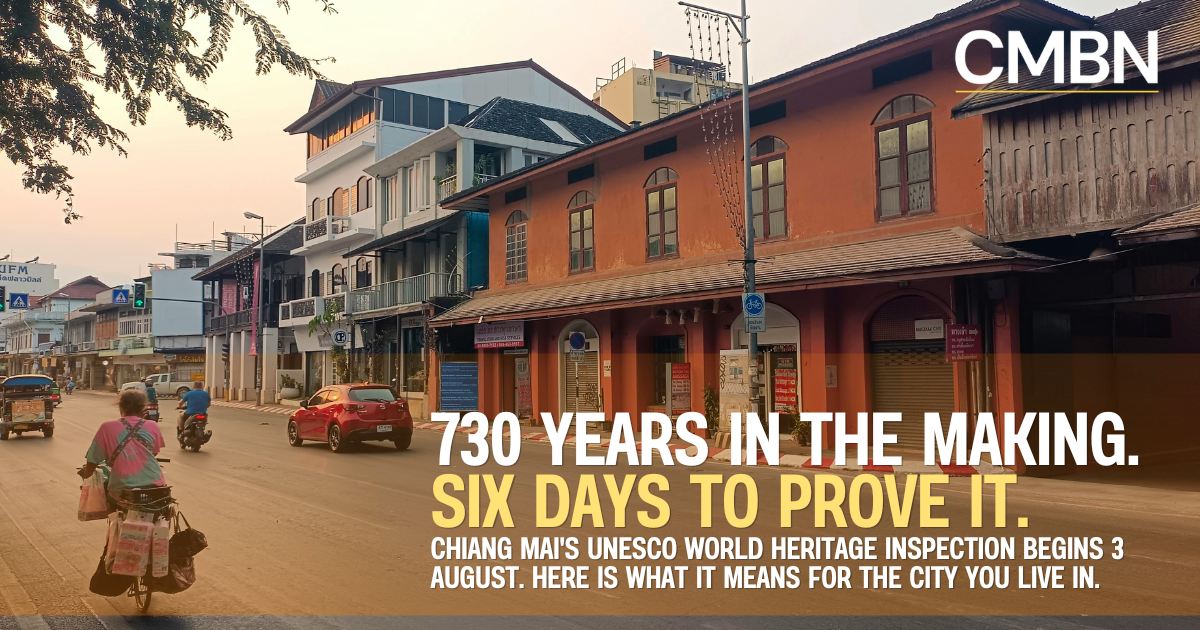
The footpaths around the moat have fresh paint. Cables that sagged across shopfronts for years have been bundled and reclipped. Billboards near the old gates are coming down. The city is getting ready, and this time the preparation is not for Loy Krathong or Songkran.
An international inspection team from ICOMOS, the advisory body that evaluates World Heritage nominations for UNESCO, arrives on 3 August to evaluate Chiang Mai’s nomination as a UNESCO World Heritage Site. Their six-day visit covers eight sites across the old city and Doi Suthep. A decision is expected before the end of 2026, the year Chiang Mai turns 730.
A city, not a museum
Thailand has eight World Heritage Sites. All of them are managed as protected heritage parks. Sukhothai. Ayutthaya. Beautiful and important, but nobody lives in them. Nobody runs a noodle shop inside the boundary or walks their kids to school past the gates.
Chiang Mai’s bid is built on a different idea. The nomination describes the city as a living cultural landscape, a place where 730 years of continuous history, more than 300 Buddhist temples, morning alms rounds and the daily rhythms of a working city all exist together. The heritage is not separate from the life. The life is the heritage.
That distinction is what makes this bid unusual and worth paying attention to. The inspectors arriving in August are not just looking at temple walls and fortifications. They are looking at how a city of nearly 1.8 million people has kept its identity while growing, building and changing around it.
What it means for the neighbourhood
The nominated zone covers 383 rai of the old city, including seven major temples, five city gates, four corner bastions and the moat. The Doi Suthep corridor, with its national park, sacred road and Wat Phra That, forms the second pillar of the case.
For residents inside and around those areas, the practical effect is a city that pays closer attention to how it looks and how it grows. Signage, building heights, visual clutter and conservation standards around historic sites all come under a more structured management framework. Some of that work is already visible in the clean-up happening around the moat right now. The goal is for those standards to become permanent rather than temporary.
Heritage designation also raises Chiang Mai’s profile in ways that benefit the whole city, not just the old town. The Bank of Thailand already identifies Chiang Mai as one of only six key tourism areas nationally, and the visitor base is diversifying. Long-haul travellers now account for a third of arrivals and half of all tourism spending, a shift toward higher-value visitors who stay longer and spend more broadly across the city.
The story the bid tells
The nomination dossier contains details that residents rarely hear but that carry real weight in international heritage circles. The sacred road up Doi Suthep was built in 1935 in five months and 22 days, with 5,000 volunteers a day working under the direction of Kruba Sriwichai. The Kham Muang language, written in the Tham script since roughly 1300, is still spoken by six million people. Chiang Mai University’s forest restoration research on Doi Suthep-Pui is cited as a global model for tropical ecosystem recovery.
These are not just facts for an application form. They describe a city that has maintained its cultural and ecological systems across centuries, through kingdoms, colonialism, modernisation and mass tourism. The bid is an invitation for the rest of the world to recognise what residents already know: Chiang Mai is not a place that preserved its past by standing still. It kept its character while remaining a real, working, complicated, living city.
What happens next
The ICOMOS team visits from 3 to 8 August. The Lanna Architecture Centre at Khum Chao Burirat will host the delegation. CMU’s Faculty of Architecture has prepared presentations for all nominated sites. The governor’s office reported in late May that preparations are more than 80 per cent complete. Chiang Mai has been shortlisted as one of 35 sites from more than 800 nominations worldwide.
After the inspection, the UNESCO World Heritage Committee will consider the case at its session later this year. The outcome matters, and the city has done serious work to get here. Eleven years of surveys, consultations, conservation planning, academic research and cross-sector coordination have brought the bid to this point. The nomination was formally submitted to UNESCO in Paris on 30 January 2026, backed by a five-million-baht PAO budget and broad institutional support from government, universities, religious communities and civil society.
Chiang Mai has spent 730 years becoming what it is. In August, it gets to show the world exactly that.
