
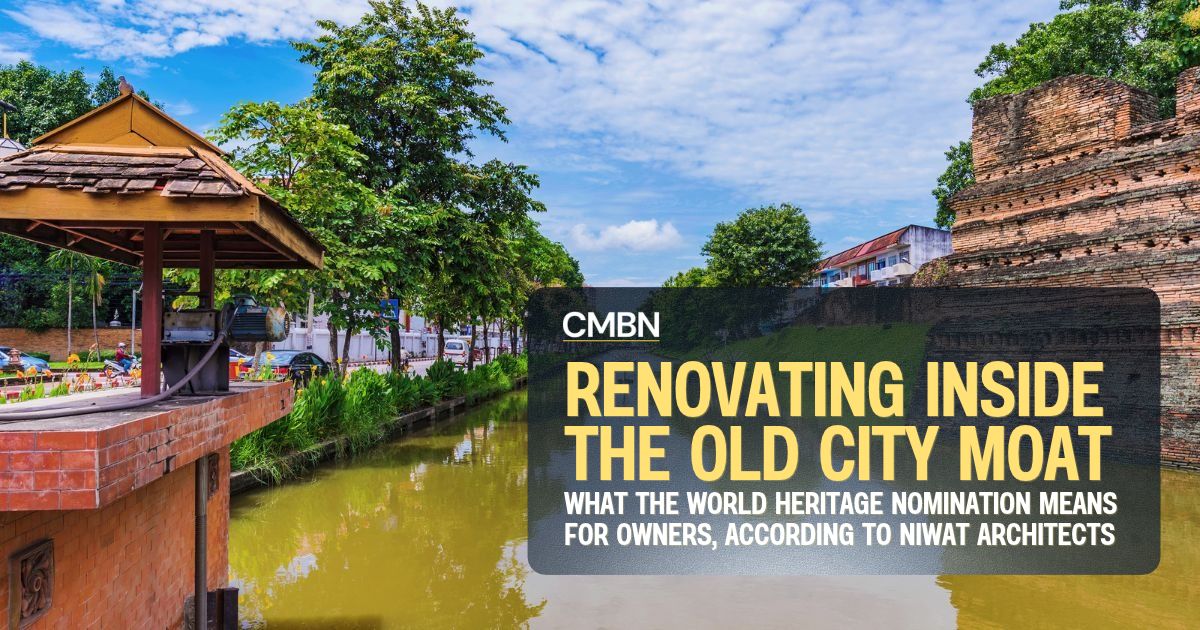
Chiang Mai’s old city is being assessed for World Heritage status, and a new city plan sits alongside that process. For anyone who owns a building inside the moat, the practical question is what that means for the next renovation. We put it to Khun Pawat of Niwat Architects, a Chiang Mai practice that lists Lanna cultural heritage among its interests in the Golden Pages directory.
Where the nomination stands
Thailand placed Monuments, Sites and Cultural Landscape of Chiang Mai, Capital of Lanna on its tentative list in 2015. The Cabinet endorsed the nomination on 13 January 2026, and the dossier reached the UNESCO World Heritage Centre by the 30 January 2026 deadline, according to Citylife. ICOMOS, the advisory body to the World Heritage Committee, was due to carry out a technical evaluation mission on 3 to 8 August 2026. Citylife reported that the Committee is expected to consider the nomination around June to July 2027, and Pattaya Mail also points to a 2027 decision.
The nominated area covers the city wall, moat, five gates and four corner bastions, together with major temples such as Wat Chiang Man, Wat Chedi Luang, Wat Phra Singh and Wat Suan Dok. If it succeeds, Citylife notes, Chiang Mai would become Thailand’s first World Heritage site set entirely within a living, populated community.
A clearer framework for owners
Khun Pawat says owners of buildings inside the old city moat area will have a clearer framework if they want to renovate in line with the guidelines for conserving and developing the city, so that it keeps its beautiful identity.
The framework is being built on rules that already exist, and they are older than many owners realise.
The rules already on the books
Control of the old city’s appearance goes back at least a decade. In 2013, Citylife reported that the then mayor, Tassanai Buranupakorn, was introducing a zoning ordinance for the city centre to regulate the colour, height and design of buildings, with the aim that new structures be unique but respectful of Lanna heritage. The mayor said he hoped residents would comply voluntarily, but that the law would stand behind the rule if not.
In November 2015, The Nation reported (in a piece republished on ASEAN NOW) that municipal regulations for the four square kilometre area inside the moat required new buildings to stay within 12 metres, follow Lanna design and use white, beige or brown exteriors. The same report quoted the mayor as saying the rules had no retroactive effect. A model project to renovate a row of ten shophouses near the Three Kings Monument was to serve as a template.
Thailand’s own 2015 submission to UNESCO, published on the UNESCO site, lists among the protections for the nominated properties a Chiang Mai Municipality law on the type, style, distance and height of buildings, which also restricts demolition, adaptation and construction in designated areas. Those texts are about a decade old, and a news report is not a legal text, so confirm the rules now in force with the municipality before design starts.
National law sits underneath. The Building Control Act B.E. 2522 (1979) governs the size, shape and height of buildings, and a law firm’s summary of it notes that different permits and procedures apply to construction, alteration, demolition, removal and change of use. Amendments that took effect in 2015, as described by Price Sanond, allow some buildings to proceed on notification to the local official rather than a formal permit, while larger or controlled buildings need certification from suitably qualified architects. Which route applies to a given building is a question for the municipality and your designer.
Where the nomination and the new plan agree
Khun Pawat says the point where the two agree is the goal of conserving and developing Chiang Mai as a city with identity, pleasant to live in, with Lanna beauty worth admiring.
The height question
Khun Pawat says the centre of the old city and the area around it should not have tall buildings, because they spoil the city’s landscape. In Khun Pawat’s view, the agencies that worked with academics and others on this were right to do so, and the results are very good.
Height limits depend on the zone and the plan in force. Chiang Mai’s first city plan dates from 1984 and was revised roughly every five years, according to a 2012 Citylife interview with the provincial planning office, so any figure should be checked against the current plan. The 12 metre figure reported in 2015 is a useful marker of how the rules were framed, not a number to design to without confirmation.
What owners often assume
Many owners think they can do whatever they like with their own property. Khun Pawat says a practice like Niwat Architects should give owners the legal information they need.
A building designed to the rules will not cause problems later.
Khun Pawat, Niwat Architects
The gap is real. A study by Deakin University, Chiang Mai University and UNESCO Bangkok, summarised by Citylife, found that government agencies are good at applying rules, while local communities hold deep knowledge of place but limited familiarity with formal heritage frameworks. It also found that architects and landscape architects are thin on the ground in local agency branches. Owners who arrive with a designer who already knows the rules close part of that gap themselves.
Planning and building control working together
Good city planning, together with building control laws and the conservation of art and culture, will help protect the Lanna spirit, Khun Pawat says. Planning sets the vision for an area, and building control is where that vision meets an individual owner’s drawings. A project that satisfies one and ignores the other is the kind that runs into trouble.
A practical sequence for owners
- Find out which rules apply to your plot. Ask Chiang Mai Municipality before design starts, and ask specifically about height, style, colour and any limits on demolition or alteration.
- Establish what kind of work you are doing. Construction, alteration, demolition and change of use are treated differently under the Building Control Act, so say clearly which applies.
- Brief a designer who works to the rules from the start, because a building designed to the rules will not cause problems later.
- Get legal advice early if ownership, leases or contracts are involved. Our guide to legal services in Chiang Mai explains how CMBN connects businesses with lawyers.
- Do not wait for the UNESCO decision. Municipal and heritage rules apply now, whatever UNESCO decides, and Citylife does not expect a decision before mid-2027.
Khun Pawat says people should be encouraged to understand and follow the rules.
Why it matters now
Interest in Chiang Mai property is also rising: foreign condominium transfers in the province grew 19 percent in the first half of 2026, according to Real Estate Information Center figures we reported. That makes it more valuable to know the rules before you buy, build or renovate.
Heritage conversations also stretch beyond the moat. Wat Ket, across the Ping from the old city, is this year’s pilot area for a nomad friendly district, as we reported in our Cosmo Local CNX 2026 coverage.
To find an architect or a design and build firm, browse the GoldenPages directory. For more local news and guidance, see the CMBN blog.
