

Thailand has stopped chasing pre-pandemic arrival numbers. The documents behind that shift show where Chiang Mai is strong, where it is exposed, and what owners can do about it.
Key takeaways
- Thailand had 32.97 million international arrivals in 2025, down 7 percent, and receipts fell faster than visitor numbers.
- Chiang Mai remains busy: 11.5 million visitors and a 75.87 percent occupancy rate in 2024, above the national average.
- Chiang Mai earns about THB 9,040 per visitor, above the national average but about a quarter of Phuket’s.
- Domestic travellers are a large but cautious customer base, and long-haul and long-stay guests are growing.
- The opportunity for owners is higher spend per guest, not more guests.
Thailand closed 2025 with 32.97 million international arrivals, a 7 percent drop from the year before, according to a FnSyrus note. Chinese arrivals fell 34 percent. Receipts fell faster than visitor numbers, and a Bangkok Bank analysis projected a 4 to 5 percent contraction in tourism income. For a market long measured by arrival counts, that points to a structural change, not just a soft season.
For Chiang Mai, the question is what that change means on the ground. The province is not in trouble by the usual measures. It recorded 11,485,568 visitors and THB 103.8 billion in visitor receipts in 2024, according to the NSO yearbook. The pressure shows up elsewhere: in what each visitor spends, in who is buying, and in the costs operators carry. This article walks through the published evidence, separates what the documents support from what they do not, and ends with practical steps.
A national reset, not a blip
The drop in 2025 was driven by short-haul markets. The Bank of Thailand October forum shows Chinese visitors falling from 6.7 million in 2024 to 4.4 million in 2025, while long-haul visitors rose from 10.6 million to 11.9 million. The World Bank monitor recorded a 38.9 percent fall in Chinese arrivals across the first seven months of 2025, its sixth straight monthly decline. Kasikorn Research adds that Chinese visitors, once the backbone of the market, now make up about 14 percent of arrivals, half their pre-COVID share.
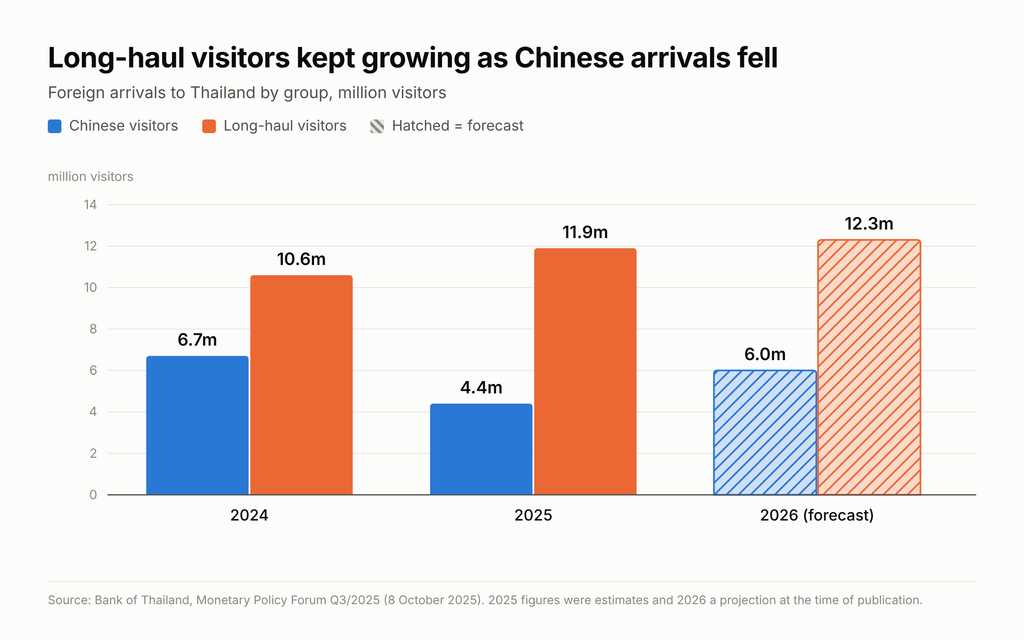
Forecasts anticipate a recovery. The Bank of Thailand forum projects 35.0 million arrivals in 2026 and 36.0 million in 2027, with receipts rising from THB 1.4 trillion to THB 1.6 trillion. Kasikorn Research put 2026 at 34.1 million in November 2025. Later private-sector estimates are lower. News reports cite Kasikorn Research at roughly 30 million arrivals for 2026 (Pattaya Mail report) and Kasikorn Securities at 31.5 million (Kaohoon report). Both are news reports rather than primary documents, so treat the exact figures with care. Forecasts are still moving.
The national strategy is built around value. The Bangkok Bank analysis describes 2026 projections of THB 65,000 to 80,000 per trip and stays of 14 to 21 days, under the “value is the new volume” approach to growing tourism income. The World Bank 2024 monitor had already found spending per person per trip about 20 percent below pre-pandemic levels, and estimated that each extra million arrivals adds only 0.2 percentage points to GDP growth.
Where Chiang Mai actually sits
The provincial table in the NSO yearbook gives Chiang Mai a 2024 occupancy rate of 75.87 percent. That is above Chiang Rai at 70.01 percent, the national average of 71.50 percent, and the Northern Region at 64.41 percent. By my calculation from the same table, Chiang Mai holds about 47 percent of Northern Region visitor receipts and about 3.7 percent of the national total.
The yield picture is more interesting. Dividing receipts by visitors gives roughly THB 9,040 per visitor in Chiang Mai, against about THB 7,930 nationally. That is a calculation from published rows, and it mixes domestic and international visitors, but it suggests Chiang Mai earns more per visitor than the national average. The gap that matters is with Phuket, where the same calculation gives about THB 37,860 per visitor, roughly four times higher. Chiang Mai is a high-volume, mid-yield market, and the new national strategy rewards yield.
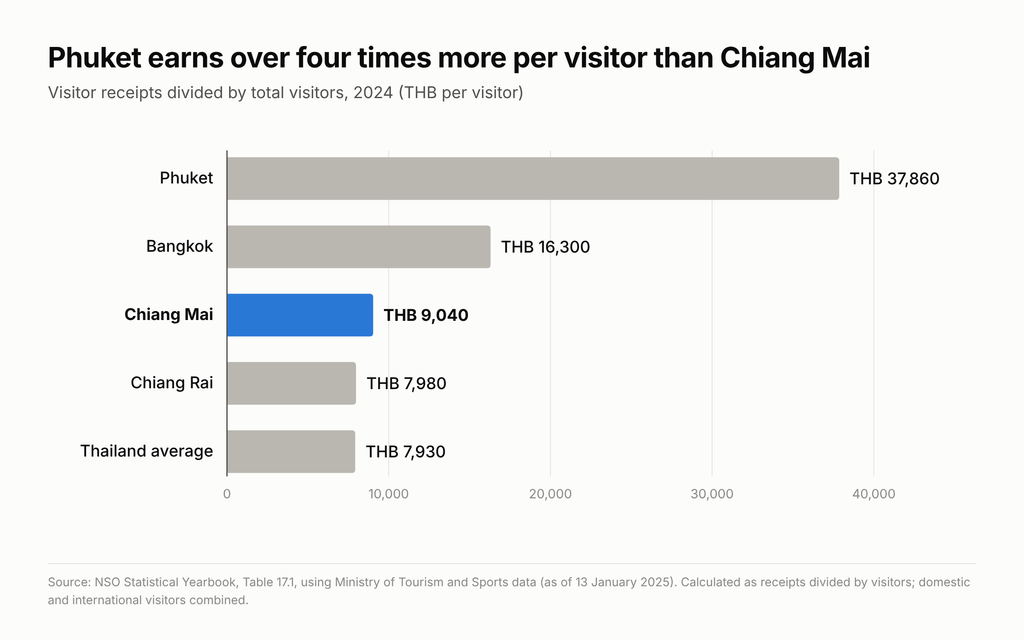
Seasonality also shows in the quarterly data. The NESDC Q1 report puts Chiang Mai’s share of Thai tourism receipts at 6.67 percent, second only to Chon Buri among provinces outside Bangkok. By the NESDC Q2 report, the share was 5.14 percent. Quarters are seasonal and not directly comparable, but the pattern fits what owners report: strong high season, thinner shoulders.
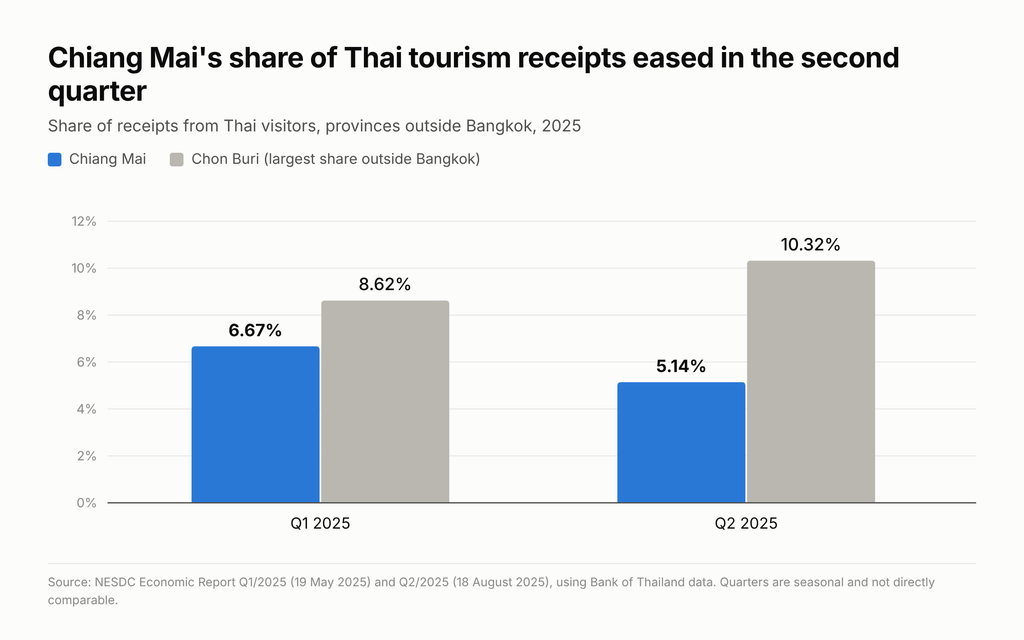
One claim worth correcting. It is common to hear that Chiang Mai has chronic hotel oversupply. The 2024 occupancy figure does not show that at province level, and no public document I found breaks occupancy down by hotel tier. If mid-tier hotels are struggling, the evidence for it sits in private data, not in these files.
The domestic cushion is thinner than it looks
When foreign arrivals fall, Thai travellers are the fallback. They are numerous: the FnSyrus note counts 202.37 million domestic trips in 2025, up 3 percent, and forecasts 210 million in 2026. But trips are not revenue. The Bangkok Bank analysis says household debt near 87 percent of GDP is pushing Thai travellers toward shorter, lower-spending trips, so the local economic impact weakens even when trip counts hold.
The latest ratio is slightly better. The SCB EIC flash reports household debt at 85.9 percent of GDP in the first quarter of 2026, a six-year low. SCB EIC cautions that the fall reflects faster nominal GDP growth and cautious household behaviour, not easing risk. Debt is still shaping how Thai families spend on leisure.
The spending gap between domestic and international guests is large. The C9 Eastern Thailand report measured average spend in Eastern Thailand in 2025 at THB 7,845 per domestic visitor and THB 18,675 per international visitor, about 2.4 times more. That is a regional proxy, not a Chiang Mai figure, but it shows why replacing a foreign guest with a Thai one does not replace the revenue.
Chiang Mai also sits in a particular spot in Thai travel preferences. In the C9 NextGen survey, Chiang Mai drew 115 votes as a top domestic destination, behind Bangkok (217), Pattaya (156) and Hua Hin (151), and was described as a budget-friendly alternative to pricier beach destinations. In the same survey, 42 percent preferred economy or midscale hotels and 19 percent said they would spend on upscale or luxury stays. The sample skews young and Bangkok-based, so it is a signal rather than a verdict. It points to price-conscious domestic demand.
Costs, rent and the long-stay customer
Operators pay for a city that is also attractive to remote workers and long-stay residents. The Bangkok Bank nomad note reports average city-centre rent of THB 19,359 per month in Chiang Mai, citing Bank of Thailand data. The same note cites an Airbnb and Oxford Economics study that put guest spending in Chiang Mai at about THB 7 billion in 2024, adding THB 5.6 billion to GDP.
Long-stay visitors are valuable because they spend consistently across weeks rather than days. Thailand’s Destination Thailand Visa allows stays of up to 180 days per entry for five years, and requires THB 500,000 in savings, according to the same note. The tension is local: a THB 120 cappuccino is small change to a foreign remote worker and a stretch for a Thai office worker. For cafes and coworking spaces, the long-stay segment is a base to build on, with a cost in the form of rising rents and shifting menus.
That bank note also reports a very large jump in Chiang Mai rents in 2023. The measure behind it is not defined in the extract, so I have left the figure out. If you cite rent growth, trace it to the underlying Bank of Thailand series first.
Air quality and the calendar
Seasonal haze remains a planning issue. A recent Chiang Mai University study reports that Chiang Mai’s haze season has lengthened from two months to three as farmers shift burning, even though enforcement delivered short-term reductions of up to 50 percent. A separate GeoHealth study notes that the zero-open-burning policy limits crop burning for only 60 days between February and April, and that burning shifts to periods outside the window.
These are scientific papers about emissions, not tourism losses, and I found no document that puts a baht figure on haze for Chiang Mai tourism. They do support owners who say the burning season is not getting shorter. Operators who rely on weekend foot traffic should plan around it.
Reading the evidence by business type
No public file splits Chiang Mai results by business category, so this section is interpretation, not data.
Operators aimed at long-haul and high-spending guests are better placed. Long-haul arrivals grew in 2025 and are projected at 12.3 million in 2026 in the Bank of Thailand October forum, and the Bangkok Bank analysis notes that long-haul travellers stay longer and spend more, with wellness and medical travellers often spending above THB 100,000 per trip. That favours boutique, wellness and experiential businesses.
Businesses that depend on price-sensitive Thai weekenders carry the most exposure to household budgets, because the domestic base is large but cautious. Independent cafes and restaurants sit between the two: a steady long-stay weekday base, but hard competition and high rents. None of these groups has published margin data in the documents I found.
Beyond the city centre
A common argument is that tourist spending stays concentrated in the inner city and nearby areas. I found no district-level data to test that for Chiang Mai. At policy level, a Chulalongkorn presentation identifies a Chiang Mai, Lampang and Lamphun cluster among Thailand’s secondary tourism city clusters, and Kasikorn Research lists promoting secondary cities through local identity as one of its proposals. A Thairath report says the 2027 plan targets a 60:40 split of tourists between primary and secondary cities.
What owners can do with this
The evidence does not prescribe a strategy, but it does point to a few practical steps.
Measure spend per guest, not just guest counts. National policy now rewards yield, and the Chiang Mai-Phuket gap shows where there is room. Track average spend by guest type for a full season, so you know what a domestic weekend guest is worth against a long-haul or long-stay guest.
Plan the calendar around air quality and shoulder periods. Offer packages that fit the long-stay customer, such as weekly or monthly rates, workspace and wellness add-ons, and keep weekday capacity for them.
Invest in direct channels. The only evidence in this set is a COVID-era survey, the enterprise survival study, which found that micro and small enterprises that adopted online marketing faced a lower risk of insolvency. It is dated and not about commissions, so it supports the direction without proving the saving.
Watch the cost base. Rent, and the UNCTAD study figure that Chiang Mai holds 3.2 percent of Thailand’s MSMEs, are reminders that Chiang Mai is a large small-business cluster, with plenty of competitors fighting for the same visitors.
The overall picture is one of a market that is still busy and well-placed in the North, but one that is being asked to earn more from each visit. Owners who understand their own spend per guest, and who build for the long-stay and long-haul customer, are in the best position to adapt
