
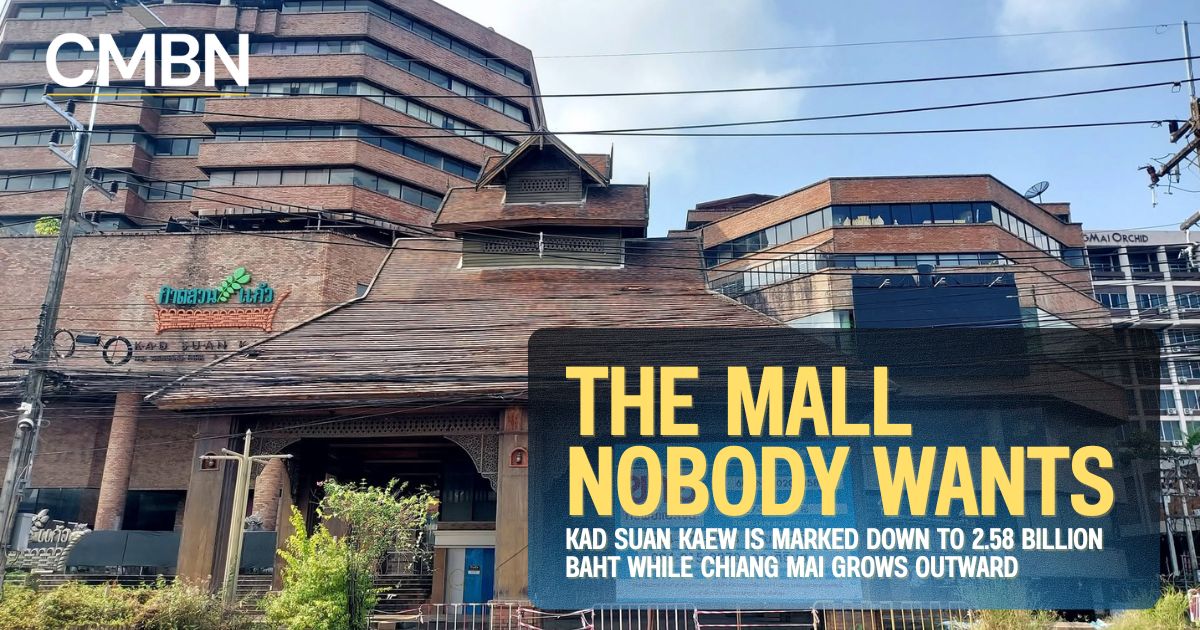
A Krungthai Bank sale sign has stood outside Kad Suan Kaew on Huay Kaew Road since September 2024, and the number on it has just come down. The bank now asks 2.583 billion baht for the shuttered shopping centre, down from the 3 billion baht it set when the property was first listed. Several parties have shown interest, Prachachat Turakij reports, but none has closed a deal.
The sale covers 27 rai 2 ngan of land in Suthep subdistrict, roughly 4.4 hectares, together with the 10-storey mall and its hotel. The plot sits between the Old City and Nimmanhaemin, in the middle of Mueang district. Its location has not changed since 1992, but the city around it has, and the long wait for a buyer says less about one ageing mall than about where money, residents and customers in Chiang Mai now choose to go.
Chiang Mai’s first big mall lost its customers before it closed
Kad Suan Kaew opened on 29 February 1992 as a 10-storey shopping centre with the 13-storey, 420-room Pang Suan Kaew hotel attached. Its founder, Police Sub-Lt Suchai Kengkarnka, was a former police architect who became a property developer, and for three decades the complex was where Chiang Mai families spent weekends and teenagers met up.
The decline began in 2019, when a slowing economy, changing shopping habits and new competing malls squeezed its cash flow. Accumulated losses passed 184 million baht before Covid-19 ended trading on 1 July 2022. Krungthai listed the property in September 2024, after the court cancelled the company’s business rehabilitation plan.
The commercial centre of Chiang Mai moved during the same years. Commercial activity shifted to Nimmanhaemin, Mahidol Road and Chang Khlan, then spread outward to the Ruam Chok intersection and the second and third ring roads, following the housing estates and the people who live in them. A property industry source quoted by Prachachat Turakij named the size of the plot, its price, the number of malls already operating in Chiang Mai and a slow property market as the reasons investors are holding back.
Retail has followed residents into smaller malls
Retail investment in Chiang Mai has continued, but in smaller formats and closer to where people live. A community mall is a compact, open centre built around a supermarket, restaurants and daily services rather than department stores, and two have opened in Chiang Mai in the past year.
CP Axtra opened Lotus’s Oasis Saraphi on an 11-rai site in Saraphi district in December 2025, with the stated aim of serving residents without a trip into the city. In February 2026 Ornsirin Group opened The Backyard Mahidol, a 9,600-square-metre community mall with parking for 250 cars on the outbound side of Mahidol Road.
Established centres are adding attractions inside their existing buildings. Central Pattana opened HarborLand, northern Thailand’s largest indoor playground, at Central Chiangmai Airport in October. Kad Suan Kaew offers 4.4 hectares and a 10-storey building to a market in which new retail space arrives in smaller units next to housing.
Chiang Mai holds more than four years of unsold homes
The Real Estate Information Center (REIC), the research arm of the Government Housing Bank, presented its first-half 2026 survey of five northern provinces at its northern region seminar on 25 September, and Chiang Mai carries the largest stock in the region. Total housing supply in the province reached 12,715 units worth 60.09 billion baht, up 12.7% by units on a year earlier, and 11,353 of those units remain unsold.
Buyers absorb an average of 1.8% of the remaining stock each month, which means about 50 months to clear what is already built or under way. REIC director Mana Nimitvanich described the northern market as entering a period of stock management, in which developers concentrate on turning existing inventory into cash. He noted that government measures continue to support the market, while high household debt and strict lending standards remain the main limits on demand.
Sales in Chiang Mai are recovering, with new sales up by roughly 18% on a year earlier, led by condominiums. Across the five northern provinces developers cut new launches by 9%, but new supply in Chiang Mai rose 189.4%, so the province is adding stock faster than it sells it.
Demand is moving to the edges of the city and into condominiums
The REIC survey describes Chiang Mai as a network city with several urban centres rather than a single core, and the location data supports that description. Outlying districts including San Sai, San Kamphaeng and Hang Dong now function as residential areas with their own services and facilities.
San Sai is the clearest example. Low-rise housing sales there rose 62.4%, with 2.3% of remaining stock selling each month. Housing estates in central Chiang Mai and around Payap University sit at the opposite end, with clearance periods of between 163 and 380 months at current sales rates.
| Segment or area | Estimated months to clear remaining stock |
|---|---|
| Lamphun province (for comparison) | 26 |
| San Sai low-rise housing | 38 |
| Chiang Mai condominiums | 39 |
| Chiang Mai province, all housing | 50 |
| Chiang Mai housing estates | 55 |
| Central Chiang Mai and Payap University housing estates | 163 to 380 |
Developers are building to the same map. Supalai has launched Supalai Parkville Bo Sang–San Kamphaeng, a single-house project with homes of 150 to 330 square metres on the eastern side of the city, with a presale this month.
Condominiums are the strongest part of the provincial market. Condominium sales rose 49.4% against 9% for housing estates, and inner Chiang Mai and the Suthep-Mae Hia area together sold 500 newly launched units. Foreign buyers drive much of that demand, and foreign condominium transfers in Chiang Mai rose 19% in the first half while the national total fell 8.8%, with buyers now drawn from a wider spread of countries than a year ago.
Foreign residents are also using a newer legal route to long-term housing. Sap ing sitthi is a registered property right created under a 2019 law, and unlike a standard long lease it can pass to heirs and be renovated or mortgaged. Akadej Udomsirithamrong, deputy chief executive of Ornsirin Holding and president of the Chiang Mai Real Estate Association, told Prachachat Turakij that Chiang Mai has registered about 500 plots under the system, more than any other province.
The top of the low-rise market is moving the other way. New supply of upper-end houses and pool villas increased in the first half while sales of them fell, so unsold inventory in that segment is rising.
Buyers want homes, and mortgage approval sets the pace
Demand for homes priced between 2 million and 3 million baht remains steady across the north, and mortgage approval decides how much of it turns into sales. REIC advises developers to work with banks to screen buyers and arrange pre-approval before they accept a reservation, and to prepare more homes at lower price points.
New projects also face growing competition from resale homes. The northern second-hand housing market is growing at roughly four times the pace of the new-home market, because existing homes sell at prices that more buyers can finance. Developers in Chiang Mai now compete with each other and with every owner, bank and asset management company selling a used house at a lower price.
The same pattern applies to commercial property. Kad Suan Kaew is a bank-held asset offered into a market that has spent four years moving away from its location, and to investors whose attention has followed residents out to the districts where they now live.
What this means for Chiang Mai businesses
The housing data is a map of where Chiang Mai customers now live, and it points away from the old centre. Families are buying low-rise homes in San Sai, San Kamphaeng and along the ring roads, foreign buyers and residents who want an urban lifestyle are buying condominiums in inner Chiang Mai and Suthep-Mae Hia, and both groups shop, eat and use services close to home.
For retailers, clinics, schools, gyms and restaurants, those districts are where new customers are forming households, and the new community malls show where retail investors expect footfall. For landlords and investors, the stock figures describe a buyer’s market in which a central address alone does not set the price, and in which a well-priced resale home competes directly with a new launch. Owners weighing a move or a purchase can compare local financial and banking providers or speak to a business consultant, and find verified local partners in the Golden Pages business directory.
To follow the property market with the people working in it, join the Chiang Mai Business Network, and find more local analysis on our latest articles page.
Kad Suan Kaew will find a buyer whose plans fit a central site in a city that no longer has one centre. Until then the sign on Huay Kaew Road records how far Chiang Mai has spread since 1992.
